Eva
An Interview with a Holocaust Survivor
Narration:
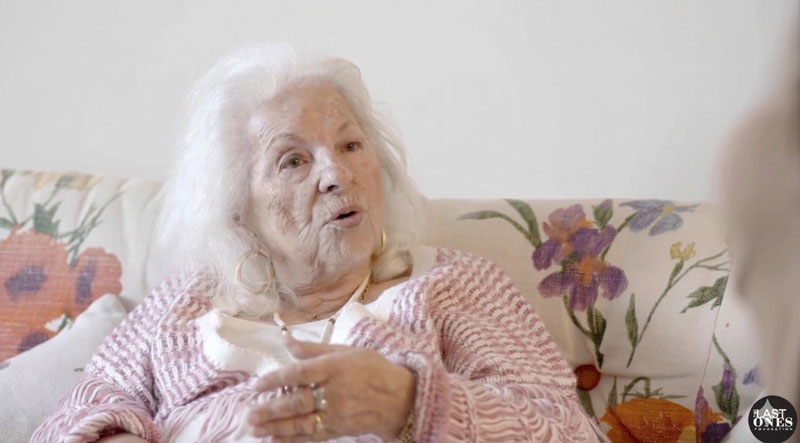
Today I’m in Los Angeles to meet Eva. She was born in Budapest, Hungary, on January 28, 1941, into an aristocratic family. Her father was a baron who owned agricultural land in both Czechoslovakia and Hungary.
Leslie: Hi, Eva.
Eva: Hi.
Leslie: How are you?
Eva: Fine. Nice seeing you.
Leslie: Very nice to meet you.
Eva: You come on in.
Narration:
Her parents were Madonna Cohn and Moses Adam. Her father was killed while on his way to bring her a doll. Eva was only one year old at the time. From an early age, Eva turned to art to express her emotions.
Art as Therapy
Eva: Art is therapy to me.
Leslie: Yeah. It’s a therapy you need after what you’ve gone through.
Eva: I also get regular therapy, but art is a form of therapy. When I get annoyed with the world, I have to do something.
Leslie: Can I ask you something? Where do I sign up if I want to look like you when I’m 85? Because you look amazing.
Eva: Come on, I don’t even know how to use makeup.
The Doll and Her Father’s Murder
Leslie: Why was your dad murdered?
Eva: Because he escaped from a work camp when I was a year old to give me this doll.
Leslie: He escaped from the work camp just to get you a doll?
Eva: For my birthday—for my first birthday. And because of that, they found him. They beat him to the point that he was literally broken up. They made him dig his own ditch, shot him, and buried him alive in front of the entire company as an example of what not to do.
So he was murdered for giving me that doll. That doll was with me for five years. It never left my sight.
Leslie: And you have no memory of your birth father?
Eva: No, except the photograph.
Narration:
After her father’s death, she and her mother moved to her grandfather’s estate, a dairy farm surrounded by agricultural fields. Her mother was often away, running the family furniture factory in town.
Life on Her Grandfather’s Estate
Eva: I didn’t even know that I had a different father until I was a teenager, because my stepfather adopted me.
I lived on an estate with my grandfather, who was Orthodox. They were Modern Orthodox. The Jews were already taken to work camps, and my father was taken away. So were my four sisters’ husbands. They all moved back to my grandfather’s house because the husbands were gone. So I lived with my grandfather, my four aunts, and all their kids. Then my mother came there on the weekends to spend time with me.
I was about a year and a half old.
The Yellow Star
Eva: One Saturday night after sundown, my mom said, “You don’t have to go to sleep early tonight because we’re having an art project.” You know how excited kids are when you say they don’t have to sleep early. I was so excited.
I picked up my doll, and the two of us went down to the main room. I noticed that all the adults had tears running down their faces and were whispering. I noticed that my cousins were all sad, and I couldn’t understand.
They let me sit on the floor next to my mom. They gave me a big piece of paper, and little by little, yellow material was given to me to make a collage with silks, cottons, and everything.
I identified the yellow material with sadness. So I never wear yellow.
That’s when the law came out that every Jew had to wear the Star of David when they were outside the house. That is my first memory of antisemitism.
Narration:
As the war unfolded, Eva’s family had been quietly working with an underground rescue network, helping shelter and smuggle Jews fleeing Czechoslovakia and Poland. But a few careless words from neighbors would expose their secret, with devastating consequences for Eva’s family.
The Underground Rescue Network
Eva: My entire family was taken away because one of the peasants went to a bar, and after three or four beers, he was bragging that he was working for a Jew who not only made sure that everybody got Sundays off to go to church and did not allow child labor on his land, but who smuggled Jews out of Czechoslovakia and Poland every week.
That was my grandfather and my family. They worked with the underground, saving people.
Narration:
By the early 1940s, Hungary had joined the Axis powers after signing the Tripartite Pact. While the deportations did not start until much later, anti-Jewish laws were being issued daily.
Eva: We were not allowed to have certain jobs. We were not allowed to go to certain schools. I mean, each day a new law came out.
The Roundup
Eva: At the beginning of 1943, I was two years old. A young girl was assigned to be my helper at my grandfather’s house. She was the one who dressed me and helped make sure I was safe.
She was getting me dressed in the morning when we heard trucks moving into the courtyard. We heard shouting, and we heard guns going off.
She ran down, and I remember to this day that this was a strong peasant girl. I thought she could protect me from anything and would never be afraid of anything. She went down and came back. She was stuttering, sweating, and scared.
She said to me, “We are going to play hide-and-seek. It’s a game, and you are supposed to act like you are deaf and mute. If anybody tries to talk to you, act like you don’t understand.”
I thought it was part of the game. She said, “You can take one item with you. That’s it.” So I picked up my doll because that doll was my everything.
The two of us went through parts of the estate where I had never been before, where the servants’ quarters were, and everything. We went out of the building, and she took me to her parents’ house.
I remember seeing the trucks on the side of the building. I remember my family being pushed onto them. My mother’s four sisters, my grandfather, my great-grandmother, and all my cousins were being pushed onto them.
I remember being hurt as a child because they didn’t wave at me. They were going on a trip, and I wasn’t going. I was ignored, and I was trying to get attention. My helper grabbed my hand and said, “We are invisible right now. We are playing hide-and-seek.”
We went into her house, and she was whispering with her mom. They told me to take off my dress.
Leslie: The dress that had the yellow star?
Eva: Yeah. They told me I could sit on the floor with her kids in front of the house. Then I saw the two trucks carrying my entire family disappear. I remember trying to wave, and they told me not to make any sound because it was part of the game.
I didn’t understand. Nobody explained anything to me.
Narration:
During the roundup, Eva’s mother happened to be at the factory in town. That simple circumstance, without her knowing it, saved her from deportation.
Two Years in Hiding
Eva: It ended up being two years of hiding after that. I was hidden in about 12 places in Hungary, in Budapest.
I was hidden once in a chest of drawers, where I had to lie flat.
Leslie: In the drawer?
Eva: Yeah. I was told to take only very small breaths because nobody knew that I was in the drawer.
I could not just go to the bathroom when I had to, because with the families who were hiding us, maybe one person knew they were hiding us—not everybody in the family. Also, in many of the houses, the bathrooms were outside. That meant the neighbors would have known if a stranger went to the bathroom.
So one of the most difficult things was, as a two-year-old child, learning how to control my bodily functions, because going to the bathroom was a treat. It wasn’t a natural thing.
Each time the people who were hiding us said, “We can’t take you. We are afraid,” they had to find another place. They took us to another place to hide. So we were in about 10 or 12 places in two years.
I was always hidden with my mother, but about a year after we started hiding—or about eight months or something—they found a little girl whose family had disappeared. The little girl was by herself. She was even younger than me.
They gave her to my mom and said, “You’re hiding with one child. Two couldn’t be that much worse.” It was actually more difficult because now anybody who was willing to hide us had to hide two children, not one. It also meant that the little food we had now had to be divided by three instead of two.
I actually felt very good because all of a sudden I had a companion, even though our mouths were taped most of the time so we couldn’t make any noise. We always had to whisper. We were taught to be invisible, unseen, and unheard. That was our motto.
We were hidden in places where we couldn’t even sit up. Somebody once dug a hole in the middle of the living room. We were underneath, and they put plywood over it with some holes. There was hardly any air. They put a chair and tables over it, and they were having their meals and everything on top of us. We were underneath, and we couldn’t even move because usually the whole family did not know that we were sitting underneath there.
I was locked away in all kinds of horrible places for two years. I didn’t see sunlight for two years. I don’t remember having a meal during the entire two years. It took me a while to get used to eating regular food. I was always hungry.
Narration:
They moved constantly from place to place, trying to stay one step ahead of the danger. But Eva, her young friend Valeria, and her mother were eventually captured by the Nazis in Budapest.
The Danube
Eva: In 1945, the Hungarian Nazis didn’t want any witnesses left. What they did was search all the places where they thought people could be hiding. The people who hid them were punished, and the people who were hidden were taken to the Danube, tied together, and shot into the Danube.
My mother, my little friend, and I were there. It was March. We were not dressed for the outdoors, and I remember freezing.
The Nazis found all these Jews, and they would tie four or five people together and use one bullet because they didn’t want to waste a bunch of bullets on the Jews. That person would drag the other people down.
You could hear the gurgling—everything—and the others would drown.
All of a sudden, I felt the rope going around my mother, me, and my friend. I was holding the doll, and the rope was going around my neck. It was so tight I could not breathe.
He dragged us to the side. The gun went off. The bullet grazed my mother.
Leslie: With the gun?
Eva: I mean, he shot, but didn’t shoot to kill—not to aim at her.
Leslie: Yeah, yeah.
Eva: We fell into the river. It wasn’t that deep, but it was so cold that there was still ice at the edge. It wasn’t deep enough there to swim in the first place, but the water was so cold that all of a sudden I felt like I was frozen. I had no feeling in my body.
We were lying there, and somebody pulled us out. I remember they threw something over us because we were soaking wet and covered with the dirt and blood in the river.
Liberation
Eva: Then we were taken to the last place where we were hidden. It was somebody who was trying to save as many people as they could.
This was the first time that, when we were taken into the room where we were hidden, there were other people lying on the floor. I remember the smell of unwashed bodies, sweat, fear, dirt, and the stifling air. The windows were covered with dark material.
Leslie: So no one could see in?
Eva: Yeah. The people were lying on the floor. My mother dragged us into the corner because we were the only kids there.
Then the door opened. I saw two men with a bunch of guns. There were guns on their shoulders and guns at their waists. I remember one of them coming toward us, and I could barely breathe.
Even though I noticed right away that the uniforms were not black—they were khaki. The khaki uniforms were those of the Russian liberating forces, but I did not know that. All I knew was that there were a lot of guns.
Leslie: That’s the day you were liberated.
Eva: Yeah. I was whimpering because I was so scared, and my mother tried to stop me because she didn’t want to bring attention to me.
That’s when these soldiers saw that there were children in the corner. One soldier’s hand went into a pocket, and I could barely breathe from fear. He took something out of his pocket and shoved it into my mouth.
It was a piece of chocolate.
This was the first time in four years that I remember having something good going down my throat—melting chocolate. My eyes opened widely, and I stopped whimpering.
That’s when I realized that I identify liberation with chocolate. If you open my freezer, there’s a lot of chocolate. I always find myself liberated daily.
Narration:
Fighting was still raging in the streets between Nazi and Soviet forces. But after Budapest was liberated from Nazi occupation, a new uncertainty began.
Waiting for Family
Eva: My family did not want to accept that everybody was killed. My mother lost six siblings, her father, and all her family. My birth father was killed, and my birth father’s sister and daughter were killed.
My family did not want to accept that people were not going to come back. Every day there was a list of people who were coming back, and I remember they were looking.
Leslie: And they had hope.
Eva: Yeah. By the time they realized that nobody was coming back, the Soviets had taken over Hungary.
Narration:
By 1946, Hungary was under Soviet occupation, and the borders were closed.
Escaping Hungary
Eva: The revolution was on the 23rd of October. In December, two tanks faced our house, and they said that if there was any movement, the house would be leveled.
We escaped from Hungary. It was December 20, 1956.
We told the neighbors that we were going to visit some family overnight, so each of us had one little bag. We went to Austria.
We went to the border on a train. We walked six hours through the snow from Hungary to Austria until we reached the other side of the border. We had to hide in the snow, so we were soaking wet.
I was wearing this ugly sweatsuit because we were just going to go visit. Then we arrived. They sent me ahead, and I saw “Arbright Strasser.” So I knew we were in Austria.
They put us in a displaced persons camp in Austria for nine months. All the Jews were put into this DP camp. My 16th birthday was there.
But I was a happy kid because it was the first time in my life I was away from Hungary. It was the first time in my life I was among a group of Jews. I mean, there were 900 of us.
I just didn’t fit in. I didn’t fit in anywhere.
Leslie: Until you were in the DP camp.
Eva: That’s right. In the DP camp, I became very popular.
Narration:
Eva’s family was left with very few options. When they finally received a visa in 1957, Eva and her mother left for New York and eventually settled in Los Angeles. Eva learned English, worked as a clerk, and continued her education at night. She married and had two children.
Narration:
Today, she shares her wartime experiences with young students, turning her darkest memories into a message of kindness and understanding.
A Message Against Hatred
Eva: They need to hear that all prejudice, all hatred, all bigotry, and all violence are unacceptable. They have to learn that because prejudice causes more prejudice, hatred causes more hatred, and violence causes more violence.
I also keep telling these kids that you should never judge a person by what church they go to, what language they speak, what clothes they wear, or where they come from. You judge them only by how they behave.
I advocate turning anger and negative feelings into creativity.
Farewell
Eva: I do everything. I’m fine.
Leslie: Thank you so much.
Eva: Thank you. Thank you.
Leslie: Thank you for having me. Bye.
Eva: It was very nice meeting you.
Leslie: Very nice to meet you.
Eva: Have a safe flight.
Leslie: Thank you. Bye-bye.