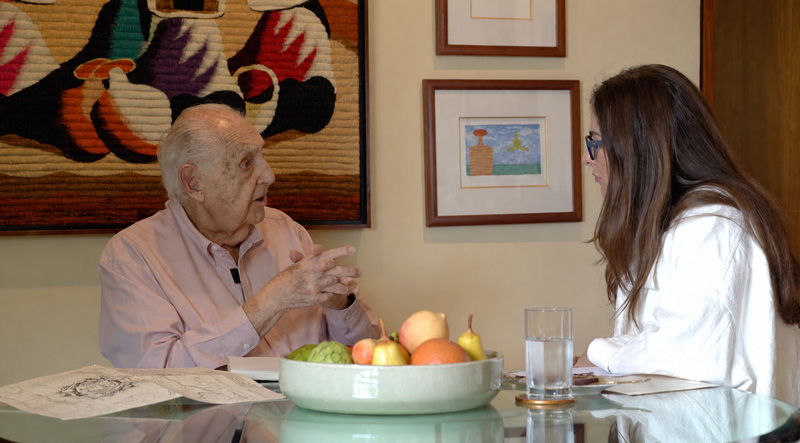
Mary
An Interview with a Holocaust Survivor
Narration:
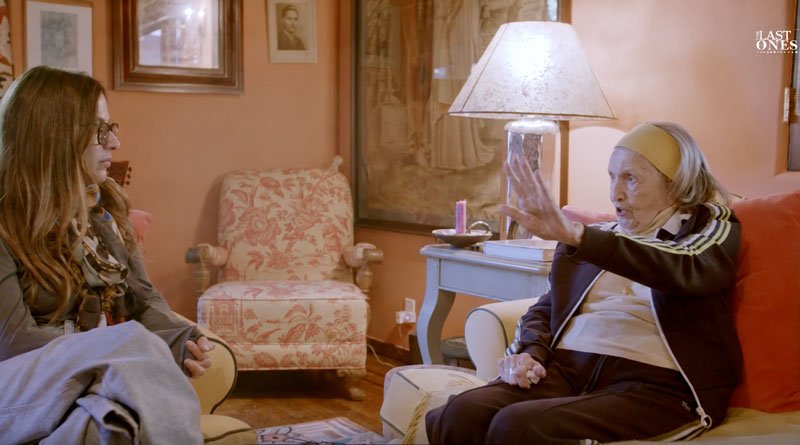
Today I’m in Los Angeles to visit Mary. She was born on May 29, 1927, in Budapest, Hungary, the only child in her family, almost 100 years ago.
Leslie: Hello.
Mary: Hello.
Leslie: How are you? You’re Mary?
Mary: Yes.
Leslie: I’m Leslie. Pleasure to meet you.
Mary: It’s a pleasure to meet you. Who are you and why do I know you?
Leslie: I saw some light outside and I figured, why not come in?
Mary: It’s a good idea. I’m glad you did.
Leslie: What do you think? I brought you a little something. It’s a leka.
Mary: It’s wonderful. I like it.
Leslie: Yeah, we need something sweet always, right?
Mary: I was born in Budapest a long time ago. My birthday is May 29, 1927. So if I make it another year, I’ll be 100.
Leslie: You will.
The German Occupation of Hungary
Narration:
Everything changed on March 19, 1944, when Nazi Germany invaded Hungary to prevent the country from making a separate peace with the Allies.
Mary: As soon as they came in, shortly after, they had laws against Jews. Part of the laws were that Jews had to put on the yellow star.
So we all had to put on the yellow star and sew it onto our clothes.
The next morning, when I went to school, I had the yellow star on my clothes.
The girl next to whom I had sat during all the years of my high school years was also my best girlfriend. We used to go to each other’s homes.
So the first day wearing the yellow star, I went into the classroom and sat down next to this girl.
She looked at me. She looked at my yellow star. She took her elbow and jammed it into my ribs.
And she said, “I don’t want to sit next to a dirty Jew.”
That was the first time that I faced antisemitism.
It just hit me.
I felt the yellow star was my black skin.
I cried right there in school.
My mom went back to the principal to complain about it. The principal at that time told her, “I cannot change the law. I can’t change the mind of the public who sees the yellow star.”
The Disappearance of Her Father
Narration:
Mary’s father was among the first victims of the anti-Jewish laws that followed. As a Jew, he was barred from serving in the Hungarian army and was instead assigned to a forced labor battalion. He reported for duty expecting forced labor, but Mary would never see him again.
Mary: I remember when my father left.
At the door, he said, “Be a good girl. Write to me.”
He said goodbye to us, and he walked out the door.
I never saw him again.
I never knew where he went.
I still don’t know, up to today.
I stayed with my mom. I did go back to school, very reluctantly.
My mom was very concerned about her parents, so she took her parents to live with us.
Preparing for an Unknown Journey
Mary: Things happened quickly after that.
The next step was that all Jews were going to go on a trip.
“You have to pack a suitcase.”
They didn’t tell us where we were going, how long we were going, what to take along, or when we were leaving.
They only said that within the next weeks we should pack a suitcase because all of us had to go on a trip.
So what do you pack when you don’t know where you are going?
I put in one doll.
The parents were clever because they packed food and sandwiches and chocolates, which was nice later.
Then came the day when we had to leave.
My grandparents came with us.
It was a column from the neighborhood. Wherever there were Jews, they were all out.
Everybody carried a suitcase.
We kept going, and they were telling us that we were going to the railroad.
We did not go to the main railroad station. They had a little railroad station, and we had to walk there.
All the people got together and started to go.
We arrived and saw no regular trains.
There were a bunch of boxcars.
The Boxcars
Mary: What was normally in those boxcars? Freight or animals.
As we arrived, at the boxcar was a Hungarian soldier completely in uniform.
We were in a line watching what was happening in front of us.
There were no men who were my father’s age there.
There were some girls whom I knew from school.
We watched what that soldier was doing.
He was holding a box.
Obviously we couldn’t hear him, but he must have said, “Any jewelry or anything you have, throw it into this box.”
We all had a necklace. We all had earrings. We all had a watch.
One of the girls who was not in my class couldn’t take out her earring.
This Hungarian guy reached over and yanked out her earring.
This was the first time that I witnessed brutality.
It cut her earlobe.
It was the first time I saw blood trickling down onto her shirt.
So as we moved on, I quickly took mine off. I took off anything I had on me and dropped it in there.
What was terrible was my grandma had a wedding ring that she may have had for 40 or 50 years.
She couldn’t take it off.
She tried and she couldn’t.
This guy reached over and probably must have broken her finger or something.
I could see my grandma’s face distorted.
After all these years, I feel it.
Then we had to get into these boxcars.
Leslie: How many of you were in there?
Mary: I don’t know the number, but I can tell you that we were as close to each other as sardines.
We must have been more than 50, 60, 70 people.
We were really close.
There were people of all kinds. Young. Old. Babies. Pregnant women. Teenagers like I was.
Some of the little children who were standing had their little faces pressed against the bodies of strangers.
Some parents picked those children up.
Leslie: How long?
Mary: Exactly.
It was a very bewildering situation.
At this point, I was crushed together with a bunch of people.
There were children crying and babies crying.
Parents were trying to calm their children down.
And it started moving.
Again, we had no idea where we were going.
There were no big windows.
There was just a little window at the top of the boxcar.
Before we entered, this Hungarian guy, who didn’t come in with us, opened the door and then shut the door from the outside.
He said that there was a bucket in the corner of the interior, and that was our bathroom.
How can you move from one corner to the other with all those people?
And who wants to relieve themselves in front of everybody?
After one day, it started to smell and stink inside.
There was no ventilation. Just a tiny little window.
Babies were crying.
As we moved on, a pregnant woman went into labor.
An old person who had a previous heart condition had a heart attack and died.
And we were all there together.
I was crying, holding my grandfather.
He embraced me.
And in this situation he was telling me, “Don’t cry. Look what I brought.”
He opened his palm, and he had a medal.
He said, “Look. I brought the medal.”
From the First World War, he had been a Hungarian soldier.
During this horrible situation he said, “Wait until they open up the door. When we come out, I’ll show them.”
Very proudly he said, “I’ll let them know I was a Hungarian soldier. I was honored. I got a medal. They will send us back.”
My comment to this is: they honored him in the First World War with a medal, and in the Second World War they burned him in Auschwitz.
Three Days and Three Nights
Narration:
During World War II, approximately 420,000 Hungarian Jews were crammed into suffocating cattle cars and deported to the Auschwitz-Birkenau extermination camp. The journey lasted three days and three nights — days of unimaginable horror.
Mary: By the next day, the stench was worse.
You couldn’t breathe anymore.
You were wishing and hoping that wherever we were going, when we arrived we would get fresh air.
Narration:
During this horrific journey, many died from dehydration, suffocation or exhaustion before the trains even reached the Auschwitz-Birkenau unloading ramp. As the convoy pulled in, Mary saw a world unlike anything she had ever known — one no human being should ever have had to witness.
Arrival at Auschwitz-Birkenau
Mary: As it turned out, we stopped.
They opened the doors.
The first thing we did was look out.
We saw a lot of people running back and forth in striped uniforms.
We had no idea who they were.
We wanted fresh air.
There was no fresh air.
The air smelled like smoke.
It was heavy.
We didn’t see trees. Only sky.
Those people running around were screaming and yelling in German, “Raus! Raus!”
That means, “Out! Out!”
The ones who could no longer walk, could no longer get out, and the ones who had died in there — these people in striped uniforms jumped in.
They took them by the hands and feet and brought them out.
I remember because we looked back.
They were piling them up outside the cattle car.
Narration:
Arriving at their final destination, the prisoners were divided into groups. From that moment on, all humanity ceased to exist.
The Selection
Mary: As we got out, these people in striped uniforms were guiding us so that the men went one way and the women another.
I couldn’t even say goodbye to my grandpa.
I couldn’t even hug him.
He was gone.
All I could see was a whole bunch of men marching, and I didn’t know where my grandpa was.
The column I was guided into included my grandma, my mother, me and a friend.
As we looked ahead, we saw German soldiers, some holding big shepherd dogs on leashes.
The dogs were barking.
In the middle was a tall man who evidently was in charge.
Today I know that man was Dr. Mengele.
He was the Angel of Death.
He selected people.
From our group, he pulled out my grandmother and my friend’s mother, who had prematurely white hair.
Leslie: She looked older.
Mary: Yeah.
So the two of them went there, and we went here.
Every time I talk about this, I recall it. Right now, I have it again in my head.
Stripped of Identity
Mary: Then we went into a huge room.
The people in striped uniforms — at this point they were women — told us, “Look up. There is a shower head. Stand under a shower head. You are going to get a shower because you are filthy and stinky and dirty.”
They also said, “Take off everything that’s on you. Take off your clothes. Take off your underwear. The only thing you should keep is your shoes.”
At the beginning, there was reluctance among women who were 40, 50, 60 years old to get naked.
Then some German women came in wearing uniforms.
They started beating into the masses of people.
“Take off your clothes!”
Everybody became scared and dropped everything.
Then the water came down.
No soap.
No towel.
Nothing.
Just water.
Then we moved on to the next one.
They shaved us.
Completely.
All the hair on our bodies.
I remember I had braids.
They were holding my braids, and they fell onto the floor.
All of a sudden — where is my mom?
There was a sea of bald-headed, naked women.
Then we were guided to the next person, who tattooed us.
I saw my mom.
I stood right behind my mom.
My number is one after my mom’s.
They were yelling, “Recognize these numbers. Remember them. This is your name from here on.”
Leslie: What is your tattoo number?
Mary: 10,860.
Of course, it’s very old now.
It’s wrinkled because I am old.
But this is it.
Forced Labor in Auschwitz
Mary: In the next room there was a bunch of clothing piled up.
We were told, “Take a garment and put it on.”
It was like a sale in a store.
In Auschwitz.
Naked. Bald.
We were yelling at each other and exchanging clothes.
“Give me yours. Give me yours. I want that.”
We went out and were assigned to work.
I worked with the hair.
All the hair they shaved from everybody had to be washed and selected.
We had to package it in certain sizes.
It went to Germany.
What did they do with it?
They upholstered chairs.
In dining rooms.
For their sick minds, they could sit on that.
What I did was considered a good job.
Starvation
Narration:
The Nazis had other insidious methods of destroying their prisoners — less visibly brutal, but equally lethal in their outcome.
Mary: Part of the killing system was starvation.
We were always hungry.
The only thing that consumed us in Auschwitz was food.
I learned how to cook from the other women by hearing how they exchanged recipes.
Thinking about food, we were trying to feel that we were not hungry.
After the war, I remembered some of it.
That’s how I learned how to cook — from the Auschwitz women who were all starving with me.
Narration:
At Birkenau, prisoners slept tightly packed on three-level bunks made of wood or brick. Each level was shared by several prisoners, sometimes as many as eight.
Mary: At three or four o’clock in the morning, we had to go outside for Appell — to be counted.
Efficient Germans.
How many are still alive?
How many didn’t come out?
Many mornings I woke up next to a dead girl.
Leslie: Many mornings?
Mary: Yes.
All we got was coffee.
Some black liquid.
But it was warm, so it was good.
Later we got one slice of bread.
On top of that slice of bread was one slice of margarine.
Later, what they called dinner, we got cold soup.
Some liquid with a lot of potato peels.
The stupid Germans didn’t know that the peel has a lot of vitamins.
So at least it was that much.
We had to line up.
Always five.
They gave it to the first person in a dish, and then they could drink it.
By the time the others had it, there was hardly anything left.
You’ve seen the pictures of how they looked.
Skeletons.
When I was liberated, according to the American weight, I weighed 76 pounds.
The Death March
Narration:
With the Third Reich crumbling, the Nazis began evacuating camps and forcing surviving prisoners to march into Germany, attempting to conceal the full scale of what had happened in the extermination camps.
Mary: Getting out of Auschwitz, there was snow.
Winter.
Freezing.
We didn’t have a fur coat.
We didn’t have anything.
It’s a good thing I had shoes from home.
Very good shoes.
I left Auschwitz by force.
I was with my mom.
In January, we were walking through the snow.
Again, we didn’t know where we were going or how far we were going.
But we were going.
We marched and marched through the snow.
No food.
We took some snow, licked it and drank it.
Next to us were very young German soldiers.
They needed everybody.
They took kids and made them fight.
They were guarding us.
The ones who could no longer keep up were shot right there.
Leslie: On the spot?
Mary: On the spot.
I want you to use your imagination.
How does blood look in white snow?
They shot you in the head, mostly.
My mom couldn’t follow.
She wanted to sit down.
One of these guys came and held the gun against my mom.
Luckily, I spoke that goddamn German pretty well.
I looked at this guy.
I said to him, “Save your bullet. She will die anyhow.”
He shrugged his shoulders, turned around and walked away.
We went to Gross-Rosen, which was another camp, where we again got into other boxcars.
Then I went to Ravensbrück.
Narration:
Of the approximately 56,000 prisoners evacuated from Auschwitz, thousands died during the death marches from hunger, exhaustion, freezing conditions, or being shot by SS guards.
Mary: They knew that the Russians were near.
They didn’t want the Russians to liberate Auschwitz.
They wanted to take as many people as they could still use for labor to Germany.
Ravensbrück and Slave Labor
Narration:
Mary’s journey did not end in Ravensbrück. She and her mother were sent to another camp where they were used as slave laborers.
Mary: It was a little camp where we literally worked as slave laborers for Siemens.
I say now Siemens should give me hearing aids for free, because maybe that’s what I worked on.
I don’t know.
We were working with our hands, putting together something in a factory where it was clean.
We got some food.
Not much, but a little bit better than Auschwitz.
Liberation
Mary: One morning, it was very quiet.
As I said, there was always noise.
Yelling.
Never quiet.
One of the girls decided to open the door of the barrack.
We all told her, “Don’t open it.”
She said, “What can happen to me?”
She opened the door.
She walked out.
Nothing happened to her.
She opened the gate.
There was quiet.
The Germans were gone.
You didn’t see any guards.
Nobody.
We followed this girl out of the camp and through the gate.
Narration:
Newly liberated, Mary and the other survivors crossed paths with Russian soldiers who directed them toward Berlin, assuring them that they could find food, clothing and shelter along the way.
The Journey to Berlin
Mary: We went through a lot of German villages.
The Germans may have just run away from the Russians.
We walked into kitchens and found on the stove half-cooked eggs, bacon, things like that.
Right away, all we wanted was to wash.
We had lice from Ravensbrück.
We stuck our heads down and wanted to wash our hair.
We took fresh clothes from the closets of German farmers.
We didn’t stay.
We ate.
We rested.
We slept.
Then we moved on.
We jumped onto trucks and moving trains.
Eventually we went to Berlin.
Berlin was occupied by the French, the British, the Americans and the Russians.
But they were all supportive of the survivors.
A New Life
Narration:
In 1946, Mary finally returned to school, this time in Berlin, where she began training to become a nurse. She started applying to immigrate to the United States. Finally, on December 7, 1951, she arrived in California and never left.
Narration:
Today, at 99 years old, Mary continues to share her story of survival with younger generations, bearing witness to the atrocities of the Holocaust while teaching lessons of tolerance, courage and responsibility.
Mary’s Message to Future Generations
Mary: I tell them my story.
Along with my story, I tell them not to be prejudiced.
Not to look down at another culture.
You have to learn each other.
You have to learn each other’s food, each other’s culture, each other’s customs.
Then you get along.
The other message:
Don’t be a bystander.
Don’t stand by and watch people abuse people.
Don’t stand by quietly.
You live in America.
You have a voice.
Use it.
Open up and stand up for your rights.
You are lucky to live in a country where you can go and vote.
A Life Still Filled with Laughter
Leslie: Mary, thank you so much. I can’t believe your life. You’ve been everywhere. Everything that you’ve gone through, and you still laugh all the time.
Mary: Well, if I cry all the time, I’ll have no friends.
Leslie: You know what? Let’s meet next year for your 100th birthday.
Mary: Okay.
Leslie: You be well. Bye. Thank you so much.
Mary: Thank you. Nice meeting you.
Leslie: Very nice to meet you. I love your voice.
Mary: Thank you.