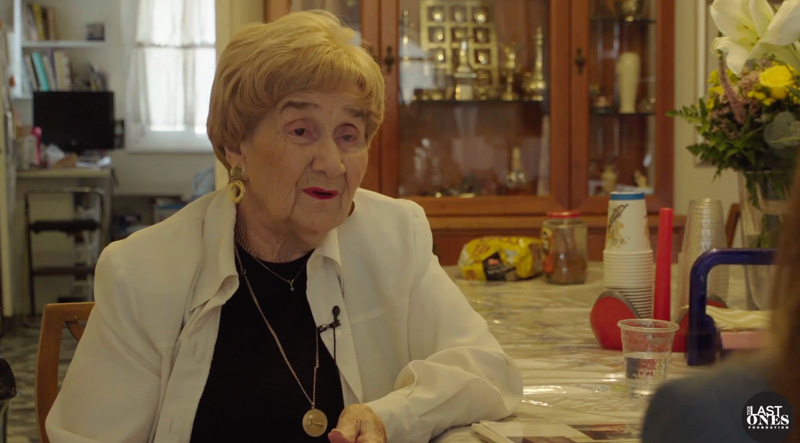
An Interview with Miriam
A Life of Resilience
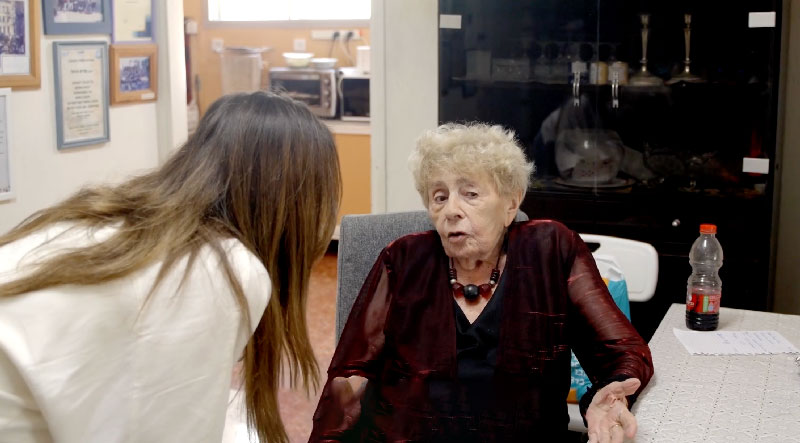
Narration: Today I’m in northern Israel to meet Miriam. Born in Lodz, Poland, on November 10, 1924, she was one of seven children raised by her parents, Gabriel and Sarah Goldberg, in a deeply religious Orthodox Jewish home.
Leslie: Hello.
Miriam: Hello.
Leslie: Hi.
Miriam: Miriam.
Leslie: Miriam. I’m Leslie.
Miriam: Leslie. Leslie.
Leslie: I’m very, very pleased to meet you.
Miriam: I am very happy to meet you. Please sit down. I brought you a little something. It’s a babka.
Leslie: Okay, thank you. And it’s you eat, Kosher? We have a wonderful cake for you.
Miriam: That’s nice. What are all these pictures?
Leslie: I was 20 times with young people. They went to Poland. And I went with them because I was born in Poland. And I could help them to understand what they see. I am 100 and one and a half. Born in 10 November 1924. I had a very, very happy childhood. Now it’s 26. So I will be very, very quickly I will be 102. what we say in Yiddish?
Miriam: You spoke Yiddish? Yes. I understand. You know why? My grandparents, they were born in Lodz as well.
Leslie: Oh my God. Oh my God. Yes. And they were in the Holocaust? Yes. Wow. How they survive?
Miriam: they did, like you, the Lodz Ghetto, Litzmanstadt. It’s a crazy story. My grandmother was dressed as a peasant.
Leslie: Sit down.
Miriam: I will, Leslie. The Germans came. They sent Gestapo men. The man was Hans Biboff. And he had to have one Jew to speak with him. So he had one whose name was Mordechai Rumkowski. And Rumkowski did everything that Gestapo wanted for him. Hans Wimbo said to him, You Jews, you are our greatest enemy because In the first war, 14 until 18 in Europe, very rich Jews from America make us to right.
Leslie: To end the war?
Miriam: Yes. That’s why now you have to pay for this war. Every Jew has to give away the Bijou, gold and silver and radio and machines, everything. And who will not give will die. So people wanted to live. They gave everything. But not my mother. Because my father, after every birth, gave my mother a diamond. She put it inside.
Leslie: Her bra?
Miriam: In ghetto, when we are dying of hunger, you could buy a diamond rice, that’s all.
The Łódź Ghetto
Narration: On February 1st, 1940, Miriam and her entire family were forced into the Lodz Ghetto, where more than 160,000 Jews would soon be confined in increasingly overcrowded and brutal conditions. On April 30, 1940, the ghetto was sealed, completely isolating its Jewish population from the outside world.
Miriam: And when they closed the ghetto, it fall out of our heart. We got something very terrible. Everyone who wants to live, no food. We got every day one piece of bread, and tomorrow another piece. And some rotten vegetables. And we got tador. How can you do it? You broke a chair. But we are not matches. But we have every day one one piece of the newspaper. So we went to neighbors to take a fire. One day, my mother sent me to a family to bring some fire. And three children sit around the oven. If I had filled some Something. I look inside. There was a pot with water. And I said, What are you cooking? She said it was a skin for a cow or a horse. I will put some salt. And the children wait for the food. My sister, Rachel, She gave everyone a piece of bread. Because my small brother was crying, I am so hungry. I am so hungry. I ate only inside the bread and the round I gave him.
Narration: Then came a notice. Men between 16 and 40 were told they could leave for work with the promise of food and wages.
Miriam: They went to station. And near the train, everyone got a loaf of bread, not a piece, a loaf. And they were so happy. They ate a lot of bread and they sat in the train singing, happy. And they came to a place near the forest And the Germans said, go out, you have to pee pee and so on from the forest. They killed all of them. They were never taken to work. They were taken to be murdered.
Narration: Victims of what became known as the Holocaust by bullets, in which approximately 1.5 million Jews were killed in mass shootings across Nazi-occupied Eastern Europe.
Miriam: Then came fall 1941, and 100 people got a call from Berlin. Are you crazy? Why do you give food to the Jews? The Jews have to die. So we went to Berlin. He said, The Jews in the ghetto. J. Kenneth walk for the army, for the German army. and everyone could work. We got the soup and we got the document. Everyone who works, don’t send them away. And we got the salary. The salary was 14 marks a month. And then came the year 1942. It was very near Rosh Hashanah, you know, two days. My father went to the synagogue and the Germans make a curfew. And he saw it with a belt. He said, cop, cop. And my father said that he is working. And he sent him home. And you were so happy.
Narration: This time, Miriam’s father, Gabriel, was spared after showing his work permit. But only a few weeks later, he and his eldest son were arrested and deported to Chenno, where they were murdered. Miriam never saw her father or brother again.
Miriam: Then one night, there was a knock at the door. It was the Kapos. It was… 8th of August 44th. And they put, come. Who is Miriam? I said, I am Miriam. Come with us. Everyone was crying. And I said, don’t cry. I will send you food. And I said to my two friends, come with me. They said, you don’t know where we are going. I said, here we will die from hunger. So they came with me.
Auschwitz-Birkenau & Selections
Narration: By the summer of 1944, the Lodz Ghetto was the last major ghetto still standing in occupied Poland, but its final liquidation had begun. On August 8th, Miriam was forced onto a cattle car. The destination was unknown.
Miriam: I didn’t know where I am, and then I was in Auschwitz, in Birkenau. I am very small, and after four years of hunger, I was only 30 kilos. I looked like 11 years old. And some men come to me, in the pajama. And he said to me, say this that you are 20. I said, I am not yet 20. Why should I, why? He said, do you want to leave? This was the moment that I understood that I am in a place where they killed people. We stood. One after one understood the great murder, Dr. Joseph Mengele. He looked at me and said to me, my child, how old Bistu? I said, I am 20. He said, okay, go. Right, it was good.
Narration: Those sent to the right during the selection had been chosen to live, for the moment at least. From there, the prisoners were taken to the processing building, where they were stripped, disinfected, registered, and given camp clothing before entering the camp.
Miriam: There was a couple, and they said, Jewish prostitute, take off your clothes. And they came to me. I had two braves. Everything took up, and I was naked. And there was dresses, and I got a dress with blood because when the mother didn’t want to get away the child, they shoot the balls.
Narration: Inside the camp, brutality was part of daily life. The cruelty seemed to know no limits.
Miriam: They said, Took off your shoes. And we had to go seven meters to go inside. And all the way was with small glasses, people of glasses. Barefoot, who will cry will die here. And I walked on glasses, on small pieces of glass, and it got inside my naked foot.
Narration: For some prisoners, what they were forced to endure became simply too much to bear.
Miriam: And it was night. The women near me began to cry. Her tears needed no explanation. She had just witnessed the bodies of Jewish prisoners being burnt in open pits. And yet, this horrifying sight revealed only a fraction of the scale of the killing. They put people on a fire. And she felt the smell.
Narration: The crematoria could no longer keep pace with the killing. Bodies were burned in open pits in full view of surviving prisoners.
Miriam: This was the night that I decided to commit suicide. And I put near me the woman said, what are you doing? I said, I want to die. She said, are you crazy? I came from Budapest and I am 40 years old. I cannot have children anymore. You are so young. Are you going to help the German? And she took my input.
Bergen-Belsen & Liberation
Narration: Three weeks after arriving at Auschwitz, Miriam was transferred to another camp. But this transfer was not about work or mercy. Something far more sinister lay behind it.
Miriam: They have no places in the dust chambers. So they took a telephone and they asked, Premlinka, do you have place? My dad, do you have place? And so on, so on. And they said, 200 girls. And I took my friends from Gordonia I have to speak with them. They said, we are not going. We don’t know where. I said, here we will die. So they put us in a train. We got a piece of bread and we went nine hours, 10 hours. It was a fabric for the Germans. And the manager said, those are not girls for walk. They are poor girls, they are going to die. I don’t need them out. And we began to cry, oh my God, they’re sending us back to Auschwitz. Mommy, mommy, we don’t want to go to Auschwitz. They put it in a train, but there was a woman with the road crates. They gave rotten apple for everyone. We came to a place with the name Bergen-Belsen. There were people from all Europe, from Belgium and Luxembourg, Holland and Hungary. in Poland and in Ukraine and nearby sat a young girl. I was almost 20, she was 50. And later I understood that she was Anna Frank.
Leslie: So you met Anna Frank?
Miriam: She was born in Germany and I spoke the language. And she said to me, you know what, I cannot decide after the war, to be a doctor or to be a writer. I said, I will be a writer and I will be a teacher, you see. And I am a writer and I am a teacher, you see. I wrote 20 books. And from the 20 books, Everyone is in Library of Congress in Washington.
Narration: Moved from one camp to another, Miriam was eventually sent to Bergen-Belsen and later transferred to Mel Teuer, a forced labor camp, where she was put to work in a German factory.
Miriam: Because I spoke to Germany, I asked them, What are we doing here? They said, Spiel, so we met parts of Europe. The great day was 16 of April, 45. It was a great alarm and I heard that two German women said one to another, it’s an enemy. It is not our enemy, it’s an enemy. They went out and didn’t close the door. We saw tanks and began to cry. They’re going to kill us. They’re going to kill us. Then we saw a black soldier. We understood this is there are no German, the American that came a Jew from New Jersey. And he said, I am so sorry. No Jews living in the whole Europe. All of you are orphans. We got food. We got everything. And after two weeks, we decided to go back to lodge to look. Maybe somebody. I didn’t find anyone. I found my sisters later.
A New Beginning & Reflection
Narration: Miriam was liberated on April 16, 1945. Of her large family, only she and two of her sisters survived. In 1946, while attending a seminar in Italy, Miriam met Joseph, the man who would become her husband. They married, and in 1947 attempted to make their way to British Mandatory Palestine. After being detained in Cyprus, they finally arrived in 1948. There, they built the life the Nazis had tried to take from them, a family that would grow to include three children, 9 grandchildren, and five great-grandchildren. And now, at nearly 102, Miriam still doesn’t mince her words.
Leslie: Do you believe in God?
Miriam: No. But I don’t answer. I said, I don’t know.
Narration: Who could blame her after everything she has seen and survived?
Miriam: I am a very happy person. When I was 100 years old, they make me a meeting, and my daughter said, My mother gave me 3 good things. She took me out from kibbutz. She showed me to love the classic music and to be optimistic. Three. Thank you, Leslie. Thank you very much. You are so sweet and so beautiful. I love you so much.
Leslie: Thank you, and you be well, okay? You take good care of yourself. Bye Miriam.