It Had to Be Told
An Interview with Guitel
A Visit with Guitel
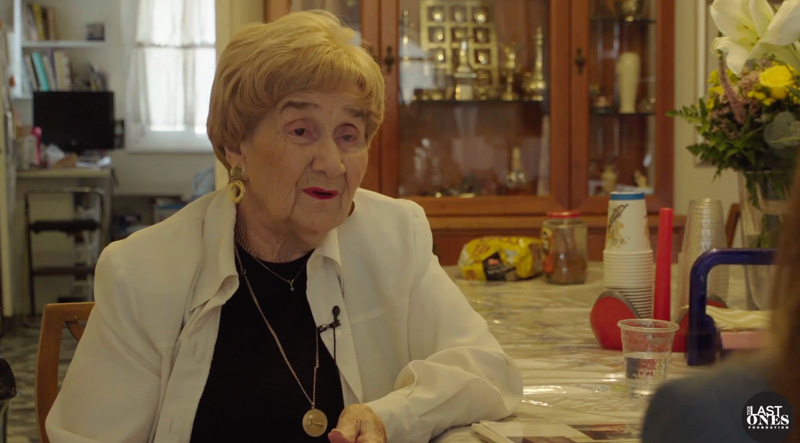
Leslie: Today I am in Jerusalem. I am meeting Guitel. She was born in Paris in 1932 into a very religious family. She was the second youngest of eight children. Guitel has lived in Israel for forty years.
Leslie: Hello, Guitty.
Guitel: Hello, hello.
Leslie: Leslie. It’s lovely to meet you. I’m delighted to meet you. I brought you a little treat.
Guitel: Oh, that’s kind of you.
Leslie: A little sweetness, when we’re talking about some bitterness, doesn’t hurt.
Guitel: That’s true. Oh my, that’s very kind. Really.
Leslie: [Unclear in source: a compliment about Guitel’s appearance or energy.]
Guitel: Listen, I try to keep in shape, but I am, after all, a woman of… ninety-one, ninety-two.
Family Photographs and Childhood in Paris
Leslie: Tell me about this photograph.
Guitel: We had this photograph taken with my little sister, with whom I shared those years, those terrible years.
Leslie: What is your little sister’s name?
Guitel: [Unclear in source: reference to Sarah and a smile.] I’m Guitel. I don’t understand why we looked sad there. At that time, we didn’t know anything yet. That’s my mother. We called her Pessalet.
Leslie: What was your father’s name?
Guitel: Leibische. My mother was from Warsaw, and my father was from Łódź. They had come to Paris to seek refuge. I missed my mother. Now that I’m an old woman, I say to myself, “My God.”
Leslie: Before the war, Guitel and her seven siblings had a happy childhood in the Marais neighborhood.
Leslie: What language did you speak at home?
Guitel: Yiddish. Still, my father tried to speak French.
Leslie: What did he do for work?
Guitel: He worked in a butcher’s shop on Rue des Rosiers.
Leslie: Did your mother work?
Guitel: Yes, she had a grocery shop. She worked, and worked hard. Fortunately, her eldest sons helped her.
Leslie: Which school did you attend?
Guitel: [Unclear in source: opening word.] Les Hospitalières-Saint-Gervais. It was a public school, but all the pupils were Jewish. The headmaster saved children, too.
The Vél’ d’Hiv Roundup
Leslie: On the day of the Vél’ d’Hiv roundup, Guitel was at home with her parents.
Guitel: They asked for the Rosenblum family… [Unclear in source: reference to the first floor.]
Leslie: Who came knocking at the door? Who came to get you?
Guitel: Policemen. Yes, it was the French police. My mother had bought us a suitcase for going to summer camp.
Leslie: Instead, you packed it to go to the velodrome.
Guitel: To the velodrome.
Leslie: So there was your little sister Sarah…
Guitel: My older sister Pauline…
Leslie: Your brother Isaac and your mother.
Guitel: That’s right. And my father too. We got on the buses. We were all happy because it was fun to go on a trip. When you’re a child, you don’t see things at all the same way. At ten, I didn’t understand.
Leslie: Over two days, more than 13,000 Jews, including 4,115 children, were taken to the Vél’ d’Hiv by the French police.
Inside the Velodrome
Leslie: Were there other families you knew at the velodrome?
Guitel: Yes, of course. Our first reaction was that we were happy not to be alone. We greeted one another: “Oh, you’re here.”
Guitel: My mother, who was very religious, had brought a [item unclear in source]. It was a Thursday. She knew we wouldn’t be home for Shabbat. She understood.
Guitel: She lit candles. Firefighters came and said, “Madam, put them out quickly. You’re going to set fire to the velodrome.”
Leslie: [Question unclear in source.]
Guitel: It was the middle of summer. It was very hot. We were packed tightly together. It was enormous. It was horrible. You couldn’t even get into the toilets. Those memories of the toilets, places that were full of…
Guitel: The smells, the cries. I remember the cries, people panicking, finding themselves locked in, crying and screaming. There were babies. A baby you can’t calm makes so much noise, and there was no milk to give them. At nightfall, when the light faded, there was this feeling of abandonment.
Guitel: You wonder how we endured it. People threw themselves from the top of the velodrome. It was quite high. They killed themselves. I can still see it. I hear the screaming. It is something I find difficult to understand, to explain.
Deportation to Pithiviers
Leslie: Those arrested were then sent to different French camps in cattle cars.
Guitel: We were packed tightly together, and we had to relieve ourselves. [Unclear in source.] When we arrived at Pithiviers, we were glad to get out of that horrible train. It was dreadful. We slept on wooden beds with straw.
Leslie: The families were together, but the Nazis initially demanded the deportation of the adults only. Children and parents were brutally separated. The children were left alone in the camp.
Guitel: They put us in front of the barbed wire, and we began to scream. They said, “Say goodbye to your parents.”
Leslie: Were your parents on the other side of the barbed wire?
Guitel: On the other side of the barbed wire. My father had tears… We began to shout and cry too. “Papa! Mama!” They took us back to the room. We didn’t understand that we would never see them again.
Guitel: We never saw them again. Those were terrible moments. I remember standing in front of that barbed wire. How hard it was. My God, my God.
Hunger and Separation from Her Sister
Guitel: We were hungry. I stole a carrot from the kitchen, and of course they put me in a prison. That’s what they called it: the prison.
Guitel: My sister looked at me through a little window. She cried and cried. She said, “Guitel, come. I can’t stay all alone. I can’t.” It was true. She couldn’t stay all alone.
Guitel: They finally let me out. The two of us went through such times. It was hard, hard, hard.
Leslie: Their uncle miraculously managed to get both girls out. He sent them into hiding in the countryside with two families.
Guitel: They separated my sister and me. My sister went to people who were cruel. She was only five. They made her do the housework, [task unclear in source], everything their own children didn’t want to do.
Guitel: I stayed with people who were quite good to me. We kept in touch after the war. They dressed me up to go to church on Sundays. They could see I really wasn’t comfortable with it. So they didn’t take me anymore. They didn’t force me to go.
Returning to Paris After Liberation
Leslie: At liberation, Guitel learned that her parents, her sister Pauline, and her brother Isaac had died at Auschwitz. Another older brother came to collect the two girls. They returned to Paris, but the family apartment was occupied.
Guitel: My brother pulled a gun out of his pocket. He said, “If you aren’t gone by tomorrow, I’ll shoot you.” We came back the next day, and the apartment was empty.
A Life with Music and Dance
Guitel: I wanted to sing and dance. My friends and I went dancing. A young man came to ask my friend to dance. She refused. Then he came and asked me.
Guitel: He danced perfectly. Well, he became my husband.
Leslie: [Brief reaction unclear in source.]
Guitel: We always loved dancing. As soon as there was music, my husband took me by the arm, and we danced a waltz. He was an excellent dancer. Goodbye, goodbye.
Leslie: Do you know how to say it?
Guitel: Oh, well done. [Yiddish expression unclear in source: “Zay magazine.”]
Leslie: Tell me, did what we asked you to do tire you out too much? It’s hard to talk about the past.
Guitel: It was hard, but it had to be done.
Leslie: Thank you very much. Thank you, Guitel. Goodbye, goodbye.
Guitel: Goodbye.