The Discipline of Survival
An Interview with Arie, Bergen-Belsen Survivor and Olympic Coach
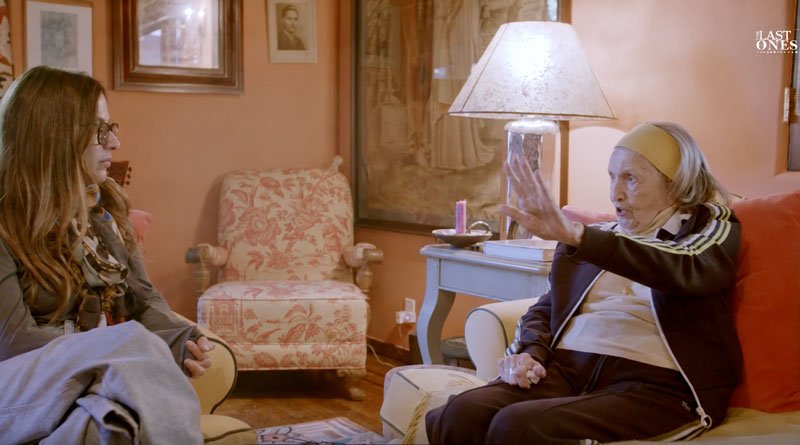
Narration: Today I’m in Israel in Haifa and I’m meeting Arie. He was born in 1937 in Krakow, Poland, but his story actually begins here. His parents had been living in Haifa just before his birth.
Leslie: Hello. Hi. Shalom, Arie. How are you?
Arie: Nice to meet you. I’m Leslie. I brought you a little something. Thank you. I don’t—It’s kosher?
Leslie: It is kosher.
Arie: I don’t care about kosher. In a concentration camp, I ate anything. Nice. Thank you. This is the only picture I have of my father. That’s the only picture left. My mother. So that’s you here.
Leslie: That’s me.
Arie: And that’s my grandmother. Wow. And that’s my mother and me and my mother’s sister. They were very elegant. Yeah, we were a rich family.
A Krakow Fortune & The Outbreak of War
Narration: Arie’s grandfather built the family’s fortune constructing buildings across Krakow. In 1936, he asked his son to return to Poland to take over the family business. Arie was born shortly after they arrived.
Arie: I had a very nice childhood. My mother was a tough woman and sometimes my mother was angry at me. My father would take me and put me on top of a stove—you know, the high kind used to warm up the house—so my mother couldn’t reach me. And I was sitting up there gesturing at my mother because she could not reach me. I had a good life.
I mean, as a child I was small. I was two years old when the war started in 1939. I remember the first day of the war. Me and my mother walked in the street and the Germans marched in. They came not with tanks, which was amazing, they came with horses. A few days later they came to our building. The man in charge was a German major. He said, “I’ll keep you for a while, but you have to go and live downstairs and do the maintenance for the house.” Later on, I remember my mother and I got German passports. Oh, I had to learn to pray like the Christians do. That was in Polish, of course, and I did it every night with the bowing and so on.
The Escape to Jesco
Narration: That arrangement lasted from 1939 until 1942, when the major came to Arie’s parents and explained he could no longer shield them.
Arie: I don’t know what happened to my father at that moment, but my mother and I went on a train to go to a nearby village called Jesco. We sat in a compartment, and across from me sat a little boy. Suddenly the boy said, “Look, I know you guys. You’re Jewish, and I know you’re Jewish.” My mother just took my hand and said, “When the train stops, go straight to the door, go out, and head to this address.” She gave me the name of the street and number 248. I came to the building—it belonged to my grandpa. At twelve midnight, my mother finally arrived. I asked her, “What happened?” She said, “Nothing. They took me to the police station and started interrogating me, but I had to pay them a few diamonds.” She had diamonds hidden inside the hem of her skirt.
The Bornea Ghetto
Arie: I remember my father briefly came to that place to move us to a different town. My mother and I had to walk from Jesco to Bornea at night through the woods—eighteen kilometers. Bornea was a very famous ghetto. We lived in a small house. At nighttime, I had to slip under the fence, go to the other side, and buy food.
One day I was looking down, and I saw the Germans chasing a Jewish man with a beard. They were burning his beard. I could see him running, running, screaming and screaming. They shot him in the back. Then one day they came in and swept the ghetto. They took us out, and we walked all the way back to Krakow. They put us on a train. The train was packed full—I don’t know how many people, maybe sixty to a car. Some people died on that train. We were sent to Bergen-Belsen.
Barrack 42: Bergen-Belsen
Arie: When we arrived, they sent us to a specific side. I soon realized that side was the “good” side because they kept us in Barrack 42. Barrack 42 was reserved for prisoners held for potential exchange, because my mother held an English passport for Palestine. It’s not that we got extra food or anything special, but at least they didn’t kill us immediately.
Leslie: So what was a typical day like in Bergen-Belsen?
Arie: In the morning at 5:00 AM, we went out and stood in line for about five hours. Summer, winter, it didn’t matter. Shoes, no shoes, barefoot, whatever—we stood in line while the Germans counted us. That took from morning until about noon. At noon they brought the food: water with pieces of bread floating in it. That was it. They gave you that and a piece of bread about a thumb-thickness deep.
The other thing was watching the prisoners assigned to heavy hardship labor. I would see them bring in those large soup containers from the kitchen. Those guys would rush in, try to scoop up the food with their bare hands, and eat it. While they were trying to eat, the guards would beat them with bats. Some made it out, some just fell right into those white pits.
Leslie: Was it like a game for the guards?
Arie: I don’t know what it was to them, but people were killed constantly. I saw open wagons going by loaded with thousands of bodies. The corpses would shift and move as the cart rolled, heading to the crematorium. You would watch the smoke come out of the chimney and know they were burning them. When you see people being killed like that every single day, death simply becomes a part of your life. A normal, everyday thing. The absolute scariest part of the concentration camp was having to use the toilets. What was the toilet? It was a large building with holes cut over a massive pit of human waste. The terrifying part was the thought that someone would come up behind you and push you in. As a child, that was the most frightening place to walk, especially if I happened to have a piece of bread hidden on me.
Tents and Anne Frank
Arie: Toward the end, so many new people were arriving that they ran out of space in the barracks. They moved us to a small corner of the camp set up with tents. Anne Frank was there, though I didn’t know her name was Anne Frank at the time. She was a taller girl than I was, with black hair.
As the front lines drew closer, American airplanes would fly incredibly low and strafe the camp. I have no idea why they shot at us. My mother, whose health was already failing terribly, would stay in bed without moving. She would tell me, “Take Anushka”—and I didn’t know who Anushka was—”Take Anushka, go hide.” She told me to run. That famous Anushka—she died of typhus shortly after the camp was liberated. Her sister, Margot, had died even before her.
Leslie: How long did you spend in Bergen-Belsen altogether?
Arie: Two years. That was long enough.
The Broken Train & Liberation
Arie: In April, they called our names, put us on a train, and we traveled for about five days. Suddenly, the train stopped in the middle of nowhere. We had no idea what was happening. At night, we heard people shouting, “Why are you just standing here? Why don’t you move them?” And the guard replied, “Because the engine broke down.”
The next morning, I looked out toward the hill. I saw trees falling, and emerging from behind the wood line were tanks—the Americans had arrived! Complete commotion broke out. The liberated prisoners immediately began attacking the German guards, taking their rifles away. The Americans had to step in to separate everyone, though a few guards were killed. The American soldiers started handing out chocolate to the children. They gave me some, but my mother firmly warned me, “Do not touch it.” She said it was to save us, because a lot of people made the fatal mistake of gorging on heavy food immediately; if you visit the Hillersleben cemetery today, you will see the graves of many people who died right after liberation from eating too much. But as an eight-year-old child walking the streets, watching the Americans drive by in jeeps throwing candy, I couldn’t resist. I ate the chocolate. When I came back that night, my mother looked at me and asked, “Did you eat?” I couldn’t lie—I had chocolate smeared all over my face. She said, “You ate chocolate.” I whispered, “Yeah.” As punishment, she made me sleep outside by the door like a dog. I fell asleep in a minute. After a while, she brought me back inside. She was very hard on me, but that strict discipline is exactly what kept me alive.
Arriving Alone in Israel
Arie: One day my mother asked me, “Would you like to go to Israel?” I said, “Yes.” She said, “Well, you will have to go by yourself.” The Red Cross had organized a transport, but it was strictly for children who already had surviving relatives waiting in Israel. My mother told me, “You tell them that your father is in Israel.”
Narration: In 1945, at just eight years old, Arie arrived completely alone in Israel. He would never hear from his father again. Arie grew up on a kibbutz. Three years later, his mother joined him, having remarried and given birth to a second son.
Arie: When my mother arrived, they wanted me to leave the kibbutz and come live with them. I told her, “No way. I want to stay right here.”
Leslie: You were happy there?
Arie: Very happy.
A Life Rebuilt on the Volleyball Court
Narration: After serving four years in the military, Arie chose a definitive path. He dedicated his entire life to the sport of volleyball—first as an elite player, then as a legendary coach within Israel and across the international stage, fundamentally transforming the sport.
Arie: Look at this—this award is for the Best Coach of the Century in the USA.
Leslie: Oh, you can read Japanese?
Arie: I can read that. Here is a picture of me with President Jimmy Carter, and here is another with Ronald Reagan.
Leslie: So that’s the silver medal you won at the Olympics in ’84?
Arie: Yes, from the 1984 Games. And then in ’92 I secured another silver medal with the men’s team. Throughout my career, my priority was always taking care of the players. That was my focus—I was always fighting against the bureaucracy, fighting against the government, fighting against all of that, but always for the players.
Leslie: Thank you so much, Arie. It was wonderful meeting you.
Arie: Thank you. Thank you. Thank you very much. In Holland, they greet each other three times.
Leslie: Are we doing… let’s do a third one. Bye-bye.
Arie: Bye-bye.