Above All, We Were Alive
An Interview with Bernard
A Visit with Bernard
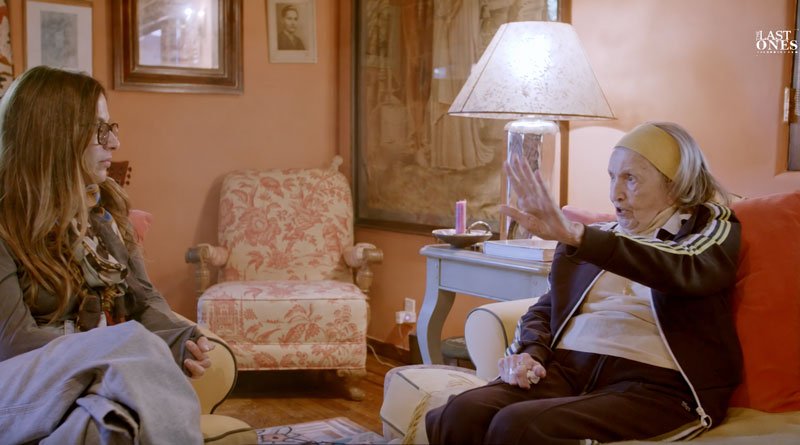
Leslie: Today I am in Tel Aviv, and I am meeting Bernard. [Unclear in source: “Michel?”]
Leslie: It’s Leslie. Hello, Bernard.
Bernard: Hello.
Leslie: Hello, it’s lovely to meet you. Leslie. I’m delighted to meet you. I’ve come a long way to see you, you know.
Bernard: From where?
Leslie: From Miami.
Bernard: Miami?
Leslie: Yes. It’s a long journey.
Bernard: Since I like wordplay, we’re going to be “à Miami.”
Leslie: Wonderful. That suits me. I brought you a little something, because when I visit someone’s home, I like to bring a small gift.
Bernard: That’s good.
Leslie: Are you somewhere in this picture? [Unclear in source.]
Bernard: My brothers and me, and my parents.
Leslie: Where are you?
Bernard: Guess.
Leslie: Well, I don’t know, but honestly, that’s quite a lineup. A lovely lineup.
Bernard: That’s me there. There you go. I was about eighteen. I don’t remember exactly.
His Family’s Life in Paris
Leslie: In this photograph, taken seven years after the end of the war, Bernard’s family is together again. His parents, originally from the Warsaw region, left Poland for France in 1922 to escape poverty and antisemitism. In Paris, they… [Unclear in source.]
Bernard: My father made trousers. Trousers and riding breeches too. A very, very difficult trade. Have you ever seen a…
Leslie: A pair of riding breeches?
Bernard: Yes.
Leslie: Bernard was born in Paris in 1934. He was the youngest of three boys.
Bernard: My father… [Unclear in source.] We laughed a lot. My mother used to say, “When you work with your hands, you can be neither rich nor poor.” It’s a good philosophy. They were poor, my parents, but… [Unclear in source.]
Leslie: What language did you speak at home?
Bernard: Yiddish. My brothers answered in Yiddish; I answered in French. I understand it fairly well, but I speak it very, very badly.
Leslie: When did you first experience signs of rising antisemitism?
Bernard: In ’41, yes. Fights, I tell you, every day at school. I came home… [Unclear in source.] Every day. They called me… [Unclear in source.]
The Vél’ d’Hiv Roundup
Leslie: It was on the day of the Vél’ d’Hiv roundup that life changed for the Biederman family.
Bernard: On July 16, 1942, it was the French police, you know, who arrested all the… You know, there is only one image of the Vél’ d’Hiv. There is a bus in a street. That’s the only photograph of the Vél’ d’Hiv roundup. There aren’t any others.
Leslie: A French policeman warned them just in time that the roundup was imminent.
Bernard: We hid… We lived on the first floor, and we went up to the fourth, I think, to the home of a Greek Jew. At that time, they weren’t taking every Jewish ethnic group. My grandmother, who was in Paris, was taken away two or three days later. It was December.
Separation and Crossing into the Free Zone
Leslie: Their parents managed to hide the children with a paid caregiver.
Bernard: She mistreated us. We had very little to eat. Sometimes she even beat us. We caught scabies, lice, everything you can imagine.
Leslie: At her house?
Bernard: Yes.
Leslie: Even though she was being paid to take care of you and your brothers?
Bernard: She was a nasty piece of work.
Leslie: How long did you spend there?
Bernard: Four months.
Leslie: And your parents went into hiding somewhere else?
Bernard: My parents took us away, and we crossed the demarcation line into the Free Zone, carried on a man’s back.
Leslie: You were on the back of…?
Bernard: On the back of a man who took us across the Saône. My father gave him his last money.
Two Years Hidden by a Priest
Leslie: The three brothers were then entrusted… [Unclear in source.] …to a priest who hid Jewish children.
Bernard: Abbé Duman, the parish priest of [place-name unclear in source]. He helped about fifty people, children and adults, get through in that area. He had a large house, called the presbytery. We stayed there for two years.
Leslie: Were there many children there?
Bernard: No, there were just the three of us. From time to time, there would be one or two others, but they didn’t stay. You see, he had them hidden with farmers and so on.
Bernard: At the bottom of the garden, there was a little space. He told me, “If the Germans arrive, head for the mountains.” We ran like rabbits in those days, toward the Pilat massif and around there. The Germans never came that way.
Leslie: Did the priest treat you well?
Bernard: Oh yes. He was kind. Very kind. There was the priest’s housekeeper too. She was kind to me, but my brothers gave her a hard time. They were terrible, my brothers.
Leslie: Did you go to catechism classes?
Bernard: Not catechism. To church on Sundays. They gave us a few coins to go to Mass, and afterward we put them in the collection. We went to ring the church bells.
Leslie: Do you remember the prayers? Have any stayed in your memory?
Bernard: “Hail Mary, full of grace, the Lord is with us,” and so on. [Unclear in source.] He scolded the parishioners. He was very funny. They called us “the priest’s kids.” That was all.
Daily Life and the Hope of Reunion
Bernard: We went to school a little there, not much. That’s why I didn’t go to school much, because the children there didn’t welcome us. So my brothers and I didn’t go very often.
Bernard: To get food, we went a long way to fetch milk, eggs, and so on, summer and winter. Sometimes we walked ten or fifteen kilometers round trip for two liters of milk and six eggs.
Bernard: In winter, we wore wooden clogs, our feet frozen. It was hard. From time to time, a parcel from our parents arrived at the priest’s house. So they knew where we were, but we didn’t know where they were. Do you see what I mean? We needed our parents, but they weren’t there.
Leslie: Were you happy?
Bernard: We didn’t always have enough to eat, but we weren’t unhappy. Above all, we were alive. That was already something.
Bernard: My brothers and I were beginning to have Christian faith. My eldest brother was baptized Catholic. It happened on its own. It’s human imitation.
Bernard: I’ll tell you something that I don’t tell many people, even though I’m not a believer. In 1944, I was in church, and I prayed to the Virgin Mary for my mother to come back. Three days later… It makes me cry. When I remember it, my parents were there. So, religion… there you are.
Honoring the Man Who Saved Them
Leslie: After the war, Bernard’s family obtained recognition for Abbé Dumas as Righteous Among the Nations.
Bernard: The bishop of Saint-Étienne came, and we held a whole ceremony to put a plaque on the presbytery of our priest. Everyone came, the whole village, the surrounding towns, the little hamlets. Everyone came to see us. My parents and my brothers were there. It was very moving.
Leslie: Was it important to you to pay tribute to him?
Bernard: Of course. He saved our lives, after all. He was a man who took risks. If the Germans had come up there, he would have been shot immediately. He was a good man.
Family, Humor, and a New Life in Israel
Bernard: That’s my tiny little baby there.
Leslie: He doesn’t look like a little baby.
Bernard: When I first knew him, he was fifty centimeters long. It’s funny, because at his bar mitzvah, he came up to here.
Leslie: Wow! And suddenly, just like that!
Bernard: To please my daughter, because she is a little… not very religious, but a little… I had my bar mitzvah at eighty-five.
Leslie: Wonderful!
Leslie: In 2018, Bernard and his wife joined their daughters and grandson in Israel.
Bernard’s daughter: That’s how he told us about his life, through humor. And he remembers… he mostly told us about the good times. The bad times… when he tells me, and when I heard him say, “We had to walk ten kilometers to fetch two eggs,” we don’t often hear that, because… Or else… [Incomplete in source.]
Bernard: We became… [Unclear in source.] I became an adult at eight years old.
A Farewell
Leslie: [Unclear in source: “Zaimagazine.”]
Bernard: [Unclear in source: “Za magazine.”] Here. It depends… In Poland, it depends on the references.
Leslie: Oh, there were different accents.
Bernard: But you understand what I mean by that. Yes, of course. That’s all there is. [Speaker changes unclear in source.]
Leslie: In good health.
Bernard: Yes, of course. Health, but… Alex? Huh? [Unclear in source.]
Leslie: [Unclear in source: a French pun involving “health” and “feet.”] Oh dear, oh dear!
Leslie: [Unclear in source.] Shalom!
Bernard: Bye!