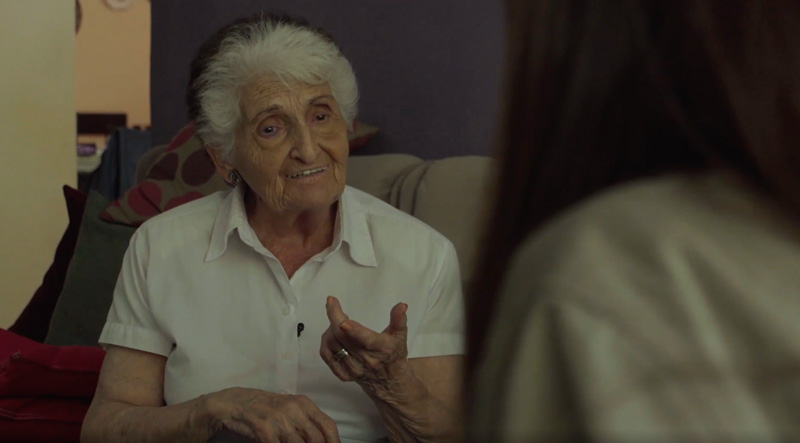
Berthe Holocaust Survivor Testimony
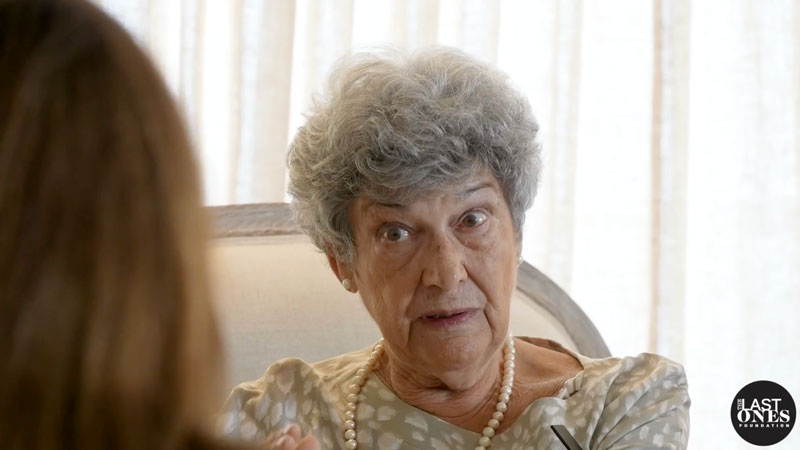
Berthe Badehi (1932–2025) was born in Lyon, France, to Polish-Jewish parents who were active in the Resistance. In 1941, at just nine years old, her parents made the heartbreaking decision to send her away to save her life. Believing she was going on a short trip, Berthe left with a small suitcase, unaware she would not see her family again for years.
She was taken in by a Christian farming family in the Savoie region, led by Marie Massonnat, who knowingly risked her life to protect a Jewish child. Living under a false identity, Berthe attended church and adapted to a new life in hiding. Despite the constant danger, she would later describe those years as the “most beautiful of her childhood,” referring to the Massonnats as her “Christian family.”
Reunited with her parents in 1944, Berthe went on to rebuild her life and later moved to Israel in 1956.
For more than two decades, she volunteered at Yad Vashem, sharing her testimony with visitors from around the world and honoring those who had saved her. Her memoir, We Were Never Children, reflects a life shaped by survival, resilience, and enduring faith.
Her story stands as a testament not only to the courage required to survive—but to the humanity of those who chose to protect life in the darkest of times.
Video Transcript
The Instinct of Righteousness
An Interview with Berthe, Survivor of Occupied France
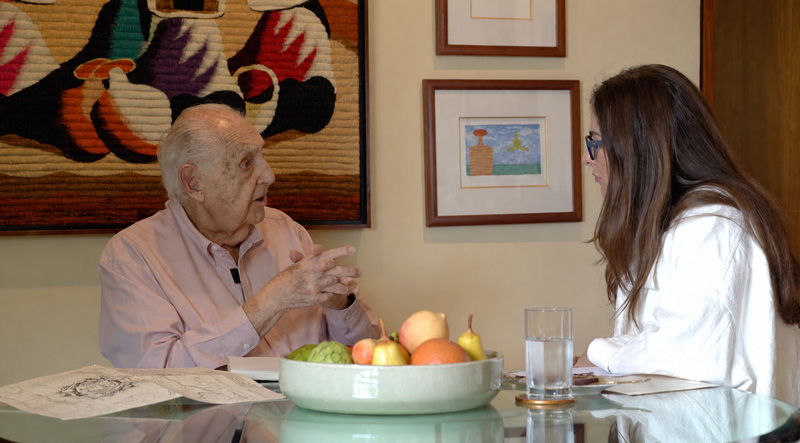
Leslie: Hi. Hello. How are you, Berthe?
Berthe: Thank you.
Leslie: I’m Leslie. Nice to meet you.
Berthe: So nice to meet you. Thank you. Nice to meet you.
Leslie: I brought you a little something.
Berthe: Yes. Okay. Very nice of you. How are you? Thank you.
Leslie: Who’s on that picture here?
Berthe: My father.
Leslie: It’s your father that you can see immediately. You know, I’m looking. Look.
Berthe: Ah, yes. Very true. Same profile.
The Shadows of Occupied France
Berthe: In 1940, I was in school in the class. The teacher said we do have a war because of the Jews. No one in the class knew I was a Jew. But I suddenly had the feeling that here I am responsible.
Leslie: You felt guilty when he said that?
Berthe: Of course. Or you were upset. I felt that, you know, “Oh, because of me.”
Berthe: Friends coming to my parents, they were already telling that Jews had been arrested—first very well-known Jews, after some communists, you know, they were feeling things. And Marshal Pétain in 1940 already had a decree that all the Jews working in the administration were to be thrown out of their jobs.
Berthe: My mother one day prepared for me a suitcase. She told me tomorrow a friend of theirs will take me to a Christian family in a village. That friend took me by train to a village called Le Monel, and there I was taken to a farm, and in that farm I met a lady called Madame Masa.
A False Identity
Berthe: When I arrived, that friend took out a certificate that I am a Christian and that I have been baptized.
Leslie: When she took you in, did she know that you were Jewish?
Berthe: She knew from the beginning, but she never said a word, you know. “Okay, she is a Jew, but she comes with a certificate that she is a Christian,” and that was enough. That was it.
Leslie: But then what did you do? Did you have to go to church?
Berthe: I went to school and I went to the church with all the other children of the village. For catechism, I did what the children of the village did.
Leslie: How did you feel at her house? Was she taking good care of you?
Berthe: With the Masa family, I found a real family. Madame Masa was a widow with three children—a son at the time who was 20, and two girls. They were all very nice to me. Marcel was the big brother I always wanted so much to have. I loved going in the fields to work with them, and I loved picking grapes. Maybe there was something from my ancestors, I don’t know, but I felt at home there.
The Climate of Fear
Berthe: The brief sense of peace and security came to an end in September 1943. After the Italians were thrown out of the southeast of France and the Germans came in, they started to look for Jews, and then at that exact moment, the fear started. I didn’t want to share that with anyone. I was afraid to share with anyone because someone did inform the police that there was a Jewish family hiding at Le Monel. I was constantly afraid. There were two more girls who had been staying with people from Le Monel, and they were in school in the same class with me. I knew they were Jewish, and they probably knew or felt I was Jewish, but we never, never asked. I kept my name because my name didn’t explicitly reveal Jewish connections, but their names I never knew. No questions asked, to know nothing and not to say anything. We could feel that there was danger everywhere.
A Terrifying Encounter
Berthe: One day she was staying with Madame Masa right by the door—there is the kitchen—and they heard a car getting into the courtyard. She saw two Germans coming out of that car, and she immediately went out of the house and managed to stop the Germans by the entrance to the courtyard. I was in my room on the second floor trembling all over when I saw them. The Germans had been looking for a young man of the village who didn’t return to Germany for the STO forced labor, and Marcel was the right age. Madame Masa managed to explain to them that Marcel was an orphan in charge of the farm, and she successfully sent them away. If she had waited for them to come inside and open the door, they would have seen my mother. And when she opened her mouth, she still had a terrible Jewish-Polish accent. For the Germans, they wouldn’t have needed anything more. She would have been arrested immediately, and I would have been too, because it was strictly forbidden for a Christian to help Jews. She was a brave woman. She was a very great lady. She was a simple farmer, but she had instant instinct. She understood immediately. She received that title of Righteous.
Righteous Among the Nations
Leslie: Did you keep in touch with Marcel and the sisters?
Berthe: To this day, we are in touch down to the fifth generation. I go there, they come to visit me here—we are like one family. It’s important to keep the past alive in order to have a better future. I’m thinking about my children, my grandchildren, and my great-grandchildren. I want for them to have the best life and not to live with fear. Not to fear the way I did, because those two years I lived with constant fear left a permanent mark on me.
Leslie: Thank you so much, Berthe. Be well.
Berthe: And you too. Thank you so much. Thank you. Please do. And thank you. Bye. Bye. Bye. Bye. Thank you.
Leslie: Bye, David. Bye. Bye.
Berthe: And the door. Good. Can you close the door? You shall close the door.