Frank’s Story
An Interview with a Holocaust Survivor
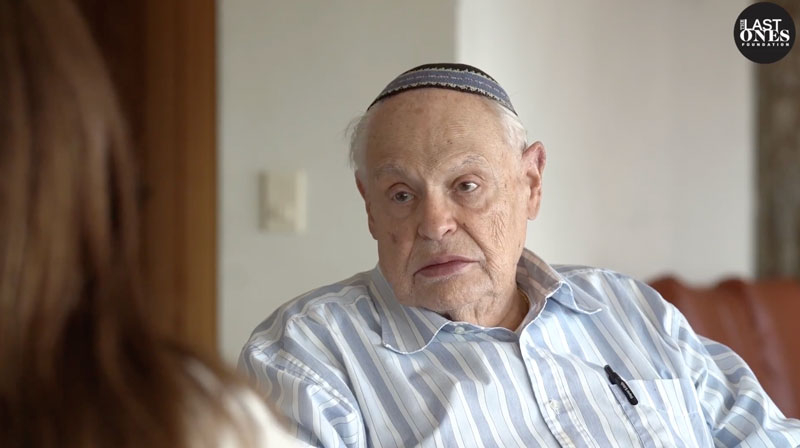
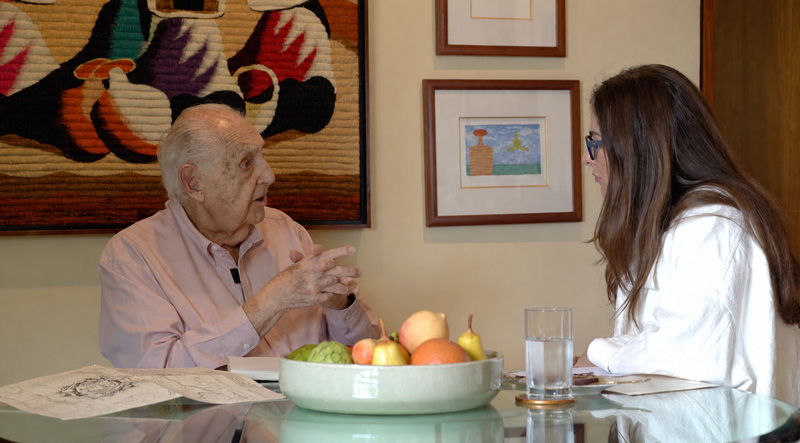
Narration: Today I’m in Williamsburg, Virginia, visiting Frank, a 100-year-old Holocaust survivor, author, and former journalist. Frank was born in Czechoslovakia near the Hungarian border.
Frank: It’s my grandma’s recipe.
Childhood & the Beginning of Persecution
Narration: In 1938, everything changed. Following the Munich Agreement, Frank’s hometown was ceded to Hungary, and anti-Jewish laws quickly took hold. In 1944, the German army marched into Hungary.
Frank: It was one of the changes.
Narration: By 1944, his world was falling apart. Everything the family had built was taken from them. They were deported to different camps, including Frank, his mother, his sister, and her baby.
Deportation & Loss
Frank: My half-brother was taken to a Nazi concentration camp, and he barely survived. Of course, my sister and her baby never came back. My mother was taken to a concentration camp, Flossenbürg in Germany, and she starved to death.
Slave Labor
Frank: It was a military camp, about eight horses or forty people. I told you, for forty people, but instead they put one hundred of us into it. So there was really only space to lay down next to each other like sardines.
I was taken into a Nazi slave labor camp to build a railroad track in the rugged Carpathian Mountains in Transylvania. I was assigned to shovel out clay. You know how clay is heavy. We had to shovel it out from those boxcars.
It would have killed me in short order. I wasn’t robustly built. But what saved me was that I knew how to handle horses. As a kid, I had my own pony. I had to take care of him myself. The Hungarian officer didn’t have a car, so I became the groom for his horses.
Part of my job was to go into villages, clean the room, and they would give me some extra food. But I had to go back to the camp. They also gave me old clothing, and again, I was going to escape.
Escape During a Death March
Narration: In October 1944, during a death march, chaos broke out as Soviet forces bombarded the area. Frank saw an opportunity. Hiding in cornfields, he escaped and made his way to Budapest. There, he joined an underground resistance network helping to save Jewish lives.
The Underground Resistance
Frank: I was an employee of the International Red Cross.
Leslie: What was your job for the underground? What were you doing for them?
Frank: My mission was to deliver fake papers to Jews in hiding. So many Christian families took in one or two Jews to hide them, but it was very dangerous for them to keep those Jews, because if they were caught, they could be punished the same way as the Jewish people.
Because I could speak multiple languages, it helped me.
Leslie: You realize that luck and resourcefulness are the two main reasons you remained alive. The fact that you could speak many languages. The fact that you knew how to take care of horses. Luck after luck after luck.
Frank: I wasn’t available, but I had seen so much.
After the War
Narration: After the war, Frank’s mission was not over. He worked as a correspondent for a Russian general and later as a journalist in Prague. Back home, he was reunited with his father and helped shelter displaced Jewish people.
Frank: I became operative in Prague for the Mossad, for the Israeli Secret Service. I was helping people escape from communism.
Escaping Communism
Narration: In 1954, shortly after his marriage, Frank and his wife escaped communist Czechoslovakia and started a new life in America.
Leslie: So did you come by boat?
Frank: We came on the Queen Mary. And it was funny. A woman was waiting for us, and she put us into a taxi. The driver was from an Italian background, and he said, “I want to take you directly to Queens.” So he did. That was our introduction to America.
Anti-Semitism Then and Now
Leslie: What do you feel about the anti-Semitism everywhere in America and in Europe? Is it the same anti-Semitism that you faced as a young person in Europe, or is it different?
Frank: America is different. It has a democratic tradition. Things happened here also, but who remembers the Know Nothing Party? They didn’t even want Irish Catholics to come to the United States. And that existed. So whatever is now, it will pass.
Leslie: Thank you so much. Thank you for everything.
Frank: Thank you so much. Bye. Thank you so much. Thank you. Thank you. Bye-bye.