Her Mother’s Diamonds
An Interview with Irene
A Visit with Irene
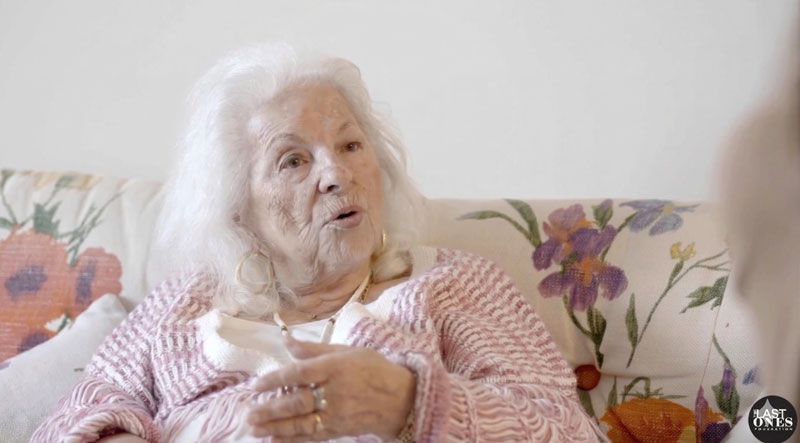
Leslie: Today I’m in Florida and I’m going to visit Irene. She was born in 1929 in Hungary.
Irene: Come on in.
Leslie: Hi.
Irene: Hi. Nice to meet you.
Leslie: How are you? I’m so happy to meet you.
Irene: Me, too.
Leslie: You know how many people spoke to me about you?
Leslie: Irene was deported to Auschwitz where she was subjected to Mengele’s experiments.
Irene: But I was always afraid that I wasn’t going to be able to have children because that was one of the things that he was trying to uh experiment on. So we should never have any children if we ever survive, which he didn’t think we will.
Leslie: She told her story in 1998 in a well-known documentary about the Jews of Hungary.
Irene: This is Steven Spielberg.
Leslie: Oh, wow.
Irene: The the last days won the Academy Award.
Leslie: Uhhuh.
Childhood and Rising Antisemitism
Leslie: Her story begins happily in a wealthy family of six children. She is 10 years old when she first experiences anti-Semitic violence.
Irene: We came to school that morning and there was already a Ukrainian teacher. Our teacher was gone with a big stick and she picked out all the Jewish kids. Get out of here and never come back. Threw us out of school. My friends came home that night and they called me a Christ killer.
Leslie: Christ killer.
Irene: A Christ killer. You killed our Lord the Christ and we don’t want to be friends with you anymore.
Arrest and Deportation
Leslie: From that moment on, the family lives in seclusion until 1944 when they are arrested and taken away by the police.
Irene: We marched down the street to the rail station where all our friends were yelling, “Get out of here, Jews. We don’t need you here. It’s about time they taking away us away.” I couldn’t believe.
Leslie: The family is first sent to the Munkács ghetto, then deported to an unknown destination.
Separation from Her Family
Irene: I was holding my 2-year-old brother. He cried, but he wasn’t crying for bread because he was hungry. He just wanted to go home. And he begged me the whole time to take him home. And I promised him that we will be home soon. I was holding on my my brother so tight. I said, “I will never let them take him away from me.” My little brother never saw his home again. And the train
Irene: stopped and the doors open. The Germans with their vicious dogs with clubs in their hands, yelling, “Get out, you dirty Jews, and make it quick.” They immediately separated men from women, older children. My mother took my my little brother from me. She said to me, “Hold your sister.” My sister was four years old. “Hold your sister’s hand really tight so she doesn’t get lost in this chaos.”
Leslie: And at this point, your father and your brothers,
Irene: they were gone. We didn’t even see them anymore. They were already out of our sight. [Unclear in captions: description of being separated from her little sister.] So I I had to let go of her little hand forever. And then I heard my mother call out to me, “Don’t cry. I will come for you later.” That was the last time I heard her voice.
Her Mother’s Diamonds
Leslie: Irene is separated from her entire family. To protect her daughter before deportation, her mother sews diamonds into the hem of her skirt.
Irene: And now I was in this huge hall with people I have never seen before. They ordered us again, these vicious people with their dogs and their the SS men and women yelling at us, “Take your shoes and clothes off. Hold them in one hand and take your valuables and put them in the bin.” They had a box for our
Irene: valuables. Oh my god. I I remembered my mother’s diamonds and my clothes was already off my body, but they were on the floor. So, I found [unclear in captions] and I found four diamonds, put them in my mouth because I had no clothes to hide them. And I went on after they shaved my hair, they tattooed my number.
Irene: I saw they were pulling gold teeth from people’s mouth. And I had my mother’s diamond in my m mouth. And I knew when they open my mouth, they’re going to see the diamond. They’re going to take them away. They’re going to shoot me for not putting them in the in the bin. So I swallowed them.
Leslie: You swallowed the diamonds.
Irene: I swallowed the diamonds and I felt free.
Leslie: But did you have a plan after? So
Irene: Well, yeah. I was going to save them because my mother said these diamonds are to buy bread and you obey your mother. So I was saving the diamonds to to a you know to to a to uh you know make my mother’s wish a reality.
Irene: Our ration for the day was once in 24 hours and we would get a cup of soup what they called but the soup had nothing in it. It was like water with maybe a a piece of potato peel or something in it. So once a day we were allowed to go to the latrine. Okay. So I had no problem finding them because like I had no solid food. So it was all water coming out.
Mengele’s Experiments
Leslie: Irene is selected by the infamous Dr. Mengele, the angel of death for his so-called medical experiments.
Irene: Mengele would come in and pick his prey for whatever he needed that day. So he would go through the whole the whole block each block. So he would like like look down the row and see what he sees and say, [Words unclear in captions.]
Irene: He put us in one of those dungeons. The first experiments he injected us with something in our eyes.
Leslie: What was he trying to do with your eyes?
Irene: To change the color of our eyes, make them blue. because his goal was to make after the war Germany a blue-eyed and blonde hair so he can make the whole country blueeyed.
Leslie: How many times did he experiment on?
Irene: Oh, many times. I can’t even tell you. Every time he had something going. Sometimes he would inject. See this finger still kind of bend and see the nail never grew back normal. And it never does. It’s always short. The nail never grows like the others.
Irene: He was injecting sometimes 12 injections a day under under under well not all of them under the finger but most of them. Such a painful thing. And the reason is because when you inject something under the nail, it travels through the body faster and that’s why he was doing it that way.
Leslie: Can you describe Mengele to me when you when you would see him? Can do you remember how he looked like?
Irene: He was gorgeous. He came up to me and said—he was taking me already. I was already being prepared by the nurse—[unclear in captions]. “What is your name?” I referred to my number because I wasn’t allowed to have a name. [Unclear in captions: exchange about her name and his wife’s name.] Here he was preparing me for an experiment, and he wanted me in a certain mood, so he talked to me about my personal life. But a minute later he was like a jackal [unclear in captions]. He was a murderer.
The Attempt to Remove Her Tattoo
Irene: the last experiment he did on me was to take the number out because the SS were tattooed with the same ink under their left arm with the SS and when the they were losing the war he didn’t he didn’t want them to be recognized so he wanted to take it out so they should
Leslie: Oh, so he needed to find a way to remove the tattoos of the SS.
Irene: Oh, yeah. My arm was cut almost to the bone to get it out, but he never took out the pigmentation. The pigmentation is still on my arm, right here. The white…
Irene: and I heard him say [Words unclear in captions: an order concerning the gas chamber.]
Leslie: Sent her to the gas chamber.
Irene: To the gas chamber. Because when he was through with the guinea pig, they went to the gas chamber. A miracle happened.
Rescue and Forced Labor
Irene: A Sonderkommando boy came down the ram to go to the gas chamber to do his job to take the bodies to the oven. And he found me first. And he pulled me out. He took off his jacket and covered my naked body. And he said, “I’ll be right back.” And I thought I was hallucinating.
Irene: And he came back like in minutes. Okay. He said, he took my hand. He says, “Come on. We’re going to walk around this gas chamber. We’re going to go over there. There is a train over there with people in it, and they’re going to a labor camp, and I’m going to put you on that train if I can.”
Leslie: She’s then sent to the [camp name unclear in captions] labor camp where she works manufacturing ammunition.
Irene: So guess how we were packing? We were emptying the shells and we were packing empty shells because they weren’t given these they were given these these to to to kill innocent people and they were
Leslie: and that was your little resistance.
Irene: That was our revenge.
Evacuation and Liberation
Leslie: Shortly after the camp is evacuated and Irene is moved from one camp to another,
Irene: we decided we’re going to sit down on the road and when they tell us to march, we’re not going to move. They’ll have to shoot us because they’re going to shoot us eventually. So we and then planes came out from behind the mountains and they were bombing everything that was moving on this little narrow road between two forest and a dark night and just us on the road and the trucks they were carrying their supplies.
A New Life and the Diamonds She Kept
Leslie: At liberation Irene is 15. She has lost her entire family. Two years later her uncle brings her to the United States. She marries and despite the experiments of the angel of death manages to have two children.
Irene: And these are my
Irene: mother’s diamonds. My husband made this on my 10th anniversary. He decided that I should put these four diamonds in a teardrop shape because I cried so much every time I held them. These four is what I swallowed.
Leslie: These are the four diamonds that you would swallow every so often.
Irene: Every so often. And I wear them every time I speak to you audience because Steven Spielberg said, “Have people touched them?” Because they touch history.
Speaker unconfirmed: Bye.
Leslie: Thank you. Thank you so much for everything.
Irene: Everything. Tell me when you need me.
Speaker unconfirmed: Bye. Bye.