Jack Holocaust Survivor Testimony
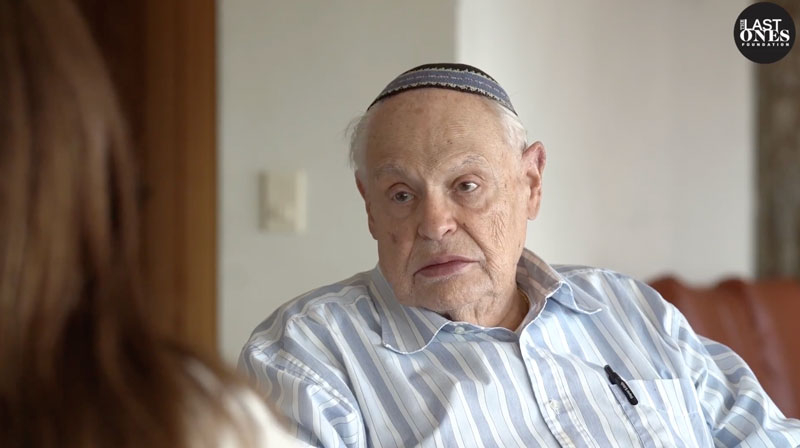
Jack Waksal was born in September 1924 in the small town of Yedlinsk, Poland, where he lived with his parents, brother, and two sisters. At the age of 15, his world was shattered when the Nazis invaded his hometown. Jack and his family were forced into ghettos and labor camps, marking the beginning of a relentless struggle for survival.
During the war, Jack endured forced labor in multiple military camps and munitions factories, including Pionki. He escaped death six times—once narrowly surviving execution at the edge of a mass grave. Recaptured and transferred through four different camps, he continued to fight for his life. In September 1944, Jack made a final escape and hid in the forest, surviving until the Red Army liberated the area in January 1945.
He emerged as the sole survivor of his immediate family—his parents, siblings, and extended relatives all perished in the Holocaust.
After the war, Jack spent time in a displaced persons camp in Germany before immigrating to the United States in 1950. He settled in Dayton, Ohio, where he rebuilt his life from nothing. There, he married Sabina—a fellow survivor from his hometown and an Auschwitz survivor. Together, they built a life defined by resilience, love, and perseverance.
Today, Jack stands as the proud patriarch of a large family: three children, seven grandchildren, and four great-grandchildren—a living legacy of survival, continuity, and hope.
Video Transcript
The Nightmares Never Go Over
An Interview with Jack, Forest and Labor Camp Survivor
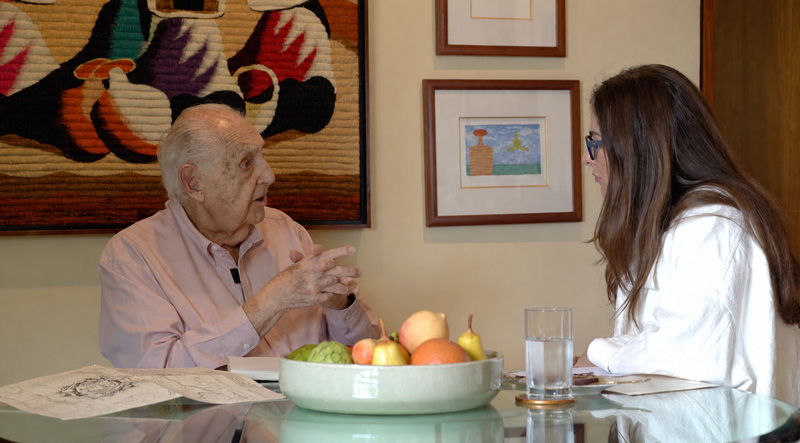
Narration: Today I’m in Miami and I’m meeting with a young centenarian named Jack. He was born in Poland more than a century ago. Jack has been a widower for more than a decade after 65 years of a happy marriage to a fellow Holocaust survivor.
Jack: Yes. Come on in.
Leslie: Hi Jack. How are you?
Jack: Good. I’m Leslie.
Leslie: Hi Leslie. It’s nice to meet you.
Jack: Nice meeting you. I brought this for you. Do you know what it is?
Leslie: No.
Jack: It’s a lekach.
Leslie: A lekach? My grandma taught me. My mother did that, too. Every Friday, oh yeah, she was baking lekach.
Jack: Well, here you go. At least you can tell me if it tastes like the one your mom used to make.
Leslie: It’s not the best I’ve made in my life…
Jack: No, it’s good. It is delicious. And that is me and my wife.
Leslie: Uh-huh. What was your wife’s name?
Jack: Sabina.
Leslie: Sabina. Yes. Where was she from?
Jack: Poland. From my city.
Leslie: Oh, the same city. You guys met when you were little?
Jack: Yes. I’ve known her since we were brought up together. Wow, yeah.
Anti-Semitism in Poland
Narration: Jack remembers the violent anti-semitism he faced as a teenager in Poland, where Jewish communities were suddenly ostracized.
Jack: No more friends. I’m telling you, it was like they wouldn’t even know that you existed before. All of the kids you were biking with, playing soccer with, and being in school with—they didn’t even want to see you anymore. People standing by stores made signs: “Don’t buy from Jewish people.” Eight days later, they burned down the synagogue.
Leslie: You remember that day?
Jack: Yeah. I’m telling you, it was pretty close to the evening, close to 5:00. All of a sudden, you see a flame. All of the Torahs, everything, everything was finished.
Horrors of the Ghetto
Narration: In 1939, Jack and his family are forced to leave their home and move into the ghetto, where they witness the compounding horrors of the Nazi occupation.
Jack: They put five, six, or more families in one house. Anybody who went out from the ghetto who was a Jew was going to be instantly killed on the spot. They liquidated it a year later. They took all the babies and put them in a grave without bullets—alive in the grave. Yes.
Leslie: They would just throw them in the pit?
Jack: In the pit. If I sat with you right now and looked back at it… They put them in the pit, and sometimes the mother went with them if she didn’t want to give up the baby. That’s what happened. Buried alive.
Leslie: And who do you think dug those graves?
Jack: The Jewish people did. You had to dig your own grave. That’s what happened.
Escaping the Mass Graves
Narration: The Holocaust by bullets was raging across Eastern Europe. Hundreds of thousands of Jews were being shot. Jack managed to save his father from a selection once.
Jack: All of a sudden, it came to me and I said to the guard, “Would you take me instead of this guy?” And he picked me up like this, took me out, and he pushed my father back. When we came to the grave, I said a word in Yiddish to the first guy, “How about before we get killed, we grab him and fight him?” And the guy said, “Yes.” When the guard went after his pistol, we got up and grabbed him. He started hollering, “Don’t shoot!” and we were fighting right close to the edge of the pit. He pushed us, a piece of sand came down with us, and we fell. We all fell into this grave. I managed to run away into the forest, but the other guy didn’t make it.
The Labor Camp & Sabina
Narration: Jack hid in the forest for a month, but in the middle of winter, the conditions became too harsh to survive, forcing him to enter a nearby labor camp.
Jack: I went in. And you know who was there in that camp? My girl that I used to meet up with—Sabina, my future wife. She started to holler, “Jack is alive!” and she came and hugged me. It was unbelievable. But as soon as I arrived, I was assaulted by Ukrainian guards. In the middle of the night, he came. I picked up my head and he took his gun and hit me on the side of my head with it.
Leslie: He hit you on the head with a gun?
Jack: Yeah. And the next day I was picked to work loading railroad cars. What comes in on the trains in Poniatowa? If you’ve got ammunition, you need to have alcohol to manufacture it. People in the beginning found out it was alcohol, and you could steal some. When the guards found it, they would hang them. And during a hanging, you had to go out, stand in line, and watch. They picked a guy, came up to you, and said, “You are going to hang him.” You couldn’t say no. If you said no, they would hang you, too.
Escape into the Deep Woods
Narration: When the labor camp was on the verge of final liquidation, Jack, his brother, and a small group made a definitive choice to break out.
Jack: I said to Sabina, “Do you want to go with me to the forest?” She said, “No, I’ve got curly hair and I don’t know what to do.” So she didn’t come with me. I cut the wire fence from top to bottom so nobody would get caught or make a mistake. When we crossed over the railroad tracks, they opened fire right away, and we lost one person immediately. Late in the night, I slipped into a farmer’s barn and took some shovels. Later we went deep into the forest and built bunkers to sleep in. We put logs and trees on top. We dug so deep that water started seeping up from the ground, but it kept us hidden. We managed to survive six months in the forest, but my brother was killed just before liberation.
Returning to an Empty Home
Narration: Following liberation, Jack returned to his hometown of Jedwabne, desperately hoping to find surviving family members or remnants of his past.
Jack: When I got into Jedwabne and went to my house, you couldn’t believe it. They knew me. They knew my parents. But Polish people were already living inside it.
Leslie: They just took your house.
Jack: Yeah, they took my house. I told them, “Don’t worry. I’m not going to ask you for my house back. I’m not going to throw you out or anything.” I knew in my mind that the local Poles would never give it back anyway. But I asked them, “Do you have any pictures of my family?” No, they didn’t give me anything. Instead, they told me, “If you want to stay alive, leave.” If any Jewish people came back to Jedwabne, they would cut their heads off. Believe it or not, even after the war was over, they just chopped a guy’s head off, and the Polish police helped them.
I discovered that my entire family had been murdered, including my father. I couldn’t believe it. I thought that I had saved his life that day at the pit, but at least I saved one night—he lived more than one night. The next time he was caught, he was killed.
Building a New Life
Narration: Jack eventually reconnected with Sabina, who had miraculously survived the horrors of Auschwitz. They married, had their first child, and immigrated to the United States in 1950, where they raised three children and built a beautiful life. Yet, decades later, the trauma returns in the dark.
Jack: I’ve had nightmares my whole life. One time I got so mad in my sleep, fighting, and my wife woke me up saying, “Are you nuts? What happened to you?”
Leslie: You didn’t realize it?
Jack: No. In my mind, I thought that I was still fighting in the forest. I was in a hand-to-hand fight with a German soldier. You know, those fights never truly go away.
Leslie: I almost feel like she was really your reason to go on living.
Jack: Yes. She was so kind. She never hated anyone. I would not be here if it wasn’t for her. If I hadn’t found her after the war, I would not be here.
Leslie: Thank you so much, Jack.
Jack: Thank you, and thank the magazine. Anything you need, call me.
Leslie: Thank you.