The Many Mothers of Rena
An Interview with a Survivor
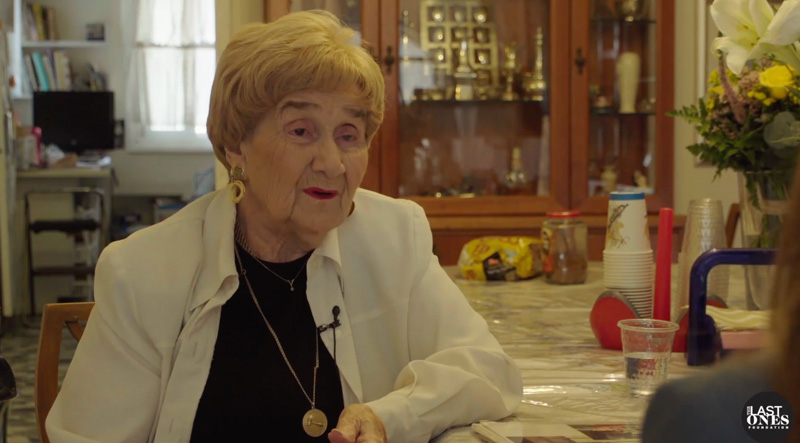
Narration: Today I’m in Jerusalem visiting a remarkable woman, Rena, at her home. She was born in 1935 in Potco, a small town in Poland, where nearly half of the residents were Jewish. Throughout her life, Rena was protected by several consecutive women whom she called her mothers.
Leslie: Hello.
Rena: Oh, how are you?
Leslie: I’m Leslie.
Rena: Hi there.
Family & Photographs
Leslie: How many pictures do you have?
Rena: Well, put it this way. I don’t have enough pictures, but I have four children, 22 grandchildren, and 41 great-grandchildren. She has six children. The second one, she has five. He has five.
That’s me when I first came to America. These were my parents.
Leslie: You still have pictures? You managed to take pictures of your parents?
Rena: No. No, I shouldn’t have said that. Yes, these are my parents. They’re my adopted parents. I don’t have any relatives from the war.
Adoption After the War
Narration: After the war, Rena was adopted by a woman who had just lost her own daughter.
Rena: So, she gave me the daughter’s name, and she was born in Germany and her birthday, and I became that child. So my passport in 1946, when I came to the United States, said that I was born in Germany and my name was Fanny Phillips, and that’s the birthday I used till now.
I was very much ashamed of being adopted. I also was embarrassed about being an only child, and I was going to tell them that I had two brothers. And how do I prove I had two brothers? I couldn’t prove anything. I just knew it. In 1981, I found proof.
Returning to Poland
Narration: Rena decides to return to Poland to investigate the traces of her past.
Rena: I found my home. I found the Polish woman living in the house. I found my birthday, my brothers’ birthdays, my brother David and Joseph. I found my parents’ marriage license, and I found out that they were married by a very famous rabbi by the name of Rabbi Meir Shapiro. I was really scared of going back, but in 1981 I found that I was really born. I mean, it’s an amazing kind of thing.
Life in the Ghetto
Narration: Rena was able to piece together the early chapters of her life.
Rena: I was outside with my mother and my brothers. There were bombs and tanks coming in. Soon after that, they made a fence around the Jewish section. We lived in the Jewish section because my mother had money. I found this out because I found her prenuptial agreement. Maybe she was able to trade shoes, jewelry, a coat, or something like that for food.
Many people in the ghetto starved. It was very crowded. They took my father and my uncle. They were taken to a glass factory where they were slave laborers. You were lucky if you were taken to work because then you wouldn’t be taken to other places. There were rumors going around that the Nazis were killing people, that there were gas chambers.
Deportation & Separation
Narration: Rena, her mother, and her two brothers survived in the ghetto until 1942.
Rena: One night in the middle of the night, they were banging down the door and German soldiers came in really fast. “You’ve got 10 minutes to pick up whatever you need.”
We ran down terrible stairs. People fell on top of each other. It was pandemonium. People were crying. We were brought into this big square. Two thousand people were gathered around. From there, we were beaten and chased and herded like animals until we got to the synagogue.
It was a big room, but it couldn’t hold 2,000 people. The ones who couldn’t get in were taken into the forest. They were shot into those graves. I was in this room with my mother and my brothers. There was shooting going on. There were beatings. They were throwing babies. I’m six years old. My brothers are eight and nine-and-a-half. I am quite sure we were holding tightly onto my mother because we were scared.
I don’t know how it happened. There was a door in the back, and there was a man there, and he beckoned to me and said, “Run.” I ran out.
Leslie: And that saved your life.
Rena: That saved my life. But I never saw my mother and my brothers, aunts and uncles, all those people again. All were exterminated at Treblinka extermination camp.
Living as a Boy
Narration: Rena’s savior took her to her father, who came up with a plan to keep her alive.
Rena: He said, “From now on, your name is Freyam, not Freda. You’re 10 years old.” Boys over the age of 10 could work. Girls were useless. He found some clothes for me. He cut my hair. I wore a hat. I had to become a boy.
Leslie: For how long were you a boy?
Rena: The whole time we were working in the glass factory. I was bringing water. They needed water to cool the glass and for the men to drink.
Deportation to Germany
Rena: The doors were slammed shut in these terrible cars meant for animals. There was nothing to eat, nothing to drink, and no toilet. Finally we crossed from Poland into Germany. We jumped into the snow and ate the snow because we were so hungry and thirsty.
My father knew that when you go into a camp, you have to undress for showers. He realized I couldn’t go with him because they would know I wasn’t a boy. He met a schoolteacher and asked her to keep an eye on me. He gave me pictures of our family and promised to meet me in our hometown after the war.
He promised. He didn’t keep his promise. I never saw him again.
Bergen-Belsen & Liberation
Rena: I didn’t have a father anymore, but I had a new mother. We got to Bergen-Belsen. Just like my father predicted, we had to go into the showers. I was holding onto my pictures. One of the soldiers thought maybe I had diamonds or money. He pried open my hand and threw the pictures away like garbage. That’s why pictures are very important to me.
One day I was very sick. Then soldiers wearing different uniforms came in. They said: “We are the British Army. We have come to liberate you. You’re free.”
I couldn’t get up. They put me on a stretcher and took me to a place with beds and sheets. I hadn’t had sheets in years. In 1945 I had typhus and diphtheria and high fever. Now I even have my hospital records.
Leslie: That’s amazing.
A New Life
Narration: Rena was adopted in Sweden and lived there for over a year. She later moved to the United States with her adoptive mother, and was then welcomed into another family.
Rena: At the age of 10, I became Rena. My adopted American parents gave me the name Rena, which means joy. They gave me a lot of love.
Leslie: How many mothers did you have?
Rena: At least six that I can identify. Every woman who took care of me gave me some protection. But the mother I got when I was 10 years old lived to be 100 years old. She became the grandmother to my children. So I had a family. Most survivors don’t. When I say “my mother,” it confuses people. I don’t say “my adopted mother.” I say “my mother.”
Building a Life After
Leslie: Is it easy to build a life after everything you’ve gone through as a kid?
Rena: I think I’m proof that it is. I had a wonderful husband for almost 60 years.
Rena: (Reading notes from her husband) “Oh my love, you bring meaning to my life. I thank Hashem that you are my wife. Love forever.”
Leslie: Oh my God. And you had these on a daily basis?
Rena: Oh my love forever. These are old. There we are. These are all my kids.
Leslie: Thank you so much, Rena. Be well.
Rena: Thank you. Be well. Nice having you. Bye-bye. Come again.