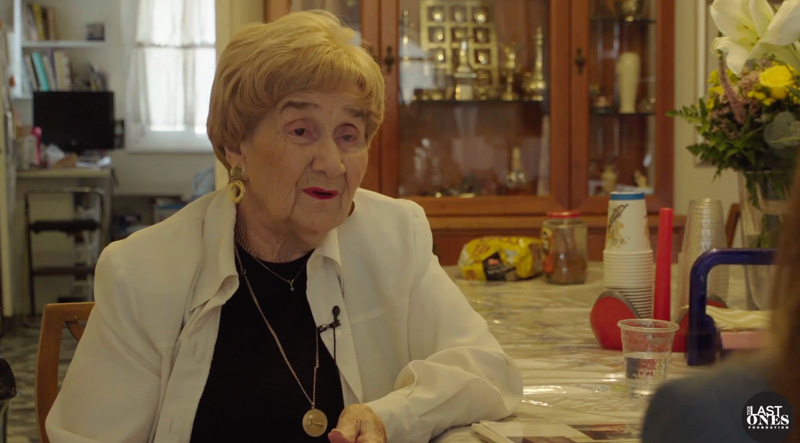
Hope Through the Darkest Days
An Interview with Jerry
Editorial draft prepared from supplied automatic captions. Speaker labels are inferred from context. Bracketed text and passages marked “caption wording uncertain” require audio review. Gaps in the caption file have not been reconstructed. Narration reflects the supplied captions and has not been independently fact-checked.
Meeting Jerry in Jerusalem
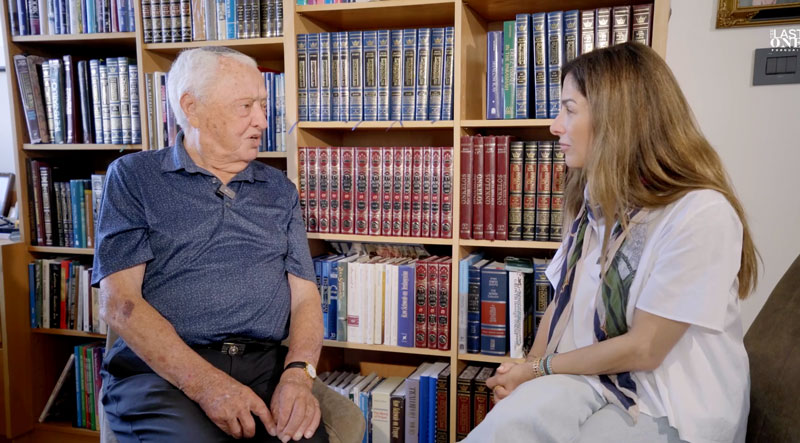
Narration: Today I’m in Jerusalem to meet Jerry. He was named Gedalia at birth on February 22nd, 1929 in a small town called Majdan, in what was then Czechoslovakia. He was the 11th of 13 children.
Interviewer: Shalom! Hi, Jerry! So nice to meet you. Thank you so much for having me here.
Interviewer: I brought you a little something. It’s a lekker. We need something sweet. Right?
Unidentified speaker: Hello. How are you? I’m Leslie. Very nice.
Unidentified speaker: Sharon. You’re a Sharon?
Interviewer: Look at this! You installed everything so you can sit and enjoy the view.
Jerry: That’s the Knesset over there.
Interviewer: The Knesset?
Jerry: Yeah.
Interviewer: Gorgeous.
Unidentified speaker: We can enjoy the view.
Narration: At 97 years old, he recently left the United States and moved to Israel to start a new chapter of his life.
Childhood & Education
Jerry: My father was Pinkus and my mother was Hinda. My father had a business in the town that supplied the old area with food and old things that is needed. I was going to public school and then in the afternoon I went to Hebrew school. The thing that I like most is going through the lake and the area that we lived.
Jerry: It’s all mountain area. I feel that it was a very happy childhood. Very, very happy childhood until [unclear wording] ’39. They got to Poland and all other countries, but they didn’t get to Czechoslovakia till ’41. [Unclear wording] the country was no more Czechs anymore because the part that we lived… So we were supposed to be Hungarian.
Jerry: When in 41, when they came in and they with the new schooling, I didn’t go. I did want to go to public school.
Interviewer: How old were you when you decided not to go to school anymore?
Jerry: Twelve years old. I was 12 years old. My father decided to send me to Khost in the big city where my other sisters lived. I should learn for the bar mitzvah coming up.
Detention & Life at Home
Jerry: I was there for about three months, and then I coming home for Pesach, and on the middle of the way they stopped the bus.
Narration: So this was around Passover of 1942.
Narration: The bus Jerry was on with several of his Jewish friends was stopped and all the Jewish children were taken off and detained. Jerry was lucky. His family business happened to be right across the street from the police station. And through connections, his family managed to get him released.
Narration: The others weren’t so lucky. That day marked the end of his education. For the next two years, Jerry stayed home, afraid of being caught and deported by the Czech police.
Jerry: I stayed at home. And I stayed from ’41 to ’44. I did nothing, [unclear wording].
Interviewer: Just inside the school, sorry, just inside your house all day?
Jerry: In the house I was in the store, and [unclear wording], was on the grounds. We had lots of land because we did not live in a downtown area. They moved us.
Deportation to Auschwitz
Narration: By 1944 the Czech authorities, now under Nazi control, were carrying out the deportation orders. And this time, Jerry was taken with his entire family on a journey with no return, packed into a cattle car, destination unknown.
Jerry: We were taken to Auschwitz, Poland.
Interviewer: Who from your family was with you in the cattle car?
Jerry: In the cattle car? Everybody. All brothers, sisters. All.
Jerry: But we got to Auschwitz. There was a Dr. Mengele, as we were coming out of the train, he pointed who’s going to the left, who was going the right. to the camp.
Jerry: The right is going to…
Unidentified speaker: The gas chambers.
Jerry: My sister and my brother, the two younger ones, they were walking with me. They sent me to the gas chamber. When I got about 10 feet before the door, I see nothing but children or older people. Something told me and I got up.
Jerry: I left them. And I went running to the back of him and ran into the camp.
Narration: After the selection at Auschwitz, Jerry was sent into a line leading to gas chambers. Somehow, just before reaching the door, he managed to break away from the line and run into camp.
Jerry: But then we were separated once we got into the camp.
Life in the Camp
Jerry: We got the tattoos right away. When we get into camp, he had to get undressed in the barracks. And we took showers, they took everything away, and we had the striped jacket and striped pants, that’s it, and a pair of wooden clogs.
Interviewer: Do you remember your number?
Jerry: Yes, 8640.
Interviewer: Do you remember how to say it in German?
Interviewer: You don’t have it anymore? And the fact that it happened exactly there… And they [unclear wording] your number and it’s gone?
Jerry: Yes, it is gone.
Narration: Inside the camp Jerry says they were treated like animals, like cows. And although his father had survived the selection, Jerry had no way of seeing him.
Jerry: My father came into Auschwitz in the Camp and he was assigned in a kitchen.
Narration: Eventually, Jerry’s father, mother, and four of his siblings were sent to the gas chambers.
Jerry: In the morning we probably got up in daylight. First we have to stand up for the counting. And once we were checked, and then the foreman took us to our place where we worked. I was taught how to lay bricks, so I was a bricklayer.
Jerry: In the morning we got a coffee and a slice of bread with a little margarine. Lunch, we had a soup where we worked. And then [unclear wording], we had supper, sleep, work. That’s it.
Jerry: [Unclear wording] was not very hard for me.
Interviewer: You had hope or something that you were hanging onto, because again, I never heard anybody that positive.
Jerry: I just went along with what things they were doing. If you want to live, you can’t be scared. You have to be strong.
The Death March & Other Camps
Narration: With the Third Reich crumbling and the Soviet army closing in, the Nazis began evacuating Auschwitz. Thousands of surviving prisoners were forced to march west, away from the advancing Soviet troops. Jerry was among them in what became known as the Death March.
Interviewer: At night during the march, where would you sleep?
Jerry: On the ground.
Interviewer: In the snow?
Jerry: In snow. Yes.
Interviewer: And you had something to eat?
Jerry: [Unclear wording], I don’t remember. I do not remember eating anything. But the March, March was not very long. Maybe two, three days.
Jerry: Not more, not a month, you know.
Narration: Jerry marched for days through the freezing cold. He remembers walking through a forest where there was no grass left, not even bark on the trees. Other prisoners had already eaten it to survive. Eventually the march took him to Buchenwald and there even the work that had somehow kept him going was gone.
Jerry: [Unclear wording] no work, just to stay there.
Interviewer: And the hygiene?
Jerry: Not as good as Auschwitz.
Narration: That alone says a lot about what Jerry endured during those few months at Buchenwald. From there, he was sent to yet another camp, Dora. But somehow, through it all, Jerry never lost hope.
Hope & Faith
Jerry: I kept my hope all the time.
Interviewer: Did you lose your faith?
Jerry: No.
Interviewer: Do you still believe in God?
Jerry: Yes, I believe in God because it’s because of God that I’m still alive. He’s the one that told me to run over there. He’s the one who kept me going.
Liberation & Building a New Life
Narration: Jerry was liberated by the Russians in 1945. From there, his journey took him through Budapest, England, Israel, where he fought in the War of Independence, and eventually to the United States. In 1954, he met the woman who would become his wife. They married just two months later and went on to build a family together.
A Message for the Next Generation
Interviewer: Any lesson that you want to share with this young generation?
Jerry: The lesson, I would say, be kind to everybody. Be generous.
Interviewer: When you see anti-Semitism everywhere right now.
Jerry: That hurts.
Interviewer: Did you ever think that you would see this in your lifetime again?
Jerry: Oh, I didn’t think so. I didn’t believe it was going to happen again.
Interviewer: How can we teach the young generation to be more empathetic to others, to not reproduce what happened before?
Jerry: I don’t think you can [unclear wording]. It’s going to be what it’s gonna be. That’s it.
Interviewer: Let me ask you this, Jerry.
Jerry: Yeah.
Interviewer: Is it not too hard to talk about the past?
Jerry: It is hard because of my throat.
Interviewer: But it’s not too hard on you?
Jerry: No. No, I’ve done [this] many times.
Interviewer: You know what you did today? You gave me a lot of hope. Because… You know why?
Interviewer: I can tell that even in the worst situations, you were always able to stay super positive. And I think this is a great lesson. So you be well. Oh, you know what I was told in Yiddish?
Interviewer: Okay, so. Thank you so much. Bye-bye.