Knowing How to Survive
An Interview with Erika
A Visit with Erika
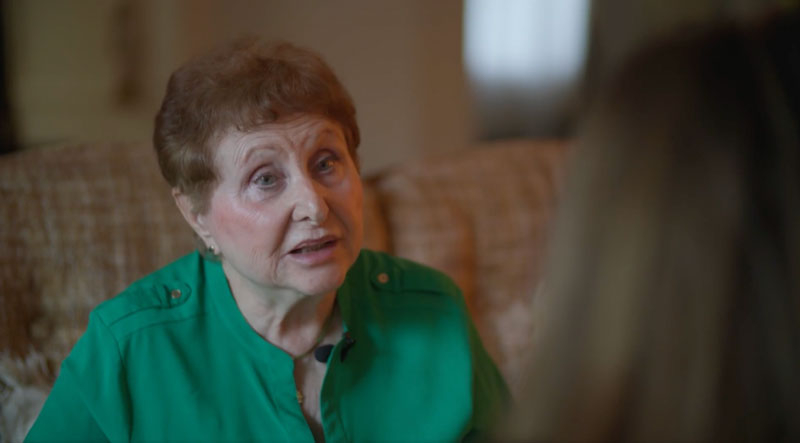
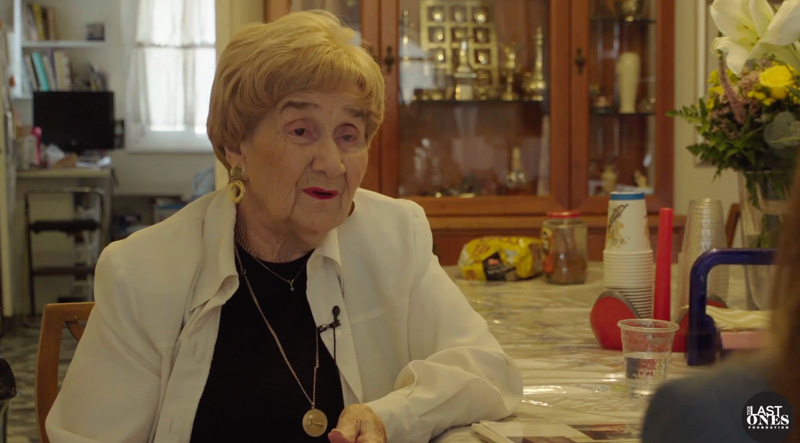
Leslie: Today I’m in Los Angeles to meet Erika. She was born in Hungary in 1940 into a religious Jewish family. She grew up alongside her sister Judith, who was three years older.
Leslie: Hi, Erika. How are you?
Erika: Good to see you.
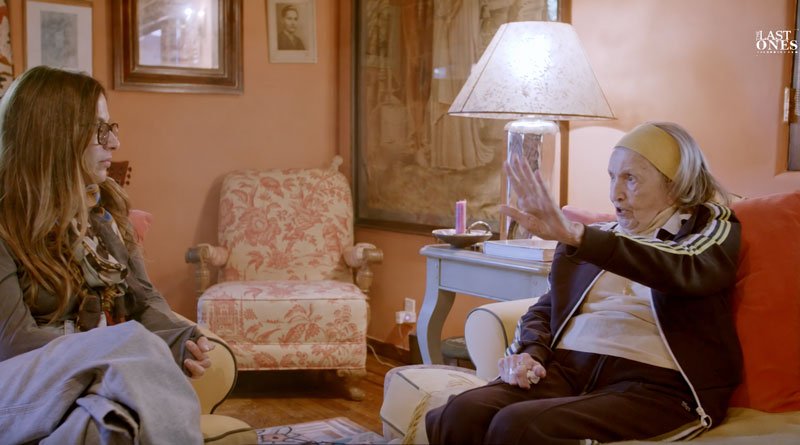
Leslie: What a lovely home you have. I mean, it’s gorgeous here. I brought you a little something.
Erika: Oh, good.
Leslie: Usually I bake them, but I’m not home, so it was hard for me to bake it, but it’s a babka.
Erika: Wonderful. Thank you. I want to show you the books I wrote.
Leslie: Show me. I follow you.
Erika: And let me take you over here. I’m going to move Buddha over.
Leslie: Oh, that’s Buddha?
Erika: That’s Buddha.
Leslie: You name him?
Erika: No, actually I bought him with the name already.
Leslie: Oh, okay.
Erika: And he was a real dog.
Leslie: For real?
Erika: Yeah.
Leslie: Oh.
Erika: He was a Hungarian sheepdog.
Leslie: Uh-huh.
Erika: And I bought it the year my husband died. Because this is a big house, I felt kind of alone. And then one day he ran across the street and a car hit him. And my older son said, I’ll have him taxidermied for you.
Leslie: I just never heard of a story like this.
Erika: Of course not. No. You gotta be little.
Leslie: You’re very special. So show me some of your books here.
Erika: Okay.
Erika: From here, all of this is my writing, my books. I love to write.
Leslie: Have you written a book about your own story?
Erika: I just finished writing my first 16 years of life. And not willingly.
Leslie: Why do you, what do you mean not willingly?
Erika: But my son, I had a very tough childhood. And my older son asked me to write it for his kids. I survived Nazi persecution. I survived communism. I had a tough childhood.
Family Life in Budapest
Leslie: There was happiness at the beginning of Erika’s childhood. The two sisters grew up in a beautiful apartment in Budapest. Their father ran a construction business.
Erika: My father was a very Orthodox Jew. For example, he wouldn’t let my mother use any lipstick. Good women didn’t wear makeup. This was like in the late 1930s.
Erika: The Hungarians actually sided with the Germans from the very beginning of the war. So Jews became pariahs. Jews were herded into ghettos. My father was taken into forced labor camp when I was three years old, so I have no actual memories of my father.
Erika: And we moved from our fabulous apartment in, like, the Beverly Hills of Budapest to another place a few blocks away that was designated as only for Jews.
Danger at the Door
Leslie: When they were forced into the ghetto, the two young girls quickly faced real danger.
Erika: Somebody was trying to break the door, so my sister and I both ran into my mother’s bedroom and said, Mommy, Mommy, they’re breaking the door down. We have to open. And Judith jumped out of bed and grabbed my mother’s legs and said, don’t open the door.
Erika: She was seven. She just knew. She knew.
Erika: But then we heard this loudspeaker saying everybody downstairs and get dressed and bring a day’s food and come downstairs. Finally, the kicking of the door stopped and my mother and my sister stood there like two statues and we didn’t go.
Erika: So anyway, we get to the door and there’s a shadow on the window. And we just froze. And then we hear this man’s voice and he says, Mrs. Fabian, I’m your neighbor. Open the door. I want to talk to you. He must have been the one Christian in the building. She opened the door and he said, I was the one who told the Nazi that you had gone already.
Leslie: Wow.
Searching for Safety
Leslie: Erika and her sister were nearly deported, but managed to escape. Following the advice of a neighbor, their mother took them to a refuge for displaced families.
Erika: We arrived at this safe house. That night, about, I don’t know, 4 or 5 in the morning, we heard a loudspeaker next door. We said, hand over your safe passes. You’ll get them back in the morning. We need to count how many people are here.
Erika: And my mother said, we’re not handing over our safe passes. We don’t know who the hell these people are. So we got up early in the morning. And I don’t know, I usually, when I give talks, I joke about it because I almost stepped on somebody and started to giggle.
Erika: And my sister, I was more afraid of my sister than my mother, leaned over and whispered in my ear, shut up or I’ll kill you. So I shut up real fast, and we went outside, and it started to snow. And it was very cold, and we had no place to go.
Leslie: She then decided to seek help from a doctor, a friend of their father’s.
Erika: He said we could stay at the Red Cross in the middle of the city. They had a hospital, and we could stay there, provided we could say we were sick.
Leslie: Oh, OK.
Erika: So they accepted us.
Taken from the Hospital
Leslie: Leaving the girls behind, their mother went to get forged papers from a former household worker.
Erika: I do remember the nurses coming in very early in the morning and bringing soup and bread and saying, eat your bread, drink your soup, put your shoes on, and everybody has to go downstairs, sick or not.
Erika: We went downstairs and there were all these soldiers in black uniforms, Hungarian Nazis. And when everybody who could be was out of the hospital, they said, Start walking.
Erika: And we walked from early morning, the light came up around 10 or 11. The light went off at two o’clock. We did not stop. We were told to march. And we knew that there were some kids who couldn’t do it. They were really sick. They were sent to the back of the line, and we heard gunshots. So we knew that they were shot because they couldn’t walk.
Erika: And finally, we got to a building. The next thing is that I heard my name. And there was a Nazi standing in the open door of this huge room full of kids. And I whispered to my sister, He’s wearing a Nazi uniform. Let’s not go. He’s going to kill us.
Erika: And my sister said, Don’t be stupid. We’re the only ones he’s calling. Get up. So We go outside. He says, these kids were brought here by mistake. Here are their papers.
A Rescue in Disguise
Leslie: The man who picked them up was actually a Jewish actor dressed as a Nazi.
Leslie: At this point, when you’re coming out, you don’t know who this Nazi is.
Erika: He said, don’t talk. We’re going to get on different streetcars. Just come with me. Don’t talk.
Reunited with Her Mother
Leslie: He brought Erika and Judith to an apartment arranged by a family friend where a surprise was waiting.
Erika: So we walked in the building, we knocked on the door and the door opened and my mother was there. This always makes me cry. Just a feeling of relief.
Erika: So she took us in the room and hugged us. And when we collected ourselves, she taught us our new names. And she said, From now on, you’re Protestants, not Jewish. If you ever tell anybody that you’re Jewish, you’ll get killed and I’ll get killed.
Leslie: And what was the new name that you had to go by?
Erika: My name remained Erika because Hitler had a girlfriend called Erika, so that was a no-brainer. And the last name became Poyak, which is a very ordinary Hungarian name.
Liberation and Survival
Leslie: The family survived for nearly a year in hiding under false identities until the arrival of the Russian army. After liberation, Erika’s mother had the foresight to teach her basic Russian.
Erika: I would go out with my mother, see these Russian tanks, with Russian soldiers standing by the tanks because people surrounded them. And I would go over to the Russian and say [Russian word omitted from captions], which means bread. And they were so fascinated with me. The fact that I spoke Russian, I would say [Russian word omitted from captions], which is thank you.
Erika: They would give me bread and chocolate and fill the little bottle I was carrying with gasoline. So I would take it all back home and say, I’m earning bread for the family now.
The Loss of Her Father and Communist Rule
Leslie: Erika never saw her father again. He had been deported to Bergen-Belsen and died of illness at the time of liberation. The family then faced a new ordeal, a different kind of oppression.
Erika: From 1950 on, the worst terrorism in Hungary over communist rule. Everybody was terrified of everybody. Everybody lied about how they felt. It was a very difficult period when the communists governed the country in fear.
An Attempt to Escape Hungary
Erika: My mother decided we should go to America. And one fine Friday night, we took a train to a border town in northern Hungary. Then a man came across the Danube River to row us over to Czechoslovakia with a bridge above us where Hungarian border guards were marching into half the bridge. Slovak border guards were on the other half. So if they looked down and saw our boat, they’d shoot us.
Erika: So we went across the river successfully. And all of a sudden a flare went up and lit us up. And then we heard gunshots. We were blindfolded and told to stand in a row. And I reached out and I touched a wall. Now I knew from childhood that if you stood against a wall, you were going to get shot.
Erika: And I nudged my mother and I said, are they going to shoot us? And she said, if they do, we’ll just join your father sooner. I can’t tell you how that relaxed me. I accepted the fact that I was gonna now die, and that was fine.
A New Life in the United States
Leslie: They spent nearly a year in prison before Erika’s mother finally found a way to reunite the family in the United States in 1956.
Leslie: Your mom was extremely resourceful.
Erika: Incredibly. You know, I didn’t realize how brilliant she was until I started writing about her. And this is a 500-page book, and everybody who’s read it, all my editors, would say to me, Your mother was incredible.
Erika: She was my mother. I didn’t think she was incredible. She just did things.
Leslie: What do you think was the hardest thing for you to bear during the war?
Erika: fear of being killed, not of death, but of being killed.
Leslie: Over the years, Erika lived in several places. Peru, Chicago, San Francisco, Mexico City, Indonesia, and eventually Los Angeles. In the US, Erika built a full and creative life as an actress, writer, mime, and dancer. She married and had two sons.
Leslie: Erika, thank you so much for taking the time for me today. You really had a crazy life. I mean, sincerely, it’s like, wow. If there’s one thing you want me to remember.
Knowing How to Survive
Erika: Just make sure that you know how to survive. And do the other thing is, of course, is always doing life what makes you happy because nobody else is going to do that for you.
Leslie: I love it. Erika, thank you so much. Be well.
Erika: Thank you.
Leslie: You’re doing what you’re doing because obviously You look great.
Erika: Thank you.
Leslie: Thank you.
Speaker unconfirmed: Thank you, bye-bye. Bye.