She Gave Me Life Twice
An Interview with Anita
A Visit with Anita
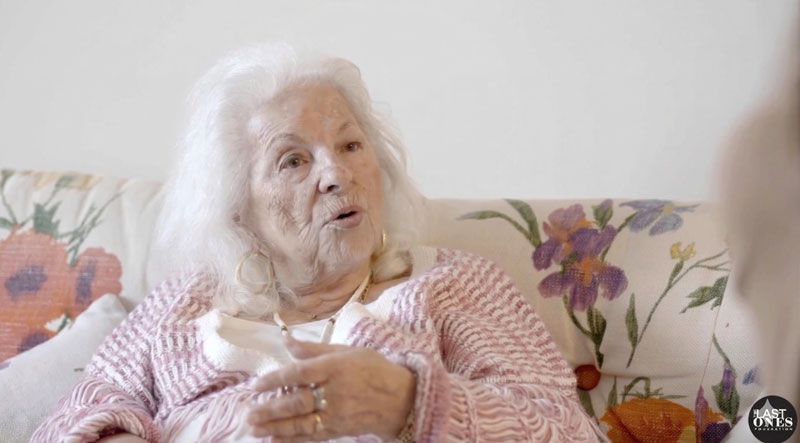
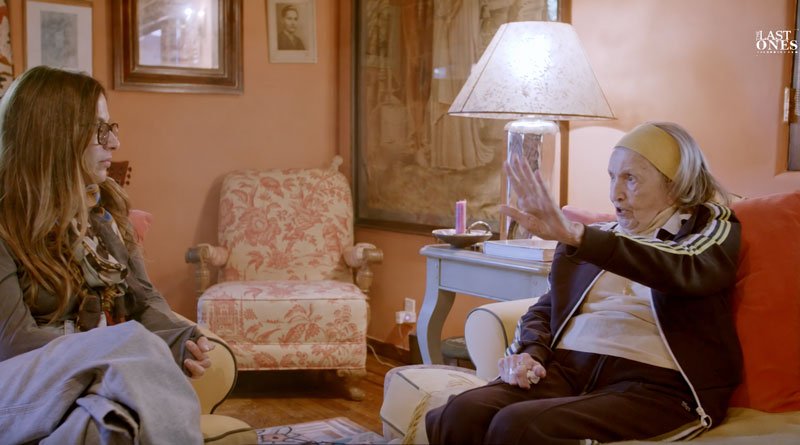
Narration: Today I’m visiting Anita. She was born in 1938 in Lvov, Poland, which has since become the Ukrainian city of Lviv. I baked, especially for her, a typical cake of her childhood.
Leslie: So good to meet you. I wanted to tell you, I brought you a little present that I baked this morning. It’s a lake.
Anita: Thank you so much. My mother also taught me how to do it, and I do a very good one also. Next time I do it for you.
Leslie: Thank you so much. So you said your mother taught you?
Anita: Yes, my mother taught us, the three sisters, how to bake and how to cook and be good housekeepers. So I guess we learned.
Leslie: Bala buste.
Anita: Bala buste. That’s what it is. Yes.
Leslie: You have a picture of your mom?
Anita: Yes, I have a picture of my mother that I would like to show you. Here she is with Golda Meir.
Leslie: Show me. Oh my God, when was that?
Anita: This is done in the 50s in Lima, Peru.
Leslie: Well, how did you manage with your mother and your two sisters to arrive in Peru after the war?
Anita: Because my uncle was the doctor to the president of Peru. Through those channels, he was able to get the visa for us to come to Peru.
Anita: My mother was a very courageous woman. She was She was a strong, loving mother who would not be a bystander, who got up and said, I will not accept the murder of my daughters. I will do whatever is necessary to save them.
Leslie: Is she the reason why you’re here today?
Anita: And she is the reason why I am here, because she not only gave me life once, but she gave me life twice.
Leslie: So now we are going to face. Well, I feel a little bad now that you told me that you’re super good at it.
Anita: No, no, no.
Childhood and the Lviv Ghetto
Narration: Anita grew up in a prosperous Orthodox family. She is the middle of three daughters.
Anita: We were three sisters. But the youngest one never was able to enjoy the house, because the next day after she was born, we had to go to the ghetto. We were moved by the Nazis to the ghetto, and our house was looted and everything of value was taken away. I recall walking, holding on to my mother’s skirt on one side, my oldest sister holding on on the other side, my youngest sister baby in arms of my mother, and my father carrying two little suitcases.
Anita: I remember a room that we were assigned where there were all three other families already in there. And we got a corner with one mattress on the floor.
Leslie: For five people.
Anita: Yes. There were no facilities in the apartment. You had to go walk on a corridor until the end of one bathroom for the whole floor in this building. Rundown, poor neighborhood.
Anita: My life as I knew it disappeared completely. I was tossed into a different world, a strange world, where there was killing, cruelty, where there was no respect, where there was abuse, where I had to wear a yellow Star of David, which gave them permission to harass us, to persecute us.
Leslie: When you say them. When you say them.
Anita: The Germans.
Leslie: They were in the ghetto?
Anita: They were in the ghetto.
Anita: The ghetto was immediately surrounded by barbed wire. So there was 100. 150,000 Jews that they brought, not only from Lvov, but the surrounding cities, villages, staples. From the 150,000, only 200 survived, and I am one of them.
Persecution and the Loss of Her Cousin
Anita: There were rumors, people heard things, but nobody expected, nobody imagined what was going to happen to us. Nobody imagined the anti-Semitism that would grow to such extent. The desire of the Germans to exterminate the whole people was unimaginable.
Anita: The cruelty that they displayed, the hatred, the persecution, and the way they dehumanized us was impossible to imagine.
Anita: One day, I was sitting with a cousin of mine and playing. She was a little older than I. Probably, I was four years old or something like that. And we’re sitting on the street in this corner playing in the dust. And an officer, a Nazi officer, a German, comes by, looks at us and says, Would you like this piece of chocolate? Can you imagine? We opened our eyes big. Chocolate. I didn’t even know what anymore what chocolate was.
Anita: We both got up, and we ran to him. My cousin was faster than I, and she got there before me. He picked her up, sat her on his lap. With one hand he gave her the chocolate, and with the other one he took out his revolver and shot her in the head.
Anita: Is this a human person? This is a boy of 20-some years, maybe less.
Leslie: And your cousin, she was five years old.
Anita: And she was five years old. She dusted himself off. She fell on the floor. He walked away without as much as a– where was his humanity? Where was his heart, his feelings? How can a human being do that?
Leslie: What was the name of your cousin?
Anita: The name was Ruja.
Leslie: Ruja.
Leslie: And she was five years old?
Anita: And she was five years old.
Leslie: Did you understand right away what happened?
Anita: I realized that she was dead, and I ran away with so much fear. I was completely out of control. I ran to my mother, I cried, I didn’t know What was going on and why? Why? What did she do wrong?
Escaping the Ghetto
Narration: The Germans decide to empty the ghetto and have no intention of keeping the children alive.
Anita: In the ghetto, the Germans, when they came with their armies, the officers, they brought with them their German wives and children. But every day, they came to visit their husbands. I had long, long hair, blonde braids. I was really very Aryan looking. My mother also, as you can see in the picture, she had a very tiny nose.
Leslie: Fair skin.
Anita: Yeah, fair skin, green eyes. So my father and my mother made a plan that my mother would mingle. with these women and children and walk out of the ghetto.
Anita: And in order to succeed doing that, my father could not come with us. She promised that if we were successful, she would somehow…
Leslie: Find a way.
Anita: Find a way to get him out of the ghetto. And so the next day, We — she dressed us, she combed us, my braids. And we mingled at 5 o’clock, I don’t know what time, and we left the ghetto with these women.
Anita: And we walked to the train station, and my mother boarded the first train.
Leslie: Without any papers?
Anita: Without anything, without knowing where it was going. We got on the train, and we left.
Anita: And she sat next to a woman, and the train stopped at many stations. And at the first station, my mother said she was getting off the train to get milk, and if the woman would take care of the children and look at the bundles.
Anita: And my mother took five or 10 minutes, and she was back. And suddenly, she starts to move the bundles, and she says to the woman, Where’s my purse? Remember, I left my purse here with the bundles and my children. Where’s my purse?
Anita: And the woman said, Look, I don’t know where the purse went. I know you left everything in my charge, but there were so many people coming and going, somebody must have taking your purse.
Anita: So, my mother started to cry hysterically. You know, all my documents are in the purse. And she cried and screamed, and the woman said, Calm down. I will tell them that your purse was stolen. So, my mother had an alibi. She had not only an alibi, but she had a witness.
Leslie: Who felt bad?
Anita: Who felt bad? She thought it was her fault.
Anita: Because of her fault. So, when the conductor came and the Nazi checking the IDs, the woman gave her testimony, and she said, I know, I saw, I was there, I’m here. And so they let us go.
Life in Hiding and Her Father’s Scarf
Narration: Her mother has managed to obtain fake papers for all of them. She rents a small house and finds a job that allows her to feed Anita and her sisters. A few months later, her father also manages to escape the ghetto, but the children should never know that he’s hiding in the house.
Anita: One day I was very sick. And so they thought I was really not going to make it. I was going to die. My temperature was way high. I was already half delirious, so my father came. He came to me. He sat with me during the night, and he held me in his arms, and he took off his scarf, and he put it around my neck.
Anita: And the next day, I got better, luckily, and obviously. And I asked my mother, Who is this wonderful man who sat here with me, held me, and kissed me? And my mother said, You were delirious. There was no one here. You dreamt that there was I assure you there was no one. But I had the scarf.
Anita: Do you want me to show you the scarf now? I have it.
Leslie: You have the scarf?
Anita: I never saw him again, and I still have it now. And it’s really very… it’s falling apart, you see. That is the only thing that I have from my father.
Leslie: And that’s the last time you saw him?
Anita: And this is the last time I saw him.
The Loss of Her Father
Narration: Faced with the advance of the Russian troops, the Germans decide to evacuate the villages by force. Her hidden and undocumented father cannot escape from the village of Bucac.
Anita: My father said, look, I have lived already my life. He was 33 years old. Take the children, save the children. Let them be one day witnesses to what this horror that rained upon us. And, hopefully, I will survive, because the Russians were only a few days away. They were coming a week. In a week’s time, they would be in Buczacz.
Anita: And so we went on this march, my mother and the three of us. And my father was left behind, but he was found The next day, they found him. And he was taken to the forest, and he was made to dig his own grave. And he was shot with the last 30 people, 30 Jews that they found.
Anita: I don’t know where he lies, and I can never take flowers even to his grave. This is Samuel Carl.
A New Life in Peru
Narration: Anita, along with her mother and sisters, walk all the way to Krakow. When they get there, the Russian troops are already at the gates of the city. They have to get back on the road and begin a long journey from Krakow to Berlin. With the help of an uncle, they manage to obtain a visa for Peru.
Anita: Later on in my life, she married my mother. And he adopted us legally.
Leslie: Wow, I didn’t know that. Okay, so I forgot that part that he’s coming from a very religious family, which is technically what you’re supposed to do in a religious family.
Anita: Exactly. And they had for 25 years a beautiful life together.
A Message for Future Generations
Leslie: Wow, you have a lot of pictures here, too.
Anita: Yeah.
Anita: My daughter, my son, all of these are my grandchildren. This is my duty in life, because through…
Leslie: But a duty towards whom?
Anita: To humanity and to our history. trying, of course, that this would never happen again. Humanity must learn that there are other ways to settle our differences, not through bombs, not through killing.
Leslie: So what do you think about what’s going on today in Ukraine?
Anita: It is a very, very sad picture, because I am afraid that they have not looked to the past, and they are having a history that repeats itself.
Leslie: Anita, I mean, honestly, thank you for all your wise words for the life lesson, for the tears that came out of my eyes because I usually don’t cry.
Anita: You are very, very welcome and I am so happy that you came. and that this is going to be a project for the next generations and everybody will be able to see it and I hope learn from it.
Leslie: Thank you so much.
Anita: You are very welcome.
Leslie: Thank you so much, Amita.
Anita: Bye-bye.