Look at the Exceptions
An Interview with Celia
A Visit with Celia
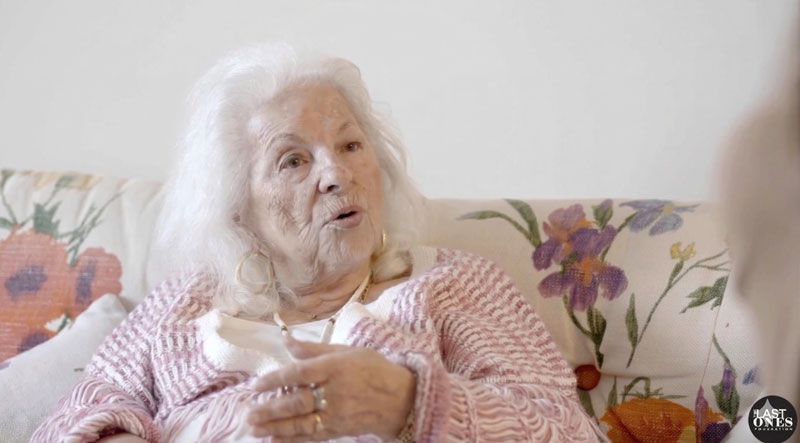
Leslie: Today I’m in South Florida, and I’m going to meet Celia. She was born on December 1, 1935, in Lviv, Poland, today Lviv, Ukraine.
Leslie: Good morning to you.
Celia: Good morning.
Leslie: Thank you for having me here.
Celia: It is my privilege. Thank you.
Leslie: Thank you. This is a little something for you. It’s a babka.
Celia: I love babka.
Leslie: You have a very nice house.
Celia: Thank you.
Childhood Before the War
Leslie: Celia was an only child. She grew up in a close-knit household with her parents, aunt, uncle, and cousins. She remembers a joyful childhood until the war shattered her world.
Celia: This is delicious. This is like the old-fashioned babka.
Celia: Before the war, we did not live in a luxurious style. My parents had one large room. I slept on a couch. I played in the backyard of the house where we lived, and it was a backyard that we shared with a Catholic school. When I went out to play, I was with those children. I spoke like them. I looked like them.
The German Invasion
Leslie: Celia recalls the German invasion in 1941, when the Soviet army was pushed out and a violent pogrom began.
Celia: At the crack of dawn, the Germans invaded.
Leslie: Mm-hmm. Sorry.
Celia: My biological daddy was drafted into the Russian army. I was devastated. The following day, I ran out to the backyard to be calmed and soothed by my friends. But these friends, they turned on me. They didn’t want me to come near them. Much like if you have an unruly dog, they were pointing at me.
Celia: Someone like a guard grabbed me by my hair and pulled me to the front of the house. There’s a truck, and my eyes are focusing on the bed of the truck. There are children behind a chain, and they’re crying and vomiting.
Celia: As I’m going up there, I turn to the guy guarding the truck and I say, “What am I doing here? I didn’t do anything. How would you feel if your children were here?”
Celia: He pulled me down and said, “I’m letting you go this time, but if you want to live, do not come back in the daylight hours. You won’t be able to get away like I’m letting you.”
Celia: By the time I came home to my mother, who was crying and hysterical, she was now mourning my father and my death. No one came back off these…
Leslie: Because she thought you were gone.
Celia: I was gone.
Life in the Ghetto
Leslie: In 1943, Celia and her mother were forced to move into the ghetto with other members of their family. Her mother was sent to work in the Yanovska camp. Celia stayed behind with her aunt, uncle, and cousins.
Celia: Mom isn’t there, and my aunt and uncle do everything they can to keep me calm and happy. Occasionally, I play outside with kids. We’re playing, and all of a sudden one is lying down, and I would shake them: “Get up.” But they weren’t lying down as part of the game. They were sick or hungry. They never got up.
Leslie: Dead.
Celia: Dead.
Left Alone During a Raid
Leslie: As in all ghettos, the liquidation operations followed one after another.
Celia: The people who were offering the hiding for this particular [raid] said, “You two and your two children can come, but not her,” meaning me.
Leslie: Why not you?
Celia: “This is going to be a long raid. There is no light, no food, no bathroom. What will a child do?”
Leslie: They’re scared that you’re going to cry and give away all the others.
Celia: My aunt was torn, but she said, “Celia, this will probably be over in the morning. Here’s a blanket. You see the ruins nearby of that house that was [unclear in source]. Cover yourself with the blanket. In the morning, when the raid is over, we will find you, and we’ll be together again.”
Celia: Did I like what I had to do? No.
Leslie: And you were left alone.
Celia: As night went on, I could hear a gunshot or a person screaming, meaning they were found or they were dying. But eventually, I fell asleep. I think I’m dreaming because I hear footsteps. The footsteps come closer, and a voice rings out: “Celia, Celia, if you’re here, if you can hear me, we won’t see you anymore.”
Celia: My aunt, my uncle, my cousins, and all the other people who were hiding—I never saw them again. I wasn’t allowed in. I’m alive, and they’re gone.
Shelter with a Polish Family
Leslie: Left alone in the ghetto, Celia survived by caring for children in exchange for bits of food. Eventually, her mother found her and managed to hide her with a Polish family outside the ghetto.
Celia: The woman opens her arms, embraces me, and brings me into the house. They told me the following: I am never, ever to wear shoes in the house. I am never, ever to go near a window. I am to sleep and be downstairs unless they permit me, when we’re eating, to be upstairs.
Celia: They had no children. Now I have a mommy and a daddy, and I had a grandma and a grandpa, and I love my life.
Celia: One morning, I got up and shuffled upstairs with my bare feet. I see the picture window, and my family is facing the window. My grandmother—[name or term unclear in source]—heard me shuffling and ran quickly to cover my eyes, but it was too late. What I saw, what they were looking at, were two adults and two children hanging by their necks outside the window.
Celia: They closed the curtain, sat down, and explained to me that this was what happens to people who save Jewish children. “We’ll have to work out something because it’s very likely they’ll come and search our house.”
Finding Her Mother Again
Leslie: The Polish mother now decided to keep Celia hidden from the rest of her family, in the barn, where Celia soon discovered she wasn’t alone.
Celia: There emerges this skeletal, unkempt woman, and she’s whispering names like parents would call you “sweetie pie,” or whatever. Who do you think that was?
Leslie: Your mom.
Celia: The guards who worked in the camp where Mom worked liked her, and they told her that the camp was going to be liquidated. “If you have anywhere to run, go now. Go now.”
Celia: One time, we heard something like thunder—a grenade or a bomb fell, but not where the family was sleeping. She said, “You see, God is repaying me for saving two lives.”
Celia: If we had been found out, all of them would have been killed. But she did… when the war was over. [Incomplete in source.]
Reunion and a New Life
Leslie: After liberation, they returned home and received a letter from her father, who had deserted the Russian army.
Celia: All of a sudden, he comes off the plane and wants to embrace me.
Leslie: And you don’t know him.
Celia: I don’t know him until he pulls out the original photo. [Unclear in source.] That was what brought and built my life back.
Leslie: After moving through several displaced persons camps, they immigrated to the United States in 1949 and settled in New York City. Celia was fifteen when her baby brother was born. She later married and raised three children. Years passed before she began to share her story.
Sharing Her Story with Future Generations
Celia: I realized how important it was for kids to hear my story so that they know it’s real. Yes, there is so much antisemitism, but look at the exceptions. Look what a non-Jewish family did, so that I survived, so that my parents were able to see grandchildren, and I’m able to see grandchildren and great-grandchildren.
Celia: Hopefully, it’ll be something worthwhile, and that the children…
Leslie: It is worthwhile. Thank you very much, Celia.
Celia: Of course. Be well. Take care of yourself.
Leslie: Okay. It’s a pleasure. [Unclear in source: “I’ll speak with you, will you?”] Thank you. Bye.
Celia: Bye, honey.