The Last Branch of the Tree of Life
An Interview with David
A Visit with David
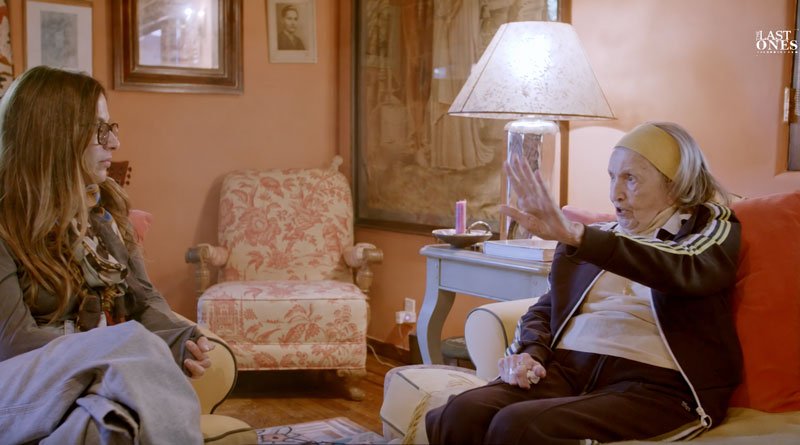
Leslie: Today I’m in South Miami visiting David. As his wife Sydney hinted to me, his story is quite heavy and David has a hard time talking about it.
Sydney: Hi.
Leslie: Hi, Sydney. Nice to see you again
Sydney: [Unclear in captions.] My husband, David.
Leslie: Hi, David. It’s nice to meet you. I’m very drawn to that picture.
Leslie: This photo of the joy that was captured at the liberation is far from reflecting what the end of the war looked like for David.
The Tree of Life
David: Next to our house in uh Slovakia was a [unclear in captions] tree, named in the Bible as a [Hebrew term unclear in captions] a tree of life. That tree of life had 105 branches and each branch was for the name of a member of our family.
David: And in the end, there was only one branch left, me.
Deportation from Slovakia
Leslie: David had a brother and two little sisters. But after the war, he could not find any pictures of any member of his decimated family. The whole family lived in the wine growing region of [place-name unclear in captions]. His father was arrested in 1940 and sent to a labor camp. In 1941, the Slovak Nazi party deported the rest of the family.
David: The trains came. They started to load us into the cars. You couldn’t put more than maybe 50 people and they would put in as many as 80. Most people tried to sit. There was no way to sit. There was no way to lay down. It was only standing up and falling on top of each other.
David: We were in this cattle car for over two days. They put in two buckets of water for 80 people.
David: Yeah. I remember my mother crying. I remember Jacob trying to comfort us all. Approximately 25% of the people in the cattle car when they arrived in Auschwitz were either dead or dying.
The Loss of His Mother and Sisters
David: But my mother kept the two girls at her side.
David: She was walking. She was made—she was driven. They were pushing them and beating them to walk toward those pits, those holes. Then they were [unclear in captions: reference to machine-gun fire], and they were falling into these holes. We could hear it. We could hear it, and it never stopped.
Surviving Auschwitz with His Brother
David: Almost very much immediately after that, they came the what they called appel and someone yelled out to Jacob that I should stand on his two feet so I’ll look bigger. And I remember Jacob was like lifting me up and put me on his two feet.
Leslie: How old were you?
David: I was 11 years and 8 months old. That was before they were showered, our heads shaved before we were tattooed.
David: [Unclear in captions: David recites his tattoo number in German.]
Leslie: because you have to know it in German.
David: [Unclear in captions.] And I was here and here.
Leslie: What was a day in Auschwitz?
David: A day in Auschwitz was [unclear in captions]. Up in the morning, six o’clock in the morning, and then we’d march to work at least two to three kilometers.
David: My responsibility and Jacob’s responsibility was to work on the axle of the cars. We had to clean the wheels and the axle and then put the grease.
David: I would go to pick up those goddamn canisters of the grease and the son of a [word censored in captions] would hand me one that was twice as big and that uh that I’d have difficulty in carrying and maybe fall and get killed. And Jacob knew that he went ahead picked the type of of grease that uh was in smaller canisters
Leslie: for you to carry.
David: Yeah.
Leslie: Thanks to the help of his older brother Jacob, who was then 15 years old, David managed to survive 18 months in Auschwitz. Their commando had to clean at a hectic speed the cattle cars in which more and more deportees were arriving every day.
Forced Labor at Buchenwald
Leslie: They were then sent to Buchenwald to do the same work. David remembers well the daily trip between the camp and the town of Weimar where the cars to be cleaned were located.
David: And we would walk early at 6:00 in the morning. The people would come out of their homes with their [term unclear in captions] pot. They would keep on their beds at night to relieve themselves and they would throw it in our faces. Those were the people of the intelligencia. That’s how they treated us.
David: And now it’s 1944. The Germans are now aware they’re losing the war. For us, it’s actually worse because now they have to quick quick kill and kill more than they they uh than they had the capacity to kill. So they go ahead and poison the pipeline of water. And we knew godamn well that we could boil the water and we might not die.
The Loss of Jacob
David: and I’m uh working and I’m looking for Jacob and I don’t see him under under under the car and I look for him and I saw him. He’s at a water fountain and he’s drinking the water. And I screamed and yelled at him, but he’d already drunk the water.
Leslie: He didn’t know it was poisoned.
David: He did. He did.
David: And next morning we’re marching to work and he’s weak and he can’t walk and he can’t walk but he has to walk and he can’t walk and falls and I can’t pull him up and I can’t stop because the bastard [unclear in captions] guard is pushing his gun in my head and I let go of Jacob and Jacob lays dead
David: and then within about 10 20 seconds later I hear the sound of a gunshot and I knew that they shot him on the ground and I Never saw Jacob after that.
David: Maybe Jacob felt that I can survive without him because he said to me that he didn’t want to live anymore.
Escape and Liberation
Leslie: The Nazis then decided to send David’s commando by train to work in another camp.
David: All of a sudden, the train was being bombed by the Allied [unclear in captions] American Air Force. The train is on fire and it stopped. I managed to jump out of the car and I was running into the forest and I was in that forest for more than eight days.
David: And then I was spotted. One of the soldiers was a Czech. And then he helped me and picked me up and carried me to the to what they called a field hospital.
Leslie: At the end of the war, David, who was then 15 years old, weighed only 83 lbs. He was the only survivor of the 105 members of his family. He was placed in an orphanage in Prague and remained there until the age of 20.
A New Life and a Lasting Memorial
Leslie: David was then taken by the Jewish agency to study in the US. There he met his future wife, became an engineer, and had a career in industry.
Leslie: In 1989, with other survivors, David founded the Holocaust Memorial in Miami Beach to honor the memory of his family and the 6 million Jews who were murdered.
Keeping His Story Alive
Leslie: Really, thank you for taking the time. Thank you for sharing your story. I told you I will make your story I’ll make sure that your story told way after you after me. Thank you so much.
David: You know what we say… [Unclear in captions.]
Leslie: Okay.
David: Okay.
Leslie: Thank you.
Speaker unconfirmed: Bye. Thank you. Bye.