Remembering Her Family
An Interview with Denise
A Visit with Denise
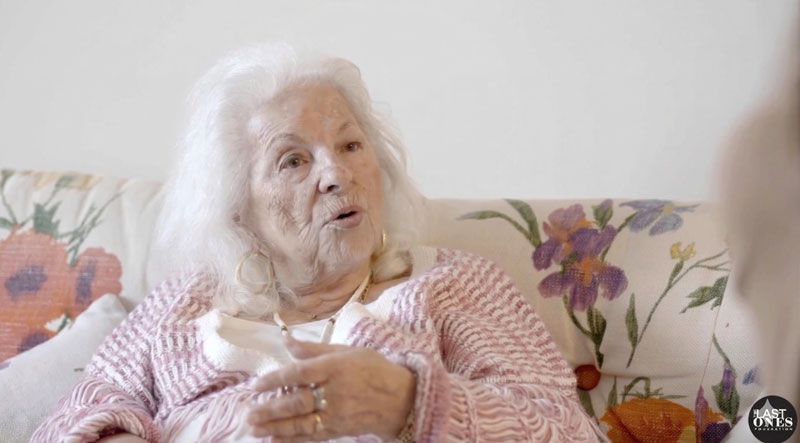
Leslie: Today I’m braving the freezing cold of Montreal to visit Denise. She was born in 1938 in Paris into a large family.
Leslie: Bonjour, Denise. How are you?
Denise: I’m fine.
Leslie: I’m Leslie. Nice to meet you.
Denise: Nice to meet you too.
Leslie: How are you?
Denise: I’m fine. I’m okay.
Leslie: I brought you a little something. I brought you a little babka.
Denise: Yes.
Leslie: Here we go.
Denise: Thank you very, very much.
Her Mother’s Resourcefulness
Leslie: I’m sorry. I’m, like, going straight to this. You kept this?
Denise: Yes. So it had to be put like this. Now, it had to be sewn. And my mother, who was a seamstress, she was smart. She put snaps.
Leslie: Oh, so you could remove it sometimes.
Denise: Right, and she was told that’s a no-no.
Leslie: Who’s this?
Denise: Those are my parents.
Family Life in Paris
Leslie: Her parents, Perla and Michelle, were both originally from Poland, but they met in Paris. Denise remembers the birth of Monique, the youngest of the six children.
Denise: In 41, the Jews were not allowed to go to the hospital. It was forbidden for the Jews, so my sister was born at home.
Denise: I remember all the kids were in one room, and we opened a little bit the door. My view was clear because I was shorter. So I saw the midwife come and go. But I do remember very clearly the baby crying.
Speaker unconfirmed: OK. And whoa, chocolate [unclear in captions], beautiful. Okay.
Her Father’s Arrest
Denise: My life at home changed when my father received [unclear in captions: reference to a summons]. It’s in May 41. That was the first big roundup of the Jews, male, only males at that time.
Leslie: Her father, Michelle, reports for the mandatory summons and is sent to the Pithiviers camp, but he manages to obtain temporary release permits.
Denise: Whenever the pass—the three weeks passed, my mother took us the six children with the baby and we went to Orleans because that’s where the Gestapo was sitting. Now, we are the six children, beautifully dressed, and we come in the office of the Nazi and he looks very agitated. and tells my mother, your husband has to go back to Pithiviers. That’s it, I’m not giving you any more prolongation.
Denise: So my mother begs him, what is she going to do with the children and so on. Anyway, he’s red in his face and he tells her to go and the baby start to cry. So what happens when a baby cry? Well, we all cry, the six children, we all cry. And we are scared.
Denise: And my mother gets even more scared. She puts the baby on the table, and she says, Without my husband, I cannot take care of that baby. And he’s so startled, he makes such a face that first he signs a extension to the pass.
The Family in Hiding
Leslie: After his last leave, Michel decides not to return to the camp. In the apartment where the family lives, an uncle, an aunt, and two nieces also come to hide.
Denise: All of a sudden, there is a big bang on the door, and here in comes a civilian and two French policemen. And they come and the civilian has a paper in his hand. And he’s coming to pick up my aunt and her oldest daughter, Cecile, because Cecile was born in Poland.
Denise: And my mother’s brother was there. They came for him as well because the wife had been taken. They knew there is a husband.
Denise: And then the German turns to my father with his finger, and who is this? So my mother says he’s a friend. And I’ll never forget that because the German has a rictus, you know, a little mean smile.
Denise: And he says to my mother, when your niece comes back from the market, brings her to the police station, in the meantime, we taking your friend. with us, and when you bring me your niece, we’ll give you back your friend.
Separation and Fear
Leslie: The exchange never happens. Michelle, Nathan, and Ellen are deported to Auschwitz, leaving Perla alone with eight children.
Denise: So throughout that time, we were very scared. We hung to my mother like she was, like we were grapes.
Denise: For example, when there was bombing, So the four youngest children, we would jump in our bed. So my mother is in the bed. I am on the right foot. My sister Mireille on the left. The baby is on the right hand, arm, and my brother Fernand on the left.
Denise: I held that foot throughout the war That was the only thing that could make me secure was that foot and remembering how it was soft and how I held it like this.
Hidden on a Farm
Leslie: Denise’s mother then decides to hide the children on a farm. But the family who takes them in does not do it out of kindness.
Denise: My mother had to give all the coupons
Leslie: They rescued you because you were bringing them money?
Denise: Yes, and also labor, free labor.
Denise: For example, where my brother, he said something one day and Madame Baillon gave him a big smack and she told him that he was a dirty Jew.
Denise: I had my other brother used to wet his bed and she beat him up every day with a stick. who were not fed enough.
Denise: And one time, my sister Isabel sent a postcard, and she wrote in Yiddish,. I’m not well.
Denise: So they come, and my mother, what does she give them? A glass of milk and some cookies, some crumbs fall on the floor, and [name unclear in captions] goes flat on her stomach and licks all the crumbs. Can you imagine my mother, how she felt?
Baptism and Life in a Convent
Leslie: Perla eventually manages to place the children with another family.
Denise: That time, the peasant that we were with, they started, our guardians got scared. The Germans were frantic. They were searching every house, every place to find Jews, more Jews. So they asked my mother to be baptized. And I remember my baptism very well.
Denise: Yes, it was very beautiful, actually, because I remember my sister Monique, because the Catholic Church They put water on your forehead and some salt on your tongue. And when she got the salt, she went like that. So I remember her. So we were baptized. I have my certificate.
Leslie: The girls are then hidden in the convent of Saint-Domain [convent name to verify].
Leslie: So you’re learning the—
Denise: I’m learning Abraham and Joseph and Isaac, Jacob, all those beautiful stories. And I’m I can tell you, I love those stories. I absolutely love those stories. I was taken by that, the pageantry, the smell of the incense. I liked everything about the church.
Reunion and Jewish Identity
Leslie: Denise stays there until 1948. The three sisters finally reunite with their mother, who has since remarried.
Denise: There is my mother. We see her, we see our siblings. To me, they’re all strangers. It’s been too long since I have been in contact. And I see a man, and effectively it’s her husband, Monsieur Brennaire [name or wording unclear in captions].
Denise: And my stepfather calls us and he tells us, Bring me everything you brought from the convent. Anyway, Monsieur Brenner takes all that, tears it up, throws it in the garbage. He tells us, now you have to learn that you are Jewish, no more Catholic, and from now on, you are going to go to a synagogue.
Denise: Then we went to learn Hebrew and Jewish stories.
Denise: Something funny happened at that time, something so funny. They started telling me the story of Abraham and Jacob and Joseph, all the beautiful stories. So then I said, really, there is something wrong. How can it be a Jewish story and a Christian story?
Denise: So then that’s when, at the age of 10, that I said, no more religion. It makes no sense. Many people ask me, are you Jewish or are you Christian? So I tell them I am 100% Jewish, because denying that I am Jewish would be denying that my father died for any other reason.
Remembering Her Father and Mother
Denise: We found out later on, as soon as they arrived in Auschwitz, my aunt and uncle were gassed. And we thought for many years after the war that my father had had the same fate, but no, he died when Auschwitz was going to be liberated. And when they emptied the camp, So during that march, he was killed.
Leslie: The death march.
Denise: The death march. He was killed six days before liberation.
Denise: I lost my mother also. When I came back to Paris, I never reconnected with my mom. I never, this leg that I cherished so much during the bombardment disappeared. It never was there.
Denise: I am sad to say that I felt the connection only when she passed away.
A New Life in Canada
Leslie: In 1956, at the age of 18, Denise joins a cousin who immigrated to Canada. Shortly after, she marries Milan, and together they have three children.
Denise: Every time It really makes me very emotional, and I am sick every time the night before, and I have stomachache. It’s very emotional, but it passes. I’m very glad that I was able to do that.
Leslie: Okay, thank you.
Leslie: Thank you so much.
Denise: Thank you.
Speaker unconfirmed: Bye-bye. Bye.