Staying with Her Sister
An Interview with Hedy
A Visit with Hedy
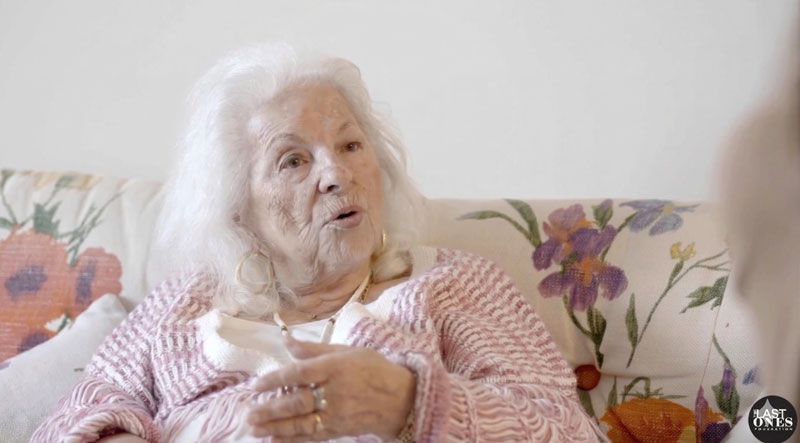
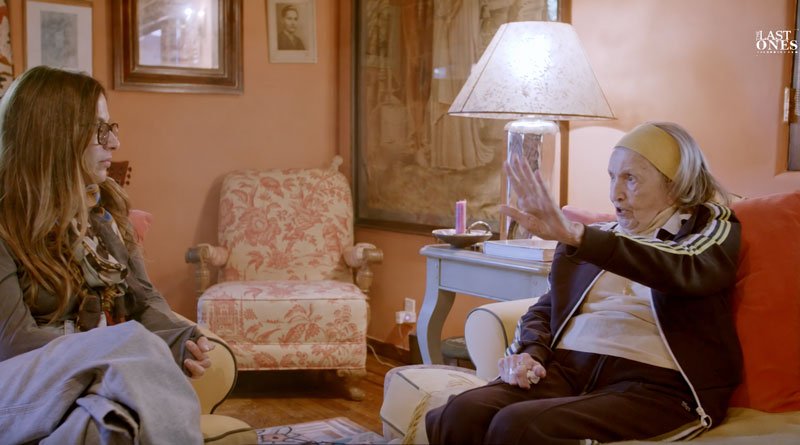
Leslie: Today I’m in Florida, and I’m going to visit Hedy. She was born in Romania in 1931. Hedy grew up in a poor family of four children.
Leslie: Hi, Hedy. How are you?
Hedy: Hanging in all good like old people.
Leslie: Why old people? How are you? It’s so good to meet you.
Speaker unconfirmed: [Unclear in captions.]
Leslie: I brought you a little something.
Hedy: Why should you bring me something?
Leslie: I baked this for you. It’s a [cake name unclear in captions].
Hedy: Oh.
Leslie: what are all those pictures? I love seeing the pictures on the
Hedy: This was the [unclear in captions] pictures.
Leslie: That’s you as the queen.
Hedy: Yeah, that’s me.
Hedy: This is the picture when I first came to America.
Leslie: And you came right after the liberation. So you you were liberated from Auschwitz?
Hedy: Yeah. No, we had I have gone away from Auschwitz.
Leslie: Gone away.
Hedy: I Well, it was And if you want to hear the story,
Leslie: of course.
Hedy: You want me to start from the beginning?
Childhood and Rising Antisemitism
Leslie: Her father leaves for the United States in the 1930s, hoping to make a fortune. Life is not easy for young Hedy, especially as the first signs of anti-semitism begin to appear.
Hedy: We heard
Hedy: some Jewish guys were uh beaten up and then looting started breaking into the Jewish businesses and looting everything, broken windows and stuff like that. And when we called the police, the Hungarian police were worse than the Nazis. Then
Hedy: they made us wear the Jewish armor enemies, the Jewish star on their but Oh, it was a bend. Okay. And they said anybody caught with that add it will be severely punished. And then they made it the curfew 6:00. Any Jew found in the streets after 6:00 will suffer the consequences.
Confined to the Ghetto
Hedy: Then after all that they formed a ghetto. Several ghettos in the city and they collected all the people around the city and the neighboring towns. and the ghetto, one of the ghettos started on my side of the street. They boarded up our windows and doors and we couldn’t get out front. A few months
Deportation to Auschwitz
Leslie: later, she is deported with her mother and sisters to an unknown destination.
Hedy: And they put in in one cattle car about 100 people with hardly room to sit. Not I mean this was a plain wooden floor and they put a in the middle they put a bail of hay and a bucket of water and the hay was our bathroom.
Hedy: Anyway, this went on for four nights and a lot of people did not make it. Infants didn’t make it because they didn’t have milk and mothers didn’t have the milk to give them and elderly people they never were dying in the cattle cars in the cattle cars. They died.
Hedy: So after 4 days it was at night time when we arrived in Auschwitz. So they told us to disembark and leave all our belongings and just put get in line. So mothers tried to get the food out. So whatever was left so that she could feed the children and they would hones German shepherds and with their whips millions of soldiers all around they would whipped anybody that went to get something and sometimes they whipped people so hard they couldn’t even get up
Hedy: and we were very scared very scared we didn’t know then we came to a platform where Dr. Mengele and the soldiers would put their hands on the people and he would he had a stick in his hand and he would motion to the right and to the left. People to the right. They he picked the young ones to go to the right because they needed work through throughout Germany.
Crossing Over to Her Sister
Hedy: So I was picked to go to the left with my sisters and my mother. Only my sister was picked to go to the right, my older sister, cuz she was [age difference unclear in captions] older and she was fully developed and she looked healthy and strong. Then I looked at my sister and I said, “Ma, Pearl’s crying. I’m going to go get her. We should all go together. Why should she be alone?”
Hedy: And with quite a bit of hardship till I got across cuz those German shepherds were jumping and barking and with their teeth and there with the whips. So after a few tries I got across and I got a hold of my sister and I said to her come let’s go back to mother we’ll all go together why should you go alone
Hedy: to no avail there were we were not able to get across after several tries then we looked across and we couldn’t see my mother anymore so I said to my sister you know what pearl let’s stay here let’s get into any trouble look what’s happening We’ll catch up with them later.
Leslie: The two older sisters never see their mother and younger sisters again.
What Hedy Remembers
Hedy: All those people that went to the left was stripped naked, herded into the gas chambers and in they told them they were going to get showers. There were thousands of showerheads in there and instead of water uh gas came down.
Hedy: Those people with the mothers with the crying and seeing their children without any breath and then dying and everybody died. Every 25 minutes, 2,000 people died in that gas chamber. But there [unclear in captions] couldn’t accommodate all those dead people. There were too many of them. There were mountains and mounds of [unclear in captions] bodies laying in the streets.
Leslie: You you saw them.
Hedy: I saw I then they made our men uh build mass graves and they threw all those bodies that [unclear in captions] couldn’t accommodate into the mass graves one on top of another and then they spilled the dirt and I saw all that. I saw them throwing babies and children and mothers and young mothers and fathers and all and just cover it up with dirt afterward.
Survival and a Prisoner’s Advice
Hedy: Anyway, so then I remained with my sister on the right. All those people that went to the right were taken to a place. You were stripped naked. You were examined of any bad things, rashes or stuff like that. And your hair was cut off completely, shaved off in the
Hedy: morning. They woke us up at 6:00 in the morning and they told us to line up. And then there were a lot of soldiers and dogs. They picked groups. They gave me a broom and a shovel to clean the streets. And as I walked, I met up with a guy. He was a Polish guy. In Poland, they took him very early. So he he looks at me and he goes like that. In Yiddish, [unclear in captions], my child, how old are you? I says, I’m going to be 13. He says, “If anybody asks you how old you are, do not tell them you’re going to be thirteen. Tell them you’re 17. You’re not going to survive otherwise.”
Hedy: Then he said to me, “You listen to me. I feel very sorry for you, but I have to tell you this.” He says, “Every day transport going out of Auschwitz to make room for the new people.” And he says, “If you can get on one of those uh transports, you’ll survive, maybe.” As
Hedy: I’m sweeping and going and the streets back and forth, I saw a truck and a soldier came over. The soldier was calling out names to go on the truck for women. And I put my broom and my shovel on the side and I walked up on the truck.
Forced Labor and the Death Marches
Leslie: After only two weeks in Auschwitz, she manages to escape and is assigned to cleaning duties in a [unclear in captions] soldiers barracks. Hedy remembers the visits from the soldiers families.
Hedy: It was unbelievable. They used to come sometimes in a Sunday to women with children to put, you know, to to take pride in what they accomplished to the camps to see us.
Leslie: Oh, they would bring their own wife.
Hedy: Yeah. to see right and then the little children and they would even the children would say look at us pig Jews the little kids would yell you there you so they were all 100% with Hitler
Leslie: she is then sent on what became known as the death marches
Hedy: winter was horrible we didn’t have the proper clothes and German the snow days all year long. They don’t shovel them or plow the streets and people with very little shoes, holes in the shoes and uh no proper uh clothing or whatever. One
Hedy: day we heard the German German women shouting, “The Krue is ended. The Krue is ended, the war is over, the war is over.” And we got to a rail a road and all of a sudden I saw the American tanks and jeeps come down the road.
Reunion and a New Life
Leslie: Hedy spends 2 years in a camp before miraculously finding her sister. Together they reunite with her father who is still living in the United States. She marries Henry and they have two children.
Sharing Her Story
Leslie: I promise you that I’m going to make sure that a lot of people listen to your story. Yeah,
Hedy: you better make sure that they understand the three mastermind that were responsible for the 6 million Jews. He gave me great pleasure to talk about it cuz I love to talk about it anywhere I go.
Leslie: It was my pleasure. It was my pleasure to meet you.
Hedy: Thanks for listening.
Leslie: Thank you. Thank you, Hedy. Thank you.
Speaker unconfirmed: Bye-bye. Bye.