Living with the Memory
An Interview with Leon
A Visit with Leon
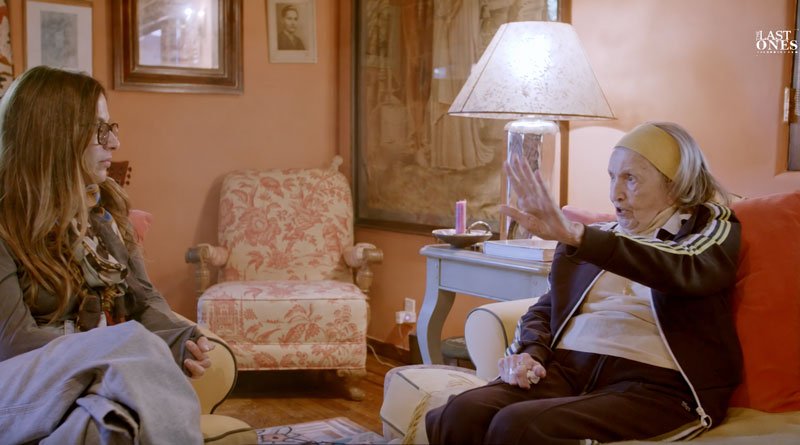
Leslie: Today I’m in Florida and I’m going to visit Leon. He was born in 1926 in Poland in a small village not far from [place-name unclear in captions]. Leon lives alone. He’s a widower and at 100 years old, he has agreed to testify once more.
Speaker unconfirmed: Okay. Her name is Leslie. Okay. Hello.
Leslie: How are you, Leo?
Leon: I’m alive. That’s
Leslie: You’re alive. That’s good news. That’s that’s the most important thing.
Childhood and the Loss of His Family
Leslie: Leon is the eldest of six children. His father takes care of horses. His mother raises the children. He grows up surrounded by Catholic friends. But in his village in 1942, a first massacre of Jews takes place.
Leon: They executed the entire Jewish community from the town.
Leslie: How many?
Leon: [Number unclear in captions: “10. about that.”]
Leslie: they shot them.
Leon: Yeah, they shot him and certain people I knew.
Leslie: Shortly after his family is deported. Leon is not there.
Leon: They were deported. Not only my family, the whole vicinity, the whole town. After this, I was in prison and from the prison to the ghetto.
Survival in the Ghetto
Leslie: Leon is 15 when he is sent to the Tarnów ghetto.
Leon: I was alone in that time. I started to look different than meaning I tried to survive and and I said to myself, I have to look for job. I had a cousin. He said, you know, he said, Leo, you go, you need somebody has a horse in a in a in a buggy, but you’re going to have to drive around with the killers.
Leslie: Wow. So good. So you were a driver for the Gestapo and they knew you were Jewish.
Leon: Oh, sure.
Witnessing the Killings
Leslie: So they would sometime ask you to go to places where they would kill Jews in front of you?
Leon: Yeah. They took two girls.
Leslie: Mhm.
Leon: You know, they took him out for from a place and when I came to the cemetery, they told me to stop. They took took him down. They shot him. This sounds like this.
Leon: Three of over three and a half thousand people executed. Three companies companies SS special forces came in to execute.
Leslie: It’s what we called the the Shoah by bullets.
Leon: That’s right. The the mass shooting was on the synagogue which was the ruin. You know, the the new synagogue was uh destroyed. Mhm. So they were bringing even there to execute some.
Leslie: Did it ever happen to you that you had to witness someone you knew being killed?
Leon: My cous with the two children. They saw me, you know, and she was I will never forget. So she hold the head like this. She recognized me when they were taking her to shoot. It was a I I say, you know, but like a butchers. Yeah, butchers. T butchers. That’s
Deportation to Auschwitz
Leslie: He then spends a few weeks in the [camp name unclear in captions] camp before being sent once again to the train station.
Leon: We started to march to the train 3 kilome and we were undressed.
Leslie: What do you mean undressed?
Leon: To take everything.
Leslie: So you had to march naked for what? 3 kilometers. You said
Leon: 3 kilometers and it was liquidating the about 3,000 men, you know, 1,200 women. We all went undressed. The Ukrainian bastards were the worst, you know, Ukrainian special auxiliary for undressed completely n were loaded to the cattle cars outfit.
Leslie: How how long was the journey?
Leon: 3 days.
Leslie: Can you tell me about this journey? How many people was were they
Leon: over 100 in the car.
Leslie: Over 100 people in in each
Leon: car. Each car. Yeah.
Leon: And so no food, no water, no nothing. Well, we came there at night to the commercial station because the train didn’t go to out to Birkenau that they were sending one line. The guy was in binoculars, you know, high high command SS. Yeah. They asked me [German word unclear in captions], meaning profession?
Leslie: Yeah. What do you do?
Leon: [Words unclear in captions.] I clean the horse. I dress the horse. I sleep the horse and I bring it to the commandant to ride like this. Yeah. To the right. This was the selection. First thing we had to go for a shower.
A Number Instead of a Name
Leon: Mhm. and then give us the the stripe uniform. They give you the tattoo everything there 161744.
Leslie: So at this point this is your new new new place in your name. They teach
Leon: you how to march and you know what teach us how to carry stones. People were dying. You know, you walked around, you see people dying. I remember the from Holland, a transport from Holland came. 90% of them were dead when they arrived.
Leslie: Yeah.
Leon: Four gas chambers, two new ones, two old ones. So you see some of them went straight there. You know this.
Forced Labor at Auschwitz III
Leslie: Leon is then transferred to Auschwitz 3 a camp where deportees are used as free labor for German industries.
Leon: sent us out to Buna you know awitz three completely different a different I thought it’s a hotel can
Leslie: three was a hotel compared to
Leon: yeah because it was only 200 people in the bar the block masters were very strict to have the place clean yeah you have to go to the toilet everything cream you know you can you you get a work detail.
Leslie: So what was your work there?
Leon: So, so they find out for me [work-detail name unclear in captions] and then my German engineer was a very good man. You see a different he was a older man but he was he was installing the the tanks of of they were drawing gas from coals.
Leslie: Okay.
Leon: There I was working all the time and I was there until the liberation.
Leslie: So how long did you stay there?
Injury and Liberation
Leon: A year almost. Uh this was January 15. is the camp is going to be deported and you all have to be prepared and if you cannot go you go on the [word unclear in captions] because our road if you cannot walk you will be shot. I didn’t I said I cannot go to the blocker because of the hole in my neck.
Leslie: How did that happen?
Leon: the bombing the American bombing on 26th December 1944.
Leon: You see this how I remained in Buna and that’s how I was liberated. The Russian uh forces came about two hours later after well when they were all dressed in white you know I didn’t know I thought it was Germans they went [words unclear in captions] and they walked they took us out
Rebuilding a Life After the War
Leslie: he learns that he has lost his entire family he joins the Polish army trying to forget but the trauma is always there
Leon: It comes back in the dreams at night
Leslie: at night
Leon: and you miss a lot of things you know you miss you have no family you know you have to now start a new life and everything it was very tough
Leslie: he later leaves for Israel where he meets Betty a fellow Holocaust survivor they marry then move to the United states.
Leslie: You and your wife were both Holocaust survivors. Do you think this is why you decided not to have children?
Leon: The the damage was mentally too far. It was would be a big problem to
Covering His Tattoo
Leslie: What happened to your tattoo?
Leon: I I wanted to take it off off. Yeah.
Leslie: So you covered it.
Leon: So I the guy said I I have to cut the skin and take it off. So he says you’re better off to cover it. So he I cover it.
Leslie: And this is what
Leon: a panther.
Leslie: A panther. And why a panther?
Leon: because I I was in the army was the pent was the symbol.
Leslie: Leo.
Leon: Yeah.
Protecting His Story
Leslie: Thank you very much for taking the time to speak to me today.
Leon: Thank you um for coming.
Leslie: And I know I know it’s not easy because I know for days you think about it and everything.
Leon: It’s it’s it cannot be easy because you live with it.
Leslie: Yeah.
Leon: This is part of our culture and we should protect it.
Leslie: Count on me. I’m going to do that.
Leon: Good. Thank you.
Leslie: Okay. Thank you very much, Leon.
Speaker unconfirmed: Thank you. And you know what we say? [Yiddish farewell unclear in captions]. [Yiddish farewell unclear in captions] is good, too.
Leslie: I’m coming back.
Speaker unconfirmed: Thank you. Bye.