A Childhood in Shanghai
An Interview with Monika & Gitta
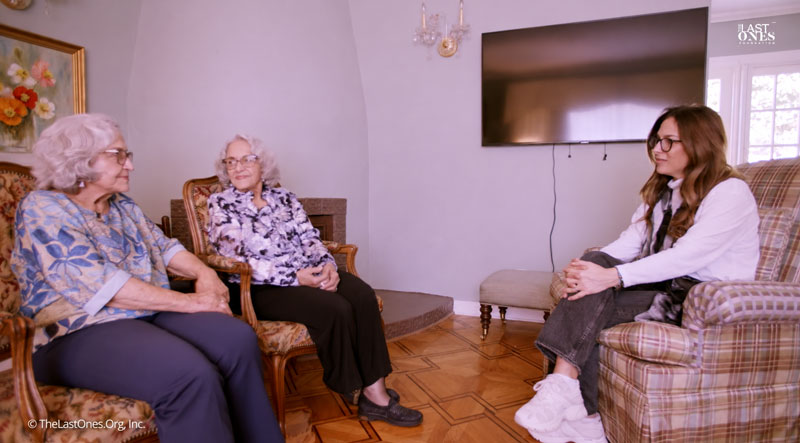
Meeting Monika & Gitta
Narration:
Today I’m in Los Angeles to meet twin sisters, Monika and Gitta. Their story of survival is unlike any other. Their mother, Estera, was Polish and their father, Eric, was German. As Nazi persecution of Jews intensified in Germany, their parents made the wise decision to flee, traveling halfway across the world in search of safety. It was in Shanghai, far from the growing danger in Europe, that Monika and Gitta were born in 1939.
Interviewer:
Hello. This is so special.
Exchange:
Can I have a double hug? You bet.
Interviewer:
Very nice to meet you both.
Introductions:
Who’s Monika? Who’s Gitta? – I’m Monika. I’m Gitta.
Interviewer:
It’s very nice to meet you. I have a little something for you. I should have brought two. It’s warmer than I thought it would be.
Monika / Gitta:
Thank you.
Their Parents’ Escape from Germany
Monika / Gitta:
We were born in Shanghai, China, in 1939, before the war. Our parents fled Germany. Hitler had already built five camps.
Monika / Gitta:
They weren’t concentration camps at the time. They were work camps, labor camps. And he had one goal in the 1930s: get the Jews out of Germany.
Monika / Gitta:
Well, what would happen was that if someone was with other people, they would say, “See that guy, John, over there? He’s a Jew.” And John would disappear. Off the street, from work, at school, at home – wherever someone was identified as a Jew, they would disappear into one of these five camps. That’s what happened to our dad.
Narration:
In 1937, their father was deported to Buchenwald because he was Jewish. His wife and family managed to secure his release by presenting a document called “Passage Out of Germany,” proving that he would leave the country, and also by paying a bribe.
Monika / Gitta:
1938, if you know anything about World War II history, was the year that no country in the world was accepting Jews, right? Thousands of ships were turned away, including in the States.
Monika / Gitta:
That is correct. Except China. Shanghai, as it had always been, was an open port.
Finding Refuge in Shanghai
Narration:
[Place name missing from subtitles] was one of Shanghai’s poorest districts. Yet between 1937 and 1945, this unlikely corner of the city became a refuge for thousands of Jews fleeing Nazi persecution. As borders closed and countries turned refugees away, Shanghai remained one of the few places in the world where they could enter without a visa. More than 20,000 Jewish refugees found sanctuary there, thousands of miles from home in a city they had never imagined would become their lifeline.
Childhood in the Shanghai Ghetto
Monika / Gitta:
Well, it became the Shanghai Jewish ghetto. Surprisingly, we have some pretty vivid memories, as young as we were. In these two-story buildings, every family got one room.
Monika / Gitta:
A room. We didn’t have a kitchen. We had a coal stove. No electricity or indoor plumbing. There were facilities for everybody outside, with huge, long sinks. Everybody got their water there. However, you couldn’t drink the water without boiling it.
Monika / Gitta:
We’re guessing about this because we never got a chance to measure the room, but from memory, it was probably about 12 by 15, maybe. Small. Yeah, very small and narrow.
Narration:
In [district name unclear in subtitles], refugees found a measure of stability far from the horrors unfolding in Europe. But survival in Shanghai came with its own hardships. Life was far from easy.
Hunger & Daily Survival
Monika / Gitta:
Food was hard to come by. Nobody sent food or money. I mean, people tried to help. Frankly, we have no memory of eating at all. Neither one of us could tell you what we ever ate, but we do know this:
Monika / Gitta:
It was not walnut shrimp or chow mein. I mean, it wasn’t Chinese food as we know it here. Neither one of us can remember anything about food.
Monika / Gitta:
Once the war started and we were in the internment situation, there was a soup kitchen. The adults would get together and combine their food so that there was something for the children to eat. We remember being hungry.
Monika / Gitta:
Yeah. Yeah, the whole time. And it got worse once the war started. It was harder. Less food. It was harder for the head of the household to find work.
Confinement under Japanese Authorities
Narration:
Life in [district name unclear in subtitles] was far less deadly than in the ghettos of Europe, but everything changed as Japanese authorities tightened their grip on the district, imposing increasingly harsh restrictions on its refugees.
Monika / Gitta:
Now the war had started. Everybody was coming out of their rooms and their buildings. We saw a wall of Japanese soldiers with guns. There were tanks. We can still see this. That was pretty traumatic.
Monika / Gitta:
They marched right into the ghetto, herded us all out of our rooms, and put us in a different part of the ghetto. We were confined. Interned.
Monika / Gitta:
Now we lived in a room with four other families. We were in a different part of the ghetto, within that one square mile, quite far from where we had been. We were somewhere else.
Monika / Gitta:
It wasn’t like there was a wall or a gate or anything like that. We were just herded into a smaller area. By now, there were 20,000 of us.
Monika / Gitta:
And we were all confined. There was no gate; nobody was standing there with guns. I mean, there were soldiers around, but there were no gates or fences or bars. Still, we were not free.
Monika / Gitta:
And we were crowded, very, very crowded. So we lived five families to one room, a little bigger than maybe the size of a small kindergarten classroom. And if you were lucky, and most people found a way, you would hang a sheet or a blanket to separate you from the other families. That’s the best you could do.
Monika / Gitta:
What did we have in there? A bed. A table. We barely remember. We used to sit by the window and look out, all the time.
Monika / Gitta:
All the time, when we were home. Because, God forbid the world should end…
School & Air Raids
Monika / Gitta:
If you’re Jewish, you go to school. School never stopped. There were a couple of schools built by wealthy Jewish families for the refugee children, and we went to one of them.
Monika / Gitta:
We were three, four, five years old. All the children were taught that if you were alone in the building, without adults, and the air raid siren went off, you ran to the windows and opened them. So if there was a bomb, the building wouldn’t implode. It would explode, right? And we learned that.
Monika / Gitta:
And then you would run to the middle of whatever building you were in, all of you, and we would huddle till the all clear.
Monika / Gitta:
One time, when we were in school, an oil refinery next door was bombed. All the glass came shattering into our classroom and along that side of the school. Everybody ran out into the courtyard, and the older kids came out and took care of us.
Monika / Gitta:
Our dad, who happened to be home in the ghetto, could see the flames from the bombing. So could the other parents, and they all came running to the school to collect the children.
Monika / Gitta:
And then we didn’t have school for a while. But yeah, there were scary times.
Their Mother’s Disappearance
Narration:
And those frightening times were also marked by even more dramatic events.
Monika / Gitta:
Probably the most traumatic thing that happened to us during the war was coming home from school one day and finding that our mother was gone. We were about five, so it was nearing the end of the war, but we were still in camp. One day we came home, and our mother was gone. No explanation.
Narration:
With their mother gone, school gave the girls a sense of normalcy.
Songs Remembered from Childhood
Monika / Gitta:
Even during the war, the school tried to normalize life. They had things like talent shows. Here’s what they did with us: they taught us songs from other countries, in other languages, phonetically.
Monika / Gitta:
We had no idea what we… We sang in Russian, Spanish, French, and English, phonetically. And to this day, we can sing three of those songs.
Conversation:
That’s what I wanted to add. No, we’re not going to sing them. No, but at least the words, without the singing.
Conversation:
Which one do you want to do?
Monika / Gitta:
It’s hard to do it without singing, right? We’ll try one. We’ll try one. OK.
Monika / Gitta:
Ichi nee cha la la. Haku chi chi chi chingla hako ya ya da go chi go wet. Chummy na.
Interviewer:
I love it.
Monika / Gitta:
That was our only interaction.
Memories of Their Father
Narration:
Through all the hardships and tragedies, the twin sisters and their father stayed close, creating memories that would last a lifetime.
Monika / Gitta:
We were very close to the Yangtze River, where the ghetto was, yeah. And every year it flooded into the ghetto, three feet high.
Monika / Gitta:
Wading through. We both have this really vivid memory of our dad carrying us, one on each shoulder, so we wouldn’t get wet. He got wet. I mean, we have lots of memories.
Life on the Streets & Making Ends Meet
Narration:
For all its hardships, life in the ghetto left the twins with stories and memories that would shape them forever.
Monika / Gitta:
People lived there, died there, cooked there, slept there, had babies there. There were a lot of people on the street in those days. We walked by them. Sometimes somebody was sick or dead.
Monika / Gitta:
I mean, this is what we saw every day on our way to school, which was just a little bit outside the ghetto. I mean, we have those kinds of memories that are very alive.
Narration:
Despite everything, their father kept taking on different jobs to provide the girls with the bare necessities.
Monika / Gitta:
For a while, our dad worked at a water purification plant, so that was more steady. Then, when the American organizations came in to start helping – CARE – he worked for CARE for a while. That was absolutely amazing for us because once in a while he would bring home a CARE packet.
Monika / Gitta:
We were then introduced to powdered milk for the first time and chocolate. And that was amazing.
Interviewer:
How old were you the first time you ate chocolate?
Monika / Gitta:
I don’t know. It was during the war. So the war started in ’41. So we were three or four or five.
The End of the War
Narration:
And finally, the war came to an end.
Monika / Gitta:
The war was over. Yes, the war was over. The war was over in ’45.
Monika / Gitta:
And like we said, we moved back into a small room. Then, when we were seven, our dad met and married another German Jewish refugee, a woman who was, I guess, divorced and had a daughter.
Monika / Gitta:
They met there and got married, and now there were five of us. Five in the room. In the room. There were five of us.
Monika / Gitta:
And then began… I don’t know how to say this. We already knew hunger. We knew fear, being scared. We knew loss. [Unclear in subtitles.] And we were five by then.
Unanswered Questions about Their Mother
Narration:
But some questions remained unanswered. Where was their mother? Why had she left when they were so young?
Monika / Gitta:
We were never angry at our mother, our birth mother. We never felt abandoned, not that we knew those words. We always thought something had happened. Something happened. She wouldn’t have left otherwise. So we never had bad feelings about her throughout our lives.
Monika / Gitta:
Well, I can tell you that it was the talk of the camp. And this is what they would do. It goes with a hand gesture, like this: “Better you shouldn’t know.” Right? “Better you shouldn’t know.”
Monika / Gitta:
You knew the hand gesture. Absolutely no one would ever tell us, which only kind of deepened the mystery.
A New Life in America
Narration:
In April 1948, Monika and Gitta, who had survived the war in Shanghai, finally arrived in San Francisco, ready to begin a new chapter of their lives.
Monika / Gitta:
So we came to America. We came to America. We arrived in San Francisco. And oh boy, was that something.
Monika / Gitta:
We saw things… You have no idea what we didn’t know. Indoor plumbing. Beds, real beds. Water fountains, with water coming out, and people drinking it without boiling it. We were scared for them. We wanted to say, “No, don’t drink the water.”
Monika / Gitta:
I like to say that the generosity of the American people after World War II was spectacular. We ended up in a home with everything in it. We hadn’t had anything, and there was furniture, pots and pans, dishes, linens, toys – everything, everything. And that’s how we landed in Duluth, Minnesota.
Monika / Gitta:
I don’t know if you know Duluth, Minnesota, at the point of Lake Superior. The coldest place in the United… Oh my gosh, one of the coldest places in the United States. Fortunately, we got there in April, so it wasn’t so bad.
Education, Marriage & Family
Narration:
The twins quickly learned English, mastered the language, and became straight-A students throughout their education. But life at home was difficult. Their stepmother treated them harshly and marriage eventually became their way out. At just 17, both sisters married, leaving behind their father and a painful home life.
Narration:
From there, their paths diverged. Monika went on to earn a PhD, while Gitta became the mother of five children.
Gitta:
So, five kids, twelve grandchildren, six great-grandchildren, with two on the way.
Monika:
[Beginning of sentence unclear.] …the biggest accomplishment in our lives is her giving us this huge family.
Finding Their Mother
Narration:
After years of unanswered questions, the twins finally received some long-awaited answers in 1969.
Monika / Gitta:
I got a call one morning. No “Hello, this is so-and-so from the Council of Jews,” nothing like that. She said, “Don’t get excited. Don’t get excited, but we think we’ve found your mother.”
Monika / Gitta:
Well, they found her in Israel. That afternoon, we both got a letter from her with a picture. There was no question. That was her. That was her. That was her.
Monika / Gitta:
She suffered from anxiety, PTSD, and sole survivor syndrome. You know, being the sole survivor, with no family. Anxiety, guilt, full of guilt. And she had early-onset Alzheimer’s.
Monika / Gitta:
But the truth is that she had been looking for us all those years.
Monika / Gitta:
They suffered so much with what they lost in Germany and in Poland and so on. And we forget that. And as children, we can’t know that.
A Message for the Next Generation
Monika / Gitta:
This is our message when we speak to schoolchildren: you can survive, you can get over it, and you can go on and make a life for yourself, no matter what you go through. You have to find a way to move forward, and you can do it. You can make a life for yourself.
Reflections on Antisemitism
Interviewer:
How does it make you feel when you see this rise in antisemitism pretty much everywhere today?
Monika / Gitta:
I don’t think it’s ever been gone. You know, like some Jews say, “We’re the chosen people. Please, God, choose somebody else.”
Monika / Gitta:
We’ve always been… I think it gets hidden from time to time throughout history, and now it’s rearing its ugly head.
Conversation:
You can see the parallel events that are happening in the world.
Monika / Gitta:
Absolutely. Very, very frightening.
Monika / Gitta:
And it’s so obvious, so obvious what’s happening, and nobody’s stopping it, just like then. People let it happen. It’s incomprehensible to me that this is going on.
Monika / Gitta:
It’s a historical pattern and I just can’t believe that people don’t see it.
Closing exchange:
Thank you. It was amazing. Thank you so much. Thank you. Bye bye. Be well. Bye.