Survival, Faith, and the Generations After Him
An Interview with Nissen
A Visit with Nissen
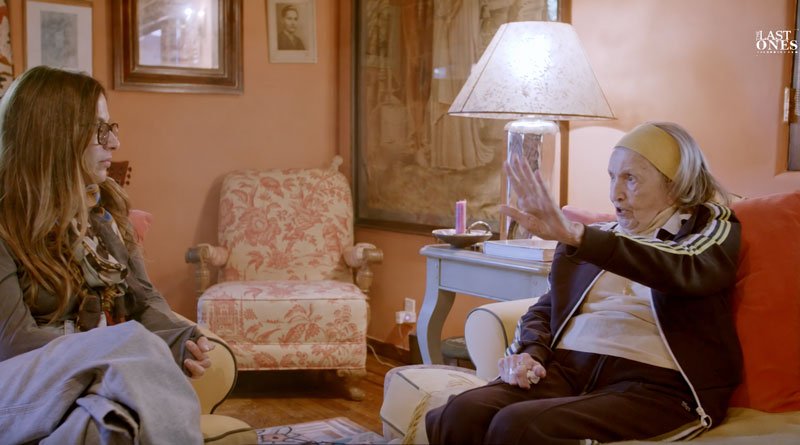
Leslie: Today I’m in New York City in the Jewish neighborhood of Brooklyn. I have an appointment with Nissen Mangel [surname spelling to verify], the rabbi of the local community. He was born in 1933 in Hungary and was deported to Auschwitz at just 10 and 1/2 years old. He was one of the youngest survivors of the camp where children were killed upon arrival.
Nissen: Welcome. Welcome. Nice to see you.
Leslie: How are you? Nice to meet you. You teach every day.
Nissen: Every day in the morning and in the evening. Yes.
Leslie: Wow.
Nissen: That’s what keeps me young.
Leslie: You are young. I brought something to put in your tzedakah box. You’ll show me after or you want to show me now?
Nissen: I can show it to you right now.
Leslie: Show me right now. Ah, okay.
Speaker unconfirmed: Always. Here you go. Good. Okay. Very good.
Leslie: That’s like this. I don’t come empty-handed.
Nissen: Good. Good. Good. Good. Good. Good. Good.
Childhood and the First Raid
Leslie: Nissen’s parents are wealthy religious Jews. His father owns a women’s hat factory and his mother runs a fabric shop.
Nissen: I had a very very happy childhood. My father traveled a lot. Every time he came back build a present for my mother, jewelry, present to the children.
Leslie: Little Nissen leads a happy childhood until 1944 when his life turns upside down.
Nissen: It was 7:00 in the morning, Friday morning. My mother since was head of shabas and they knock on the door and [unclear in captions: SS and Gestapo arrival].
Nissen: And then the list who lives in this apartment is in that apartment. Yes. My father is there. My sister is there. Where is Mrs. Mangel [surname spelling to verify]? My father says she’s the marketplace. So the Gestapo says, the chief Gestapo says to my sister, “Get dressed and go find your mother and bring her immediately. Fetch your mother.”
Nissen: I said to the Gestapo, “I want to go with my sister.” So we went to the marketplace and in the middle of the bay we see mother with two baskets full of merchandise chicken fish and cake and fruits and she run to money says ma seven ess came to our house she became so nervous so frightened her but she know what does it mean go to Auschwitz
Nissen: So she says to us, “Let’s run home. If P goes to Az, I want to go with him together.” He didn’t want to save us. Can you imagine?
Escape and Hiding in Slovakia
Leslie: In the meantime, his father has managed to bribe the Nazis and they find themselves on the road.
Nissen: So I immediately jumped as a child. Tat, how do you get out? Says, listen, now is not the time to speak. Let’s run.
Leslie: After a harrowing escape, the family flees to Slovakia where they find a smuggler and disguise themselves as peasants.
Nissen: On the way, a group of SS stopped us. Can you imagine? My heart was bleeding. They said, “We know the Jews are smuggling themselves across the border. Do you know how they do it? Where do that? How they do it? Can you imagine? Be the Jews are smuggling.” They asked, “How do you do it?” My heart was beating and I just looked at her back. They shooting my see my face with nervous but anyways he explained says please when you find out yes we will let you know.
Arrest in Bratislava
Leslie: Once in Bratislava they managed to hide in a luxurious house that shelters many Jews under false identities but their respite is shortlived.
Nissen: It was about one at night. [Unclear in captions: a knock at the door.] My father went to the door and opened it. [Unclear in captions.] Immediately, he punched my father. [Unclear in captions: description of the hallway.] “Get dressed.” They took us.
Selection at Auschwitz
Leslie: the family is deported to Auschwitz. Nissen is only 10 and a half years old but upon arrival he’s advised to lie about his age to have a better chance of passing the selection
Nissen: came the selection who goes right who goes left. Mengele was sitting always on a table and he was chained smoking continuously. So what he did millions of juice to the gas chamber and he like this smoking and this slump determined the fate of millions of Jews. You leave if you turn left right.
Nissen: This time my father says this and go behind maybe I’ll be able somehow to manipulate that he won’t notice it. He said I said go he but Mengele did notice it. He gets off from the table comes over to me and he ask me how old am I? I said 17. from 10 and a half to 17. I tell I’m 17 because I knew that you start to laugh just like you laughed. Says of all in Dutch in German I know that you’re not more than the 11 father.
Leslie: The whole family enters the camp but they are separated. Nissen goes through the full shaving and the specific tattooing required in this camp.
Nissen: Yes, I was ten years old… [Remaining words unclear in captions.]
Forced Labor and Illness
Leslie: Like every deport, little Nissen is forced to work and endures severe mistreatment.
Nissen: The capo comes over, looks in the barrel. The barrel is completely empty. Without asking me why, start to punch me. Punch me, kick me. I fell down. Why did I work? I got I was so sick I couldn’t speak. He took me to the clinic with a doctor and he saw how I feel. Opened up my jacket, saw my chest, scarlet fever, very contagious.
Leslie: Uhhuh.
Nissen: I’m tell you a high fe fever.
Leslie: Mhm.
Nissen: And I was about like a delirium. I didn’t know what’s going on with me. So I was taken next day to Lager F [name to verify]. Lager F [name to verify] was where Mengele and other doctors [word unclear in captions] medical experiments.
Confronting Mengele
Nissen: There I saw a colony of over 100 dwarfs [words unclear in captions], religious Jews made on them terrible experiments. So Mengele comes in with looks around and sees me. He says to the other doctors, “I’m going to make an experiment on him. I look at the eyes of Mengele.” Like I look into your eyes, try screaming experiments on monkeys, not on me.
Nissen: Experience I start to cry. I scream. Experience a monkey. You just can’t imagine was who was [words unclear in captions]. The biggest Gestapo gems were afraid of him. A little god. Mengele always had on his belt a revolver. A pistol.
Leslie: Mhm.
Nissen: I was sure in rage.
Leslie: He was going to shoot you
Nissen: [Unclear in captions: reaction to defying Mengele.] They looked at each other for a minute or two. At a time like that, a minute or two feels like an hour. [Final words unclear in captions.]
Surviving the Death March
Leslie: Against all odds, Dr. Mengele, known as the angel of death, spares Nissen’s life. Injured in the foot, he then faces the brutal death march alone.
Nissen: So, January, February, East Europe, very cold winter, very, very cold. I came to the conclusion I can’t continue. I have no strength what whatsoever. I can’t continue. I might as well move out. and I’ll be shot
Nissen: As I made the decision to step out, a young man came over to me. Let me tell you, on this death march nobody was speaking. When this person came to speak to me, I was astonished. [Unclear in captions: reference to where he came from.] “No, no, don’t do that. I’ll help you.” “How can you help me?” [Unclear in captions: description of lifting him.] He carried me.
Leslie: carried you. So that’s what they did
Nissen: Another two or three days afterward… [Unclear in captions: injured foot and an SS man approaching.] He had a canteen on his belt, a small army bottle. He took it off his belt and gave it to me: sweet, hot black coffee.
Leslie: the SS gave it to you
Nissen: and listen believe me I felt that I’m being resurrected revived the hot sweet that is every my ve every or every organ I became rejuvenated
Nissen: came a particularly very high mountain steep mountain in Germany a suffering temperature I felt my ease like a piece of ice that I I’m afraid I touch it, I’ll break it off. So I tell him, listen, I my ears are freezing. But what did he do? He takes up the SS cap, put it on my head, put it over my ears.
Leslie: Wow.
Nissen: I never saw this SS again.
Returning with His Family
Leslie: Nissen manages to return to his home village where he reunites with his mother and sister. His father will never come back. Many years later, Nissen, who had left Auschwitz on his own, returns. But this time, he’s far from alone.
Nissen: Here is the track, the rail tracks on which 6 million Jews came to Auschwitz. I, my wife, and here my children, Gage, 100 people. Here we see the cattle coach which came to Auschwitz came here and squeezed together. So I showed them this cattle coach and then we start to sing a song. I composed a song. Do you understand?
[The song is not transcribed in the supplied captions.]
Leslie: Yes.
Nissen: But if I survived Mengele, the Angel of Death, twice… [Unclear in captions: description of his journey without food in extreme cold.] If I am here now, is it natural? [Remaining words unclear in captions.]
Speaker unconfirmed: Okay. Thank you. Thank you.