Survival, Love, and a Promise Kept
An Interview with Rachel
Meeting Rachel
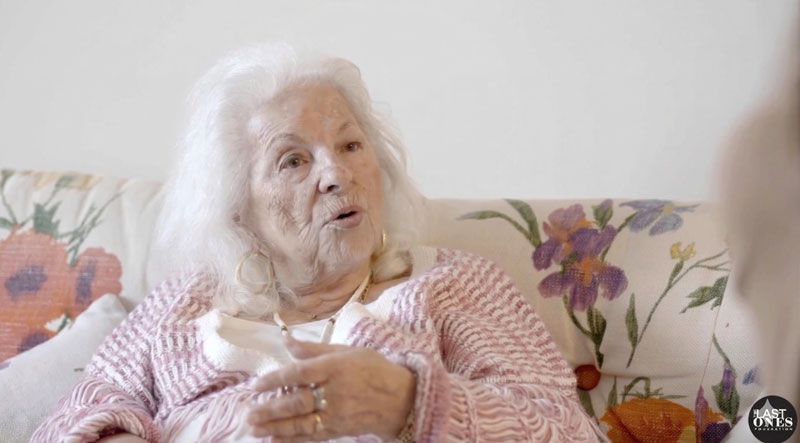
Leslie: Today I’m in Long Island to meet with Rachel. She was born in 1932 in [birthplace unclear in captions], located in the northern part of France.
Speaker unconfirmed: Hello. Hello. Hi. Bonjour. Hi. How are you? [Greeting unclear in captions.] Nice to meet you. Nice to meet you in person. How are you? Yes, good.
Leslie: I brought you a little something. I don’t like to come empty-handed. This is a babka.
Rachel: Oh, thank you.
Leslie: You like babka?
Rachel: Love it.
Leslie: Rachel is waiting for me with her husband, Ezia, whom she met when she arrived in America at the age of 17.
Speaker unconfirmed: [Brief greeting unclear in captions.]
Leslie: How are you? I’m Leslie. Nice to meet you.
Rachel’s husband: Same here. Same here.
Finding Love in America
Leslie: How did you meet?
Rachel: I arrived here very unhappy. I couldn’t speak a word of English. And he gave me a very big smile. My head was someplace else. Yeah. Right. So he would come up every day and he started to to teach me um English. He taught me the old language word by word. Are you
Leslie: happy? Because you taught her English many things. Are you happy that she taught you the French kiss?
Rachel’s husband: She didn’t taught me. She just did it.
Leslie: Were you surprised?
Rachel’s husband: Oh, was I surprised? Like my first thought was What the hell was that? What the hell is that? She was my first date.
Leslie: She was your first date? Wow.
Rachel’s husband: She was my first everything and she still is.
Leslie: I love that.
Rachel: She was so nice to me. I became a little bit a more happier girl. So he was my life. He was my lifesaver because every survivor from the Holocaust is a miracle. It is purely impossible of what the German were doing that any Jew survived.
A Childhood in Wartime France
Leslie: In 1939, Rachel, her 2-year-old little brother Leon, and her parents reside in the north of France. Her father, a professional [occupation unclear in captions] joins the French army in the fight against the Germans. In June 1940, at the time of the ceasefire, the family moves into an apartment in [town name unclear in captions], 50 mi north of Paris.
Rachel: My father
Rachel: had befriended some gendarmes. To the gendarmes, he would say, “If you have anything to fix for you, your wife, anybody, give it to me. I’ll fix it.” And he didn’t charge any money for it because not a bad idea to be to be okay with the um and beside my father was a very nice guy. So he was good with the French [phrase unclear in captions]. July 1942,
Her Parents’ Arrest
Rachel: Sunday morning about 6:00 in the morning knock on the door. He opens the door. He sees three French policemen. So my father gives them a big hello because he knows them. Then like they never knew him. Uh you have to you have to come down to the police station. Police station. She what did I do? My mother wakes up and she sees the cops. She what’s going on? And we wake up. We start to scream. My mother starts to scream and she says, “What about my children? What do I do with my children?” The cop couldn’t care less.
Rachel: But the people that live on the floor be uh below us come out and hear this commotion and they say, “What’s going on?” My father says, “I don’t know. They come here and they want us uh to the to to down to city hall. We don’t.” So [neighbor’s name unclear in captions] he says oh he says don’t worry don’t worry it’s a mistake something happened you’ll see you go down it’s a mistake meanwhile don’t worry about your children you know we’ll we’ll take care of your children till you come home just don’t worry about it so my father goes
Rachel: into the bedroom to change his clothes or whatever to take some clothes with him closes the door for privacy the cop comes and with his foot bangs Is the door open? No closing door. We are screaming. We are holding on to their clothes. We don’t want them to go. The cops are horrible. And that’s the last we saw my parents.
The Last Letters
Leslie: Her parents are detained at the [camp name unclear in captions]. They stay there for a week and manage to send the children two letters
Rachel: and then from [camp name unclear in captions] they went to [camp name unclear in captions].
Leslie: Both her parents are killed there.
Protected by Neighbors
Leslie: So the neighbors downstairs took took you and your brother in.
Rachel: We were we were with them for 5 years. 3 years during the war because I got a continuation after the war and treated us like we just were born to them. They had two sons, [ages unclear in captions].
Leslie: This was dangerous for them. They
Rachel: extremely dangerous. We lived right across the street from a Holland woman and she was collaborating with a German. Okay. And she had a a high official Gestapo as a boyfriend.
Leslie: Wow.
Rachel: Yeah. And he would come over when we used to see them. We said that’s it. Today’s our last day and shaking and trying to but so we heard the music and we heard them laugh and we but thank God nothing ever happened. And then a neighbor came and says, “Are you realizing what you’re doing? You are harboring two Jewish children. Aren’t you afraid for you and even for the neighborhood?” Because nobody was doing that. And she would answer, she would answer, “There is two two children to be saved and I promise their parents that I’m going to take care of their two children and that’s what I’m doing.”
Rachel: They started to so strong to care for us. Absolutely unbelievable. They made an underground that in case if we had to run somewhere, it would be enough for them too and for my brother and I. Wow.
Rachel: Yeah.
Escaping a Final Roundup
Leslie: In 1944, as the Germans are losing the war, they carry out one final roundup in the town where the family lives. Madame [surname unclear in captions] immediately understands the danger looming over the family.
Rachel: She saw them arresting. A woman came out with a baby with a baby. She said, “My god.” And she knew my brother was home. So she says she couldn’t go fast enough with a bicycle. And I come from school a few minutes later and they waited for me to come from school with anticipation. I come from school. I don’t know anything is going on and they say, “Grip a bicycle. Let’s go. We have to go. We have to run away.” and we ran away in a in a town near thereby about 3 4:00 he wanted to know what’s going on because we couldn’t see nothing.
Rachel: So he took his bicycle and he went back to the street to the street where we lived and he stopped on the corner. He sees the German truck is right in front of our house. The Gestapo is there and the conducting his son that arrived together with a truck. He was coming from work.
Leslie: Mhm.
Rachel: And they see the Gestapo taking his son putting him in the truck. Everybody, every Jew is in there. Every Jew knows him, knows his son because everybody knew us. And they don’t say nothing. Nobody’s saying a word. They took him in the truck to ask him because they arrived together. They said, “Do you know anything where the [surname unclear in captions] children are?”
Rachel: So, first of all, he he made himself dumb. I never heard of them. Never ask him for his papers. Never no other question. Let him out of the truck. That’s it. The father on the corner here sees him. Thank God. Okay. Yeah. Okay. That truck went directly in [camp name unclear in captions]. There was like about 130 40 people Jews that were remaining children. They didn’t directly the way they were. They were they went in the oven. That truck went directly in the oven.
The Emotional Toll of Survival
Leslie: So you were very lucky that day.
Rachel: The only two Jews that were left in town. I think I have lost all my feelings. Then I became like a zombie. This is the way I stayed till I came to the to America and it took me a while to become a person after I was here in
Leslie: You mean you had no more feelings?
Rachel: No more feelings. No more.
Liberation and Separation
Leslie: So how did that end? When how do you
Rachel: then after 3 years after was liberation when the first car them first American car came in our street with American soldiers in it I rent to the jeep and I kissed his feet and I see myself doing it.
Leslie: This is how thankful you were to
Rachel: that’s what that we were Yeah. that we didn’t have the German no more.
Rachel: And I had one uncle and one aunt that survived the war. They came over and they say, “Thank you very much for for keeping the children and now we’ll take the children.” Haha. Oh, really? You going to take the children? Children didn’t want to go. So they took my adopted family to trial.
Leslie: No way. Because the [foster family’s surname unclear in captions] they wanted to keep you. They they were fine to keep.
Rachel: We didn’t want to go. My family won and the judge says you have to give up the children. So I made up my mind to be not nice living with them. And then my uncle discovered he had a sister in America. So he went to America. So when he came back he says, “You’re going to America without my brother?” Never. So, I did everything possible to deny that I’m going to America, but I I had to go to America. The paper came true. I fought. I fought. I fought. I left my brother. My brother almost killed himself. And me too. I was pushed
A New Life and a Long-Awaited Reunion
Rachel: on the boat practically. When the boat enter America and the Statue of Liberty, you know, everybody run, they said, “Come and see the Statue of Liberty.” Statue of Liberty. Who cares about the Statue of Liberty? I didn’t even want I wasn’t interested in and Okay. Okay. The boat stopped and uh I came off the boat like a zombie and my aunt was there. My aunt here, she tried to do everything nice to me. The only thing I was thinking about my brother, my brother, my brother. Then I
Rachel: met my husband and then he knew how I felt about my brother and so forth. And we saved and it took us 13 years of saving of saving cuz you had to show that you could support if somebody comes to this country.
Leslie: So you left a kid you met the next time you met he was a young man.
Rachel: Yeah. A married man with a child. Yeah.
Leslie: Did you recognize each other right away?
Rachel: I I don’t know. It was just my brother. That’s it.
Honoring Those Who Saved Them
Leslie: Once reunited, Rachel and her brother do everything in their power to ensure that their foster family is awarded the title of righteous among the nations. They host them a few times in the United States and make sure they lack for nothing until the end of their lives.
A Love of Dance and Life
Leslie: Suddenly, Rachel starts twirling with the spirit of a young girl.
Leslie: They’re really high heels. Wow. Wow. Wow.
Leslie: At nearly 90 years old, she wants to show me something with her young tango instructor.
Speaker unconfirmed: Boy, you never had that. I wish. Oh, God.
Leslie: I am impressed.
Speaker unconfirmed: Keep walking with these heels. Absolutely. Keep rocking these heels. Absolutely. Until 120. That’s what we say. Yeah. That’s right. That’s what we say. Yeah. And I wish you luck. Thank you. What what you’re doing and good health. Thank you. Good health. Amen. Amen. Amen. Amen. Good health to you. Okay. Thank you. Well, thank you.