Holding On to Each Other
An Interview with Yolanda
Meeting Yolanda
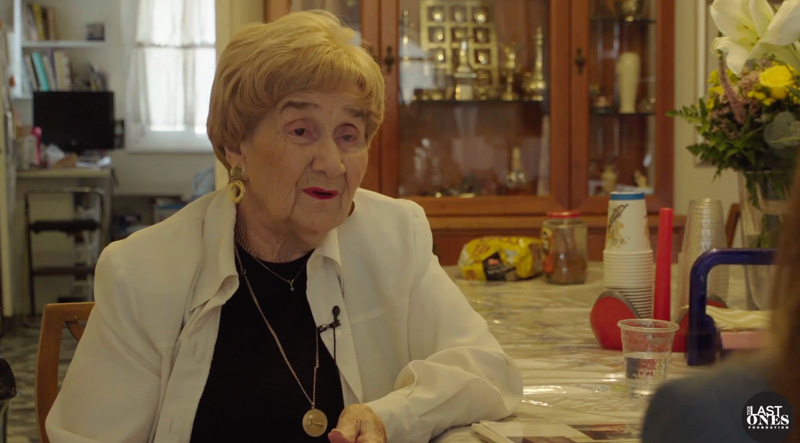
Leslie: Today I’m in Toronto, Canada, to meet Yolanda. She was born in 1937 in a small village in Hungary.
Yolanda: Hi, come in.
Leslie: Hi, good morning. How are you? Good to see you.
Leslie: During the war, she survived with her two brothers, taking refuge in a synagogue that sheltered Jewish children.
Leslie: I brought you a little something. It’s a babka.
Yolanda: Thank you.
Leslie: It’s all kosher. Please, don’t worry.
Yolanda: Thank you so much. I appreciate it.
Leslie: Is this you?
Yolanda: Yes.
Leslie: And that was recently?
Yolanda: 2019. I was the oldest. I was 81.
Leslie: What did you do there?
Yolanda: [Brief fragment unclear in captions.] We did everything that the army usually does, preparing things. It was very nice just to eat together with the soldiers, because antisemitism is rising. It’s coming out from under the rug. For a long time, it was swept under, and now it’s out in the open.
A Childhood Interrupted
Leslie: Yolanda’s parents were religious Jews of [word transcribed as “modern”; unclear] means. Her mother was a homemaker. Her father worked as a laborer in a factory. Life changed quickly.
Yolanda: I remember that we couldn’t go to school because we were Jewish. My brother, who was already in grade school, was kicked out for the same reason: he was Jewish. He was very angry that he couldn’t go to school.
Yolanda: My father was taken to a forced labor camp. He was in [place transcribed as “Orodna”; unconfirmed]. He was taken in 1942, so when my brother was born in August, he was already in the forced labor camp.
The Synagogue and Her Mother’s Deportation
Yolanda: In 1944, the Germans advanced and took over Hungary. Shortly afterward, Jews were no longer allowed to stay in their homes. We were gathered in so-called yellow-star houses, which were usually synagogues. They were individual ghettos.
Yolanda: My mother took the three of us with very few belongings, because you weren’t allowed to take anything. We were taken to the nearest one. It was a synagogue where we used to go for Talmud Torah, to learn Torah. My mother was taken during the summer. People who were able to work were gathered and taken to concentration camps. My mother was taken to Bergen-Belsen.
Leslie: What happened the day the Nazis came to take her?
Yolanda: I remember they came with guns, mostly young soldiers, about 18 or 20. They were so powerful because they had dogs with them. We children were scared and shaking. It took a very short time. They came, gave orders in Hungarian, and picked out the able-bodied people they wanted to take away. In no time, they were taken.
Yolanda: Later, when my little brother started to talk, his first sentence was, “The Nazis took my mother away.” It was very traumatic.
Three Children Alone
Yolanda: We held on to each other and supported each other. Shortly after my mother was taken away, we were taken to a bigger ghetto. That’s where we survived the war. My older brother, at the age of nine, became the head of the family. He took everything over.
Yolanda: He used to go out, and it was dangerous because the Nazis had huge dogs. If they found a Jew outside, they would let the dogs maul them, because we weren’t allowed to go out. He used to sneak out and buy us some sweets.
Yolanda: We went downstairs when the sirens were blowing. I guess the Allied forces must have been bombing Budapest at that point. I remember hiding under a table, holding each other’s hands. There was no adult to support us. We were shaking because it was noisy and scary. The whole house was shaking. When we went out, we saw the crater where the bomb had fallen.
Leslie: So it was right next to where you were?
Yolanda: Yes, in the backyard of the [word transcribed as “shore”; unclear]. It was a miracle that we survived and nobody was hurt there. Toward the end, we didn’t have the energy to climb down, so we just stayed in bed. We were lying there in feces and everything. We were near starvation when my father came in.
Her Father’s Return
Yolanda: It happened suddenly, during the daytime. Harry and I argued about who had heard the cough, because my father was a heavy smoker. He had a very distinctive cough from smoking. We were yelling, “Daddy’s here! Daddy’s here!” Just hearing his cough revived and rejuvenated us.
Yolanda: He had a couple of barbecued chickens in his knapsack, and he shared them with us. I think we must have eaten them in no time because we were very hungry. He disinfected us one by one. He had to cut our hair because of lice. As a girl, I cried because he cut my hair. We couldn’t walk anymore, so he had to teach each one of us to walk again.
Reunion and Life After the War
Yolanda: My mother came back in the summer of 1946. She had typhus. She wasn’t the same person. She was always sick and always tired. I had to do the housework and the washing. I was a little girl, but there was nobody else to do it.
Leslie: Miraculously, the family was reunited. They returned to live in their small village, which was now part of the Soviet Union.
Yolanda: Everything changed. Communist thinking and education took over. Antisemitism was always there, but not on the surface. It was under the rug, and there were a few occasions when it came out.
Yolanda: One of the girls was a head taller than me. During recess, she called me a “dirty Jew.” Although I was tiny, I organized a group during class, and after school we beat her up. The next day, her mother came and complained to the teacher. The teacher called me out and asked, “What happened?” I told the teacher and the mother, “If you don’t teach your daughter manners, I will.”
A New Life in Canada and Lasting Memories
Leslie: Yolanda continued her education and became a chemist. She married Joseph, a Canadian she met in Budapest. In 1967, she moved to Canada and started a family. But she still bears the scars of her childhood and the war.
Yolanda: I’m still afraid of noises, especially loud noises. I respond negatively because all those noises damage you and leave you scared. That never goes away. I still have bad dreams in which I’m trying to hide, and there is nowhere to hide. The Nazis are coming. They’re going to find me, and there is nowhere to hide.
Leslie: Thank you so much, Yolanda, for taking the time today to share your story.
Yolanda: Thank you.
Leslie: Thank you so much.
Speaker unconfirmed: Bye. Bye.