It Is Their Turn to Speak Out
An Interview with Laszlo
A Visit with Laszlo
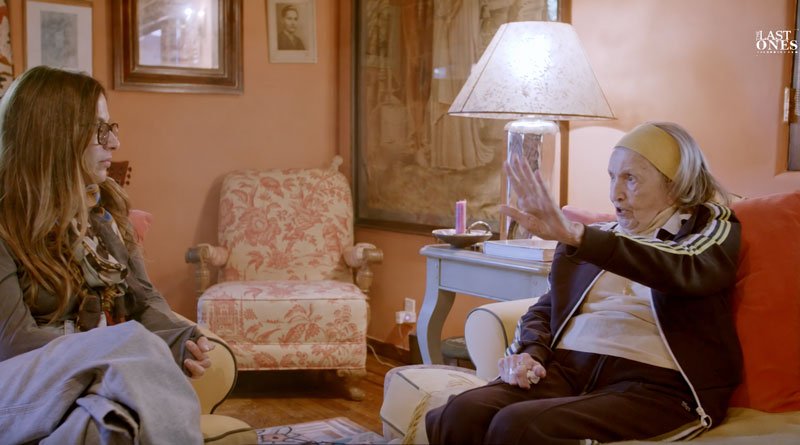
Leslie: Today I’m in Aventura paying a visit to the skilled and accomplished Laszlo. He was born in Budapest, Hungary in 1937.
Leslie: Hi, Laszlo. How are you?
Laszlo: How are you? It’s so nice to see you again.
Leslie: Me, too. I brought you a little something.
Laszlo: Oh, you shouldn’t have. But thank you.
Leslie: I baked this for you. It’s a [cake name unclear in captions]. Do you know what a [cake name unclear in captions] is?
Laszlo: No, but I will find out soon.
Leslie: Wow. You Oh, I know some of these people. Some of them. Do you take them yourself?
Laszlo: This This is my wife and I took it myself. Yes.
Leslie: Wow. Well, you’re talented.
Laszlo: I’m a professional photographer.
Leslie: Oh, yeah.
Laszlo: Yes, I am. You didn’t know that?
Leslie: I did. I did.
Leslie: In his own way, he too has contributed to the memory of the Holocaust.
Photographs That Carry Memories
Laszlo: They are not beauty portraits. I wanted people to look into their faces and imagine the memories that these people have behind them.
Laszlo: Oh, this is a sad sad story. This lady, my wife went to her funeral this morning.
Leslie: Is this why also you’re testifying? Because because unfortunately
Laszlo: Yes. Yes. That this is a big part of it also because because there are fewer and fewer of us every day.
Laszlo: And that’s me. And as you can see, I did not spare myself either.
Twins Growing Up in Budapest
Leslie: Laszlo has a twin brother.
Leslie: So that’s you right here.
Laszlo: That’s me and that’s my twin brother Rudy.
Leslie: Unlike most twins, they remained together the entire time of the war.
Laszlo: I was very little at the time, but I recall my mother sitting in our living room and sewing yellow stars on our clothes because the law in Hungary at that time was that all Jews, regardless of age, have to wear a yellow star on their clothes.
Laszlo: So when we went out on the street, they could everybody could clearly see that there goes a filthy lousy Jew because that is the way that their people thought about us. And after our playmates came to us one by one and told us that they cannot play with us anymore because their parents forbid them to play with Jews. I remember being out
Laszlo: there one day with my brother wearing our yellow stars and a man looked through the gate and saw us uh playing there and started screaming at us, “Lousy Jews, wait until I get my hands on you.” And and he started rushing us. And both my brother and I, we ran screaming back to our apartment and there was nothing our parents could do about it. And that
Laszlo: I believe is when the fear started. That was I think the first time that I realized as a kid that there are people out there that wanted to hurt me. And and that fear has not left me for for many many years.
Confined to a Jewish House
Leslie: In 1944, Laszlo and his family are relocated into a designated Jewish house in terrible living conditions.
Laszlo: We were terrified because we looked out the window and we saw that the day the Jews could go out, what they did to them.
Leslie: What did they do?
Laszlo: That young Nazis uh just surrounded this old man and they started pushing this man between them from side to side and hitting him, kicking him, spitting on him. He had I don’t know whether it was an onion or a potato. I don’t know. And the old man dropped it and this onion or potato rolled out and one of the Nazi thugs just slammed his boots down on it and and smashed it and and the man was crying
Laszlo: and they couldn’t explain to us. I we asked our parents, you know, what did this man do? Why did they do this to him? There was no explanation. They could not. The explanation was you’re not allowed to go to the window anymore and look out. That was the explanation.
The Fear of Deportation
Laszlo: Once the deportations started and and this was pretty late in the Holocaust and by that time I am sure that my parents were aware of what’s going on in the camps in the concentration camps
Leslie: in the concentration camps.
Laszlo: And I strongly believe that they knew about Dr. Mengele. He loved twins. For Mengele, uh it was a very good uh control uh mechanism to see if he does something to one twin, what happens to the other? or if uh he does something to both of them, which one heal better or faster or crazy crazy experiments. It was the
Leslie: medical experiments on twins
Laszlo: on twins and my parents were very much afraid that if we get deported that that would happen to us.
False Names and Hiding
Leslie: Desperate to keep their twins safe, Laszlo’s parents made the difficult decision to send them into hiding after changing their names. This plan led the twins to the small shop of a lady who was a member of the Nazi party.
Laszlo: My name was not always [surname unclear in captions: “Sally”]. When I was born, my name was Schwarz. So as little kids, we were warned never ever to tell anybody our real name. And this girl that worked for her try to she figured out that something is not uh quite uh kosher here.
Leslie: Mhm.
Laszlo: And she kept asking us little kids for our real name. And we would not tell her except one day she came to me with a piece of candy and she offered this candy to me if I tell her my real name. And I wanted that candy. I I wanted it real bad. And I did tell her
Laszlo: and my aunt overheard this from behind the counter and she ran out like a mad woman and threw the girl out of there immediately fired her and within five minutes we were on our way back to our parents and to the designated Jewish house and perhaps to wait for the deportation only because had they found out that she’s hiding two Jewish kids that would have killed her on the spot.
Protection and the Arrow Cross
Leslie: Laszlo’s father managed to obtained a certificate of protection by Raoul Wallenberg, a Swedish diplomat who saved thousands of Hungarian Jews at the risk of his own life. Meanwhile, thousands of Jews, including children, are still being murdered around the corner.
Laszlo: and the Nazis, the Germans kind of uh ran away. But the killing of the Jews in Budapest did not stop. It was [wording to verify: captions say “not”] taken over by the Hungarian Nazi party, the Arrow Cross. They took the Jews down. They lined them up on the banks of the river and they shot them.
Leslie: How many of them?
Laszlo: Hundreds.
Leslie: Every day.
Laszlo: Every day they were marching them down to the river. We could not see it, but I could clearly clearly hear it.
Leslie: What did you hear?
Laszlo: I heard the screams and the cries of these people as they realized what was about to happen. Fire in Hungarian. And we heard the machine gun fire and we knew that all these people were dead because of the silence afterward.
Leslie: Because of the silence afterward.
The Night Before Liberation
Laszlo: And we also knew that sooner or later it will be our turn. And then one day they did come and they came into our building and they told us that tomorrow morning we all have to be lined up in front of the building. Anybody who stays behind will be shot on the spot. And that was the worst night I can remember in my life.
Laszlo: The women were all crying, hugging their children. The men were huddled together praying. And we hoped that morning would never come.
Laszlo: Very early that morning, we heard rifle butts banging on the front door and the door had to be opened up. And there stood two Soviet soldiers. Soviet soldiers. Soviet soldiers looking for Germans. The Soviet army took the street that we lived on that night.
Leslie: That night.
Laszlo: That night. If they’ve been one day late,
Leslie: you wouldn’t be here.
Laszlo: I would not be here today.
Leslie: So, what do you feel as a kid when you go out for the first time?
Laszlo: Fresh air. I’m outside and I can look around and well, what you see wasn’t pretty, but still you were outside.
Leaving Hungary for America
Leslie: Despite the horror, although twothirds of the Hungarian Jews had been decimated, the family stayed in Budapest. In 1956, during the chaos of the Hungarian Revolution, Laszlo and his brother escaped and made their way to America.
Laszlo: Bremerhaven, Germany, which is a seap port. And at that port there was this American old World War II uh troop ship and they jammed up couple of hundred Hungarians refugees who were going to America and they put us on this ship and this was the first time we saw the
Leslie: ocean. I mean, everybody talks about, you know, when you enter the harbor in New York. Do do you recall how you felt?
Laszlo: Oh, yes. Oh, yes. Uh they told everybody that we’re going through the harbor and there is the Statue of Liberty and we were all up on deck and uh it was an incredible
Laszlo: I still get choked up to see this statue and and going wow I’m in America. It was a dream that was not possible ever. You couldn’t even think about it in in your wildest dreams that one day I will be in America. And here we were.
Leslie: He finally reunites with his parents 5 years later after the Hungarians agree to let them flee the country under one condition. They had to give up their retirement allowances.
Fear, Silence, and Sharing His Story
Leslie: What was the hardest thing for you to bear during the war?
Laszlo: Wow. Fear. Pure fear for years. It’s not easy to get rid of.
Leslie: Are you still having nightmares?
Laszlo: No more. No, I don’t have nightmares anymore. You know, since I started talking and sharing my experiences.
Leslie: When did you first tell your story?
Laszlo: I didn’t tell my story to anybody until about four years ago.
Leslie: That recently.
Laszlo: My wife heard the story the first time when I told the kids on the March of the Living.
Leslie: You had never spoken to your wife. Never spoken to your kids.
Laszlo: Afterwards, uh, she came to me and she said, “What kind of a man are you that you have this story and you never said a word about it to me? I’m your wife.”
Leslie: Never told your kids.
Laszlo: Never. Never. I had no reason to. I I did not want to remember. I did not want to recall it. It was something that happened to me in the past and it should remain there.
A Message for Future Generations
Leslie: What is your goal when you teach these kids about the Holocaust?
Laszlo: My goal is that they know the dangers of what can happen if they are not careful. They have to get involved. They cannot be bystanders.
Laszlo: And I also I try to tell them that my voice is fading and and pretty soon it will be silenced for good and it is now their turn to speak out and to tell the world and and to tell everybody that this is possible. It can happen again. Be careful.
Leslie: It wasn’t too hard for you today to talk about the past.
Laszlo: No. No. Um, by now
Leslie: you’ve gotten used to it.
Laszlo: I’ve gotten used to it. I’ve done it enough. Uh, and uh, I’m just glad that people want to know.
Leslie: So, until you have a voice, you’re going to keep telling your story.
Laszlo: Yes. Yes. And thank you for all your help.
Leslie: Thank you for doing that. Thank you for having me.
Laszlo: It’s it’s anytime you know that. And thank you.
Leslie: Well, don’t say that because I’m going to keep you like I’m going to hear it and then I might I might call you more and ask you more time.
Laszlo: Please do feel free to call me anytime you want to.
Leslie: Thank you so much.
Speaker unconfirmed: Thank you. Thank you so much. Thank you. Thank you so much. Bye. Thank you. Bye. Bye. Bye.