I Am What I Choose to Be
An Interview with Sami
Meeting Sami
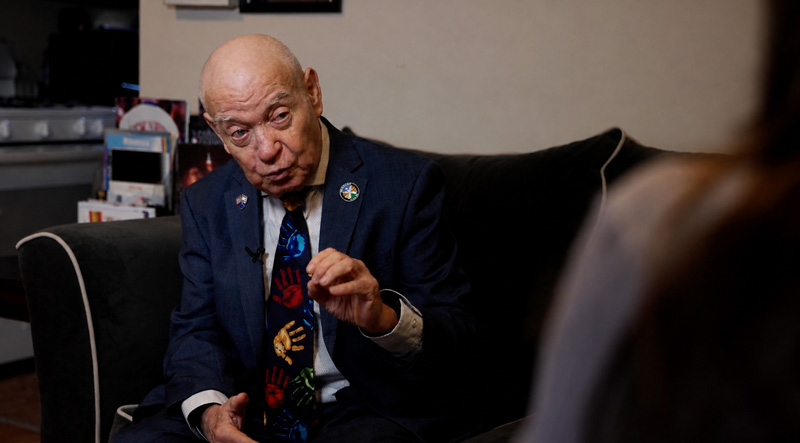
Leslie: Today I’m in New York and I’m going to visit Sami. He was born in 1939 in Czernowitz, a small village in Romania. He was only one and a half when he was deported along with his parents.
Leslie: Hi.
Sami: Hello. Here. Welcome.
Leslie: How are you? I’m so happy to see you.
Sami: Okay, welcome to my castle.
Leslie: Today, Sami devotes most of his time to the talks he gives to the young generation all over.
Leslie: How many of these certificates do you have?
Sami: This is nothing.
Leslie: It’s you you just have a few here.
Sami: [Response about the certificates unclear in captions.]
Finding His Voice
Leslie: When did you start talking about the Holocaust? Did you always feel comfortable talking about it?
Sami: I started
Sami: to speak only in 2008. What happened is the Holocaust Museum in Washington DC
Leslie: Mhm.
Sami: closed its doors to the general public for two days. They opened it up only to the Holocaust survivors. Don’t ask me why. I decided to go. There were over 8,000 people from all over the world. In at a table where I was sitting, I met a man born in the same city, was in the same camp, the same years, 1941, 1944.
Leslie: That’s crazy.
Sami: He was deported when he was 8 months old. I was deported when I was a year and a half. By meeting him, that’s the difference between history and living history.
Deported as a Baby
Leslie: Sami’s parents, observant Jews of [word unclear in captions] means are arrested in 1941. The family is placed in the [camp name unclear in captions] labor camp where they spend 3 years. Sami is still a baby and has little memories.
Sami: The only thing that my father told me that I remember is that I know that in Ukraine the winter is bitterly cold. My parents in addition of uh having to fight to survive, they also had to take care of me. So for a loaf of bread, my father gave away his winter coat for a piece of bread so I could survive a few more days. It shows the parents, okay, the sacrifices that they had to make to save the children.
Survival and Lasting Pain
Sami: In a labor camp, they did not murder you. You were worked to death, beaten to death, starved to death, died from disease randomly. One of the base commander felt like it would to shoot randomly somebody. But it was that through attrition.
Sami: If you will ask any survivor and you ask him how come you’re alive today, everyone will use only one word, luck. My luck was that I was never separated from my parents. I was subjected to medical experiments. I am in pain every single second of my life.
Leslie: You were subjected to experiments.
Sami: Yes, I have documents that it was uh acknowledged that I was subjected to medical experiments and Germans are very good in collecting uh you know documents and everything else. I got paid based on their records not on what I wrote them. And after they finished with the medical experiments came a stage that was like observation and there are physical signs big head swollen stomach swollen feet.
An Act of Compassion
Sami: So not far away from the camp, there was a farm owned by Germans and the woman brought food to the guards in the SS and she had compassion for a strange uh Jewish uh baby and uh at the risk of her entire family’s life, she decided to give me milk. I do not know the name of the person that saved my life.
Liberation and Life in Romania
Leslie: Sami and his parents are liberated by the Russian army. On his father’s side, 40 out of 42 family members have been exterminated. In 1946, a little sister is born and the family returns to live in Romania, now purged of its Jews.
Sami: People do not understand how life was in Romania after the war. Can you imagine living in a house? There is no sink. There was no toilet in the house. There were only outhouses. Uh in school, they did not have toilets.
Confronting Antisemitism
Leslie: Do you recall Jew hatred?
Sami: Of course.
Leslie: What? What do you recall as a kid?
Sami: It’s not directed at me because I don’t have the facial expressions of what people imagine a Jew supposed to look like. And my name is spelled with two Ns is the German spelling. So people felt comfortable to come to me and to tell me stupid jokes and you know how much they hate the Jews or whatever it is. And I was not afraid. And I tell them, you know who you’re talking to. I’m Jewish.
Sami: Oh. Oh, I didn’t mean you. I meant the rest of them. Why not me? Because they knew me. And I teach the young people that we hate people because we don’t know them. We don’t know them because we hate them. So you have to communicate. That’s what it’s coming. Communication.
Israel and the United States
Leslie: In 1961, after 15 years in Romania, the family manages to immigrate to Israel where Sami serves in the Israeli Air Force. Finally, in 1968, Sami embarks on a journey to the United States. But even there, his life is far from easy.
Sami: I became homeless. I tried to commit suicide. I’m not a street person. and I live under the poverty line. Uh 40% of the Holocaust survivors in New York live under the poverty line. So people do not know. People see all of this. They see me, you know, smiling and happy and, you know, I’m posting on Facebook and everything else. And people don’t know if I need anything or not. I’m the type of person that never complains.
Sami: I’m the type of person that is extremely independent and that is also my weakness. I do not ask for help.
The Power of Sharing His Story
Sami: When people came to me and they told me that my behavior, my attitude, whatever it is, has to do with the Holocaust, I said, “What are you talking about? I just try to ignore it.” And I knew that I’m a Holocaust survivor, but uh it didn’t mean anything to me. When I finally uh decided to join the Holocaust Museum in 2007 2008, I got my first assignment to speak to sixth graders that was actually the first time that I really spoke about me.
Leslie: Mhm. Do you think it has changed you to be able to talk about this?
Sami: Well, it liberated me.
Leslie: You you live and breathe for that to teach.
Sami: Yes. Without me giving presentation, I have no life. I don’t have a social life. That’s correct.
Sami: I can be I can be for instance as tired as I may be. Okay. You tell me Sami you have to talk to them. I come to life.
Choosing Who to Be
Leslie: There is a saying, something that you wrote that really I think defines you now that that we met in person. I am not what happened to me.
Sami: I am not what happened to me. I am what I choose to be and I choose to be a happy person.
Leslie: I love that. Thank you so much, Sami. Thank
Sami: you.
Leslie: I’m so happy we met.
Speaker unconfirmed: Thank you. Thank you. Bye. Thank you. Bye-bye. Bye.